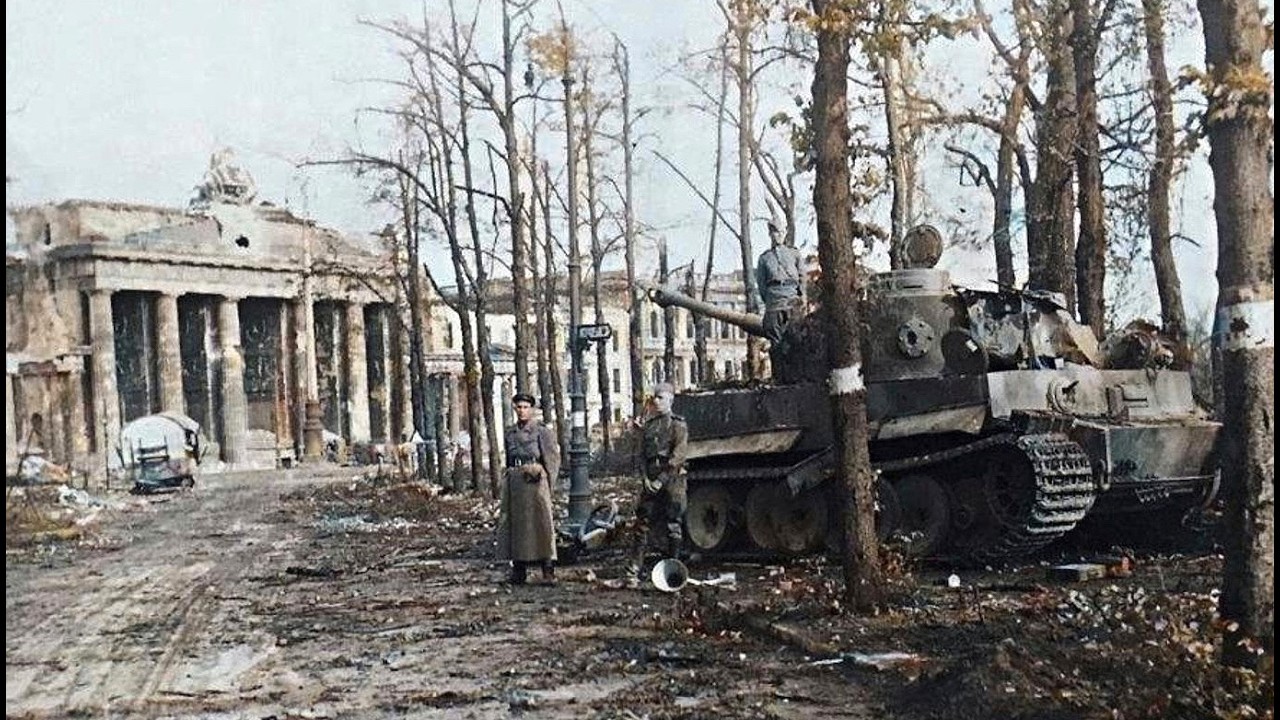
A battered Tiger I tank, known as Tiger 323, made its last stand near Berlin’s Brandenburg Gate during the fierce final days of the Battle of Berlin in April 1945. This iconic wreck epitomizes the desperate collapse of the Nazi regime as Soviet forces closed in on the city center.
The Battle of Berlin commenced in mid-April 1945, with Soviet troops launching a massive offensive after breaking through the Seelow Heights, the last major German defensive line east of the city. Exhausted German forces retreated toward Berlin’s multilayered defenses.
By April 24, the Müncheberg Panzer Division, comprising patched-together heavy armor including the famed Tiger tanks, was fiercely defending Berlin’s northeast sector. The division’s tanks, including Tiger 323, played a crucial role in stemming the Soviet advance.
On April 26, Müncheberg units mounted a desperate counterattack at Tempelhof Airport and Neukölln with 10 tanks, all failing to repel the Soviet spearheads. The battered division then withdrew to defend the city’s government quarter — against overwhelming odds.
Defense sector Z, or “Citadel,” was the central government district anchored by massive ministries, monuments, and flak towers. German troops from all branches, alongside Hitler Youth and Volkssturm militia, rallied here in a last ditch effort to protect Hitler’s bunker.
The Tiergarten park became a critical defensive position, housing an emergency airstrip and makeshift workshops beneath the looming Victory Column — repurposed as a control tower for Luftwaffe air traffic controllers directing Berlin’s final flights.
Tiger 323 was positioned near the Reichstag, guarding the Tiergarten’s southern approach in front of the landmark Brandenburg Gate. Likely low on fuel, it served as a stationary fortress against advancing Soviet armor, embodying the fierce German resistance despite hopeless circumstances.
The Reichstag itself was a focal point of brutal urban combat. Flooded trenches, anti-tank ditches, 88mm guns, and fortified firing positions all sought to barricade Soviet forces. The nearby Zoo Flak Tower provided additional fire support, intensifying the battle’s ferocity.
As the Soviets pressed forward, Tiger 323 sustained damage or ran out of ammunition, forcing its crew to destroy the tank themselves on May 1, 1945 — just a day before Berlin’s official surrender. Only one of its five crew members survived the relentless conflict.
Following hostilities, Soviet engineers relocated the tank from the roadway to clear paths for advancing troops, leaving Tiger 323 derelict amid linden trees near the Victory Column. Photographs captured soldiers posing triumphantly by this grim symbol of Nazi defeat.
Despite its iconic status as the last Tiger I in Berlin, Tiger 323 was eventually dismantled and scrapped by Soviet forces. The tank vanished before the American and British occupations, leaving only its final resting place marked by the surviving landscape.
This solitary tank’s demise was overshadowed by a Tiger II from the 503rd SS Heavy Panzer Battalion, which mounted a legendary last stand near Potsdamer Railway Station, allegedly destroying 39 Soviet vehicles before succumbing several hours after Tiger 323 fell.
Generalmajor Werner Mummert commanded Müncheberg’s forces from the massive Zoo Flak Tower, coordinating defenses in a desperate, crumbling city. His armored ammunition carrier met its own fiery end near the Victory Column, underscoring the scale of destruction engulfing Berlin.
The Tiger 323’s story encapsulates the bitter final chapter of the Thousand-Year Reich — a colossal military machine overwhelmed by relentless Soviet offensives and the collapse of Nazi Germany’s grip on its capital city. This wreck remains an enduring testament to that harrowing fight.
Today, visitors can stand where Tiger 323 was destroyed, surrounded by familiar trees and the enduring monuments of wartime Berlin. Nearby, Soviet T-34 tanks and a massive war memorial honor the tens of thousands who perished in this bloody closing act of World War II.
The Battle of Berlin was a pivotal moment, marking not only the fall of the Nazi regime but also the enormous human cost absorbed by both attackers and defenders. The silent Tiger 323 tank beneath the Brandenburg Gate powerfully symbolizes the tragic end of a brutal era.