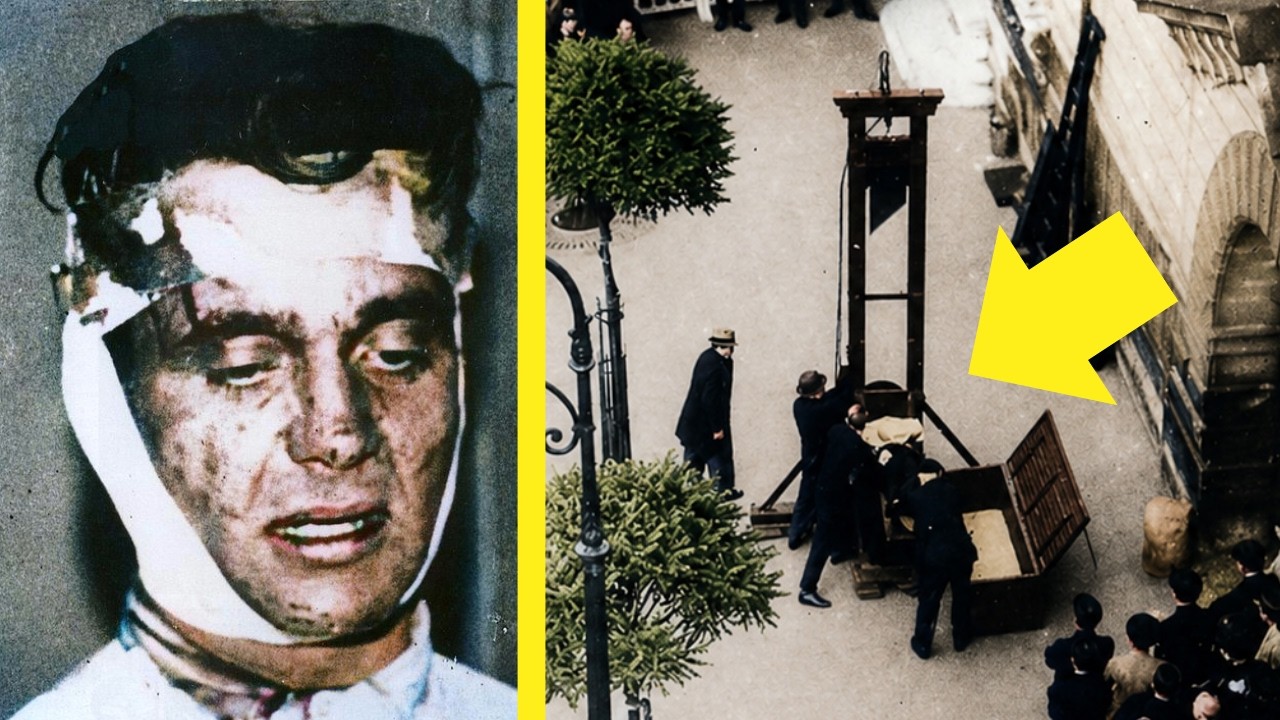
On the dawn of June 17, 1939, outside Saint Pierre prison in Versailles, a frenzied crowd gathered to witness the chilling execution of Eugen Weidmann, France’s last public guillotined prisoner. The spectacle sparked chaos, horror, and immediate government action that ended this grim public chapter forever.
As the first light broke over Versailles, thousands converged near the prison walls, their anticipation palpable. The atmosphere was thick with tension and a disturbing festivity, as if the brutal execution was a grotesque show rather than a solemn justice act. Whispers turned to excited chatter across the restless crowd.
Eugen Weidmann, a German-born criminal, had become infamous for his cold, calculated murders across France in the 1930s. His crimes—kidnappings and multiple cold-blooded killings, including an American woman—had shocked the nation. His trial captivated the public, casting a shadow over the justice served on that fateful morning.
The guillotine was erected on the public street, an archaic symbol of capital punishment still legal in France. Chief executioner Jules Henri Desfourneaux prepared for the grim task, aware this event was unlike any before. The crowd’s size overwhelmed officials, hinting this execution would ignite controversy.
As Weidmann was led to the blade, calm yet pale, the crowd surged. Some climbed lampposts, others jostled frantically. Cameras snapped as spectators treated the impending execution like a spectacle. Laughter mixed with shouting, severing the dignity of the moment and highlighting a chilling breakdown of public decorum.
The blade fell swiftly with brutal finality—Weidmann’s life ended within moments. But the crowd’s reaction exploded into chaos. Spectators surged forward, dipping handkerchiefs in spilled blood, eager for souvenirs. The macabre enthusiasm scandalized witnesses and shocked observers around the world, igniting fierce debate about public executions.
French newspapers responded with outrage. The spectacle’s grotesque nature overshadowed the justice of Weidmann’s death. Public executions, intended as solemn deterrents, had morphed into tasteless entertainment. The French government, led by President Albert Lebrun, acted swiftly. Public executions were abolished within days, forever moving death behind prison walls.
Following the execution, Weidmann’s body was discreetly taken to Cimetière de Gonards in Versailles. His burial was starkly unceremonious, placed in an unmarked grave amid countless others. This anonymity symbolized official rejection of any posthumous notoriety, seeking to erase his presence from public memory and morbid fascination.
This unmarked grave contrasts starkly with Weidmann’s notorious life and the frenzy surrounding his death. The suppression of his resting place reflected a broader penal principle: justice remained visible, but the condemned’s remains become invisible, denied the spectacle his death had unnervingly inspired.
The chaotic crowd behavior at Weidmann’s execution encapsulated changing societal attitudes toward capital punishment. By 1939, public fear and respect had given way to dangerous fascination and amusement, undermining the original intent of public executions as deterrents. This crucial shift catalyzed the eventual demise of the death penalty in France.
Though public guillotine executions ended that day, secret executions continued for decades until France formally abolished the death penalty in 1981. Eugen Weidmann’s execution stands as the watershed moment marking the death of public spectacle justice and the beginning of modern penal reform in France’s complex history.
Looking back, Weidmann’s story is far more than a criminal’s grim fate. It reflects a society forced to introspect, confronting the morality of its justice system and the human instinct toward voyeuristic cruelty. The violent end sparked necessary change, rewriting how punishment is enacted and witnessed.
Today, Cimetière de Gonards is a tranquil place where life’s natural cycle unfolds quietly. Amid its ordinary markers lies the unmarked resting place of Eugen Weidmann, a silent reminder of a darker era. His story’s erasure from physical memory may be the final chapter in the tale of justice, spectacle, and societal evolution in France.