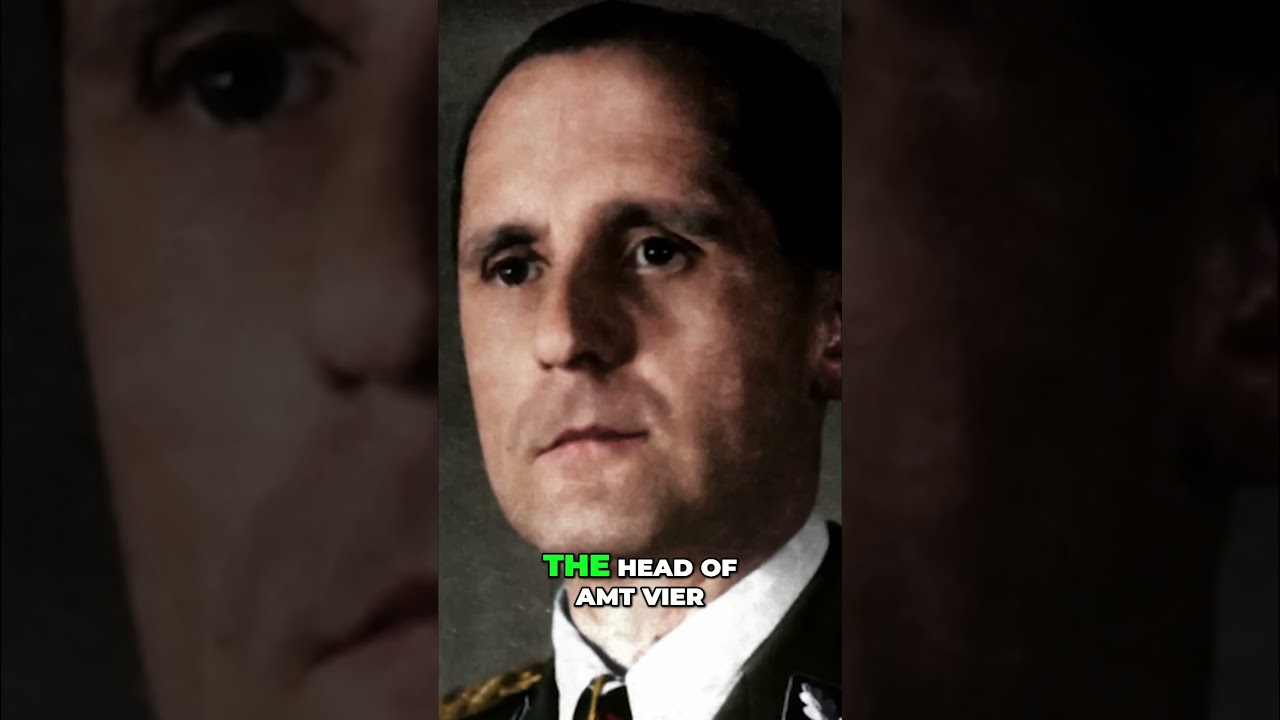
Heinrich Müller, head of the Gestapo and one of Nazi Germany’s most feared officials, vanished without a trace after World War II’s end in May 1945. Despite exhaustive international investigations, no remains or verified sightings have ever been confirmed, deepening one of history’s most mysterious disappearances.
Müller was a towering figure within the Nazi security apparatus, commanding the Gestapo and overseeing ruthless suppression operations. As the war progressed, his influence expanded, instilling terror across occupied territories and securing Nazi control through brutal intelligence methods.
In September 1939, Müller assumed leadership of Amt IV, the core division of the Reich Main Security Office responsible for Gestapo operations. His role consolidated his position at the epicenter of Nazi intelligence, giving him unparalleled access to the regime’s darkest secrets and clandestine dealings.
As Allied forces closed in on Berlin in May 1945, officials expected Müller to be captured alongside other top Nazi leaders. His immense knowledge of security operations and foreign intelligence made him a primary target for arrest and interrogation by Soviet and Western agents alike.
However, López was never detained or listed among captured war criminals. No evidence suggested his presence in Soviet prisons, and he was conspicuously absent from prisoner rosters and Allied war crime trials. This absence sparked immediate suspicion and global investigation into his fate.
Decades of searching by intelligence agencies failed to uncover any conclusive leads. American, Soviet, and British operatives alike scoured Europe, interrogated witnesses, and examined archives, all coming up empty-handed. Even the most extensive manhunts and post-war archives yielded no trace.
The U.S. CIA’s Müller files, declassified in 2001 under the Freedom of Information Act, reveal years of unresolved efforts. Investigations documented multiple theories but never confirmed any definitive outcome, highlighting the extent of his disappearance and the limits of post-war intelligence capabilities.
Historians and intelligence experts alike remain baffled by Müller’s vanishing act. Was it a covert escape, a secret death unrecorded by the chaos of Berlin’s fall, or an undiscovered hiding place? The truth continues to elude investigators, fueling intrigue and conspiracy theories.
Müller’s disappearance symbolizes the enduring mysteries of World War II’s chaotic aftermath. As one of Hitler’s closest security chiefs, his vanishing erased a vital piece of Nazi history, obstructing efforts to fully comprehend the regime’s inner workings and the post-war geopolitical fallout.
Today, the question lingers: how did one of the Third Reich’s most notorious figures simply evaporate from history? The silence surrounding Heinrich Müller’s fate remains one of the 20th century’s most perplexing enigmas, compelling new generations to revisit cold cases and historical walls.
With no physical evidence or reliable eyewitness accounts, Müller’s fate is a void in the narrative of Nazi downfall. Intelligence archives offer tantalizing fragments but fail to close the case, leaving analysts searching for clues amid postwar chaos and political intrigue.
The mystery surrounding Müller also underscores the limitations of even the most sophisticated post-war intelligence apparatus. Despite advanced surveillance, multiple operations, and decades of scrutiny by some of the world’s best agencies, the Gestapo chief simply dissolved into the historical fog.
Speculation has been rampant, but official investigations remain cautious, focusing only on verified data. Without credible proof, theories about Müller’s involvement in post-war espionage, foreign refuge, or covert assassination remain unconfirmed and outside the scope of historical fact.
This unresolved case casts a long shadow over the legacy of Nazi accountability. The absence of Müller from post-war justice proceedings left an uncomfortable gap, preventing closure for millions affected by his brutal regime and raising haunting questions about evasion and impunity.
Müller’s disappearance is more than a historical curiosity; it’s a stark reminder of the chaotic collapse of Nazi Germany and the murky aftermath that obscured justice. As archives continue to open and technology advances, hope lingers that the mystery may one day be solved.
Until then, Heinrich Müller remains a specter in history, a figure whose vanishing underscores the complexities of war, the limits of intelligence, and the enduring quest for truth in the darkest chapters of mankind’s past.