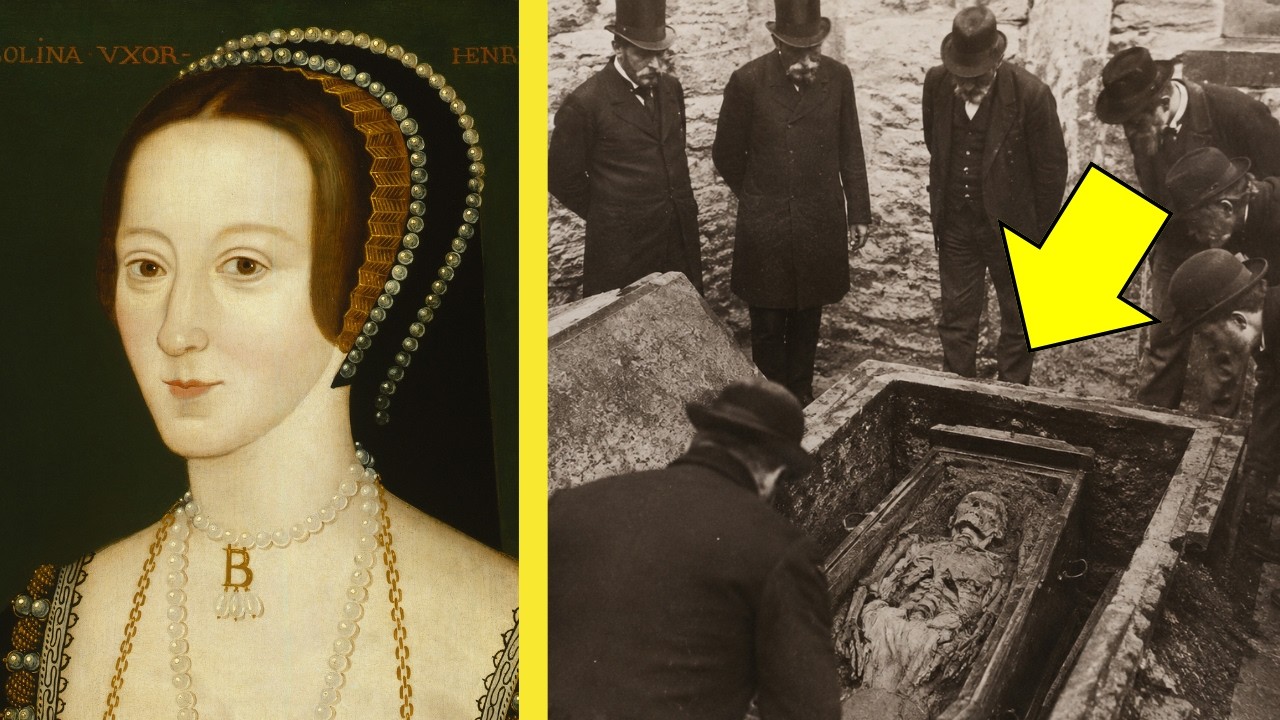
The long-lost remains of Anne Boleyn, England’s ill-fated queen, were confirmed beneath the Chapel of St. Peter ad Vincula during a 19th-century restoration, unveiling a grim truth about her burial. This discovery illuminates a dramatic Tudor tragedy, forever changing our understanding of one of history’s most infamous royal deaths.
Anne Boleyn, second wife to King Henry VIII, shaped English history by triggering the break with the Catholic Church and mothering Queen Elizabeth I. Yet her life ended in public disgrace and brutal execution in 1536. For centuries, the exact resting place of her body remained a haunting mystery inside the Tower of London.
Historical accounts detail how Anne’s remains—body and severed head—were hastily placed in an empty elm chest once used for storing arrows. Unlike royalty, she received no grand tomb or monument. Instead, she was buried in an unmarked, shallow grave beneath the chapel floor, stripped of honor and obscurity enveloping her final rest.
The Chapel of St. Peter ad Vincula, the site of her burial, deteriorated over centuries. By the Victorian era, confusion about several Tudor prisoners’ graves, including Anne’s, had grown amid altered chapel floors and moved monuments. Questions swirled about whether the queen’s remains could ever be identified.
Everything changed in the 1870s when Queen Victoria authorized a major restoration of the chapel. Floors were lifted, graves unearthed, and history was brought to light. Dr. Frederick John Mouat, physician and investigator, led the excavation, uncovering numerous burials that captivated historians and the public alike.
Among those graves, a female skeleton near the altar drew immediate attention. The location corresponded with traditional accounts of Anne’s burial, sparking hopes that the mysterious queen’s remains had finally been found. The skeleton was incomplete, but enough evidence survived to prompt a detailed scientific examination.
Mouat’s analysis revealed the skeleton belonged to a slender woman of graceful stature—qualities described in contemporary reports of Anne Boleyn. The separated skull, consistent with beheading, further strengthened the case. The delicate skull’s facial structure matched descriptions recorded during Anne’s lifetime, intensifying the identification’s credibility.
Age estimation indicated a middle-aged woman, consistent with Anne’s death around age 35. The bones bore no signs contrary to historical records. Despite injuries from building work and centuries underground, the remains aligned with what was known about Anne’s tragic end. Victorian science lent strong, though not absolute, support to the discovery.
No DNA testing was available at the time; any modern scientific analysis remains speculative. The identification rests on circumstantial evidence: burial location, physical traits, age, and historical documentation. Nevertheless, historians widely accept this as Anne Boleyn’s final resting place, ending decades of uncertainty and debate.
The grave itself revealed stark truths about Anne’s fall from grace. There was no royal coffin, no lavish memorial—only a hasty burial reflecting her dramatic political downfall. From queen crowned in splendor to condemned prisoner interred anonymously, the degraded burial site starkly encapsulates the fleeting nature of power and favor in Tudor England.
Public fascination with the find surged. Newspapers chronicled the investigation, reigniting interest in the woman who had captivated Henry VIII and altered England’s religious landscape forever. The physical evidence breathed new life into Anne’s story, moving her beyond legend to tangible reality hidden beneath stone floors.
Anne’s remains were respectfully reburied beneath the chapel floor, where today visitors can see a commemorative marker. The Chapel of St. Peter ad Vincula honors those executed at the Tower, including Anne and her cousin Catherine Howard. Yet the fragile bones remain undisturbed, a silent testament to centuries of history.
Current plans do not contemplate further excavation or DNA testing, respecting the sanctity of the burial site. While new technologies could potentially reveal more about Anne’s life and health, the challenges posed by degradation and lack of comparative material complicate any future scientific inquiry.
Dr. Mouat’s pioneering 19th-century work remains the definitive investigation into Anne Boleyn’s royal corpse. His discoveries transformed historical understanding and confirmed centuries-old accounts of her burial, blending archaeology with history to illuminate a figure often shrouded in mystery and myth.
Anne Boleyn’s remains remind us that beneath the political intrigue, betrayal, and spectacle, there was a real woman—ambitious, loved, feared, and ultimately executed. The discovery underscores the human cost behind the Tudor dynasty’s dramatic saga, bridging history with humanity across nearly five centuries.
Though centuries have passed since Anne walked to the scaffold, her story continues to resonate. The chapel floor holds her secret still, a royal corpse unearthed that symbolizes both the glory she attained and the tragic fall she endured, immortalizing her legacy within England’s historic Tower walls.
This remarkable finding continues to captivate historians, archaeologists, and the public alike. Anne Boleyn’s legacy endures not only through history books but through the tangible evidence found beneath the Chapel of St. Peter ad Vincula, where her troubled soul quietly rests, forever entwined with English history’s darkest hour.