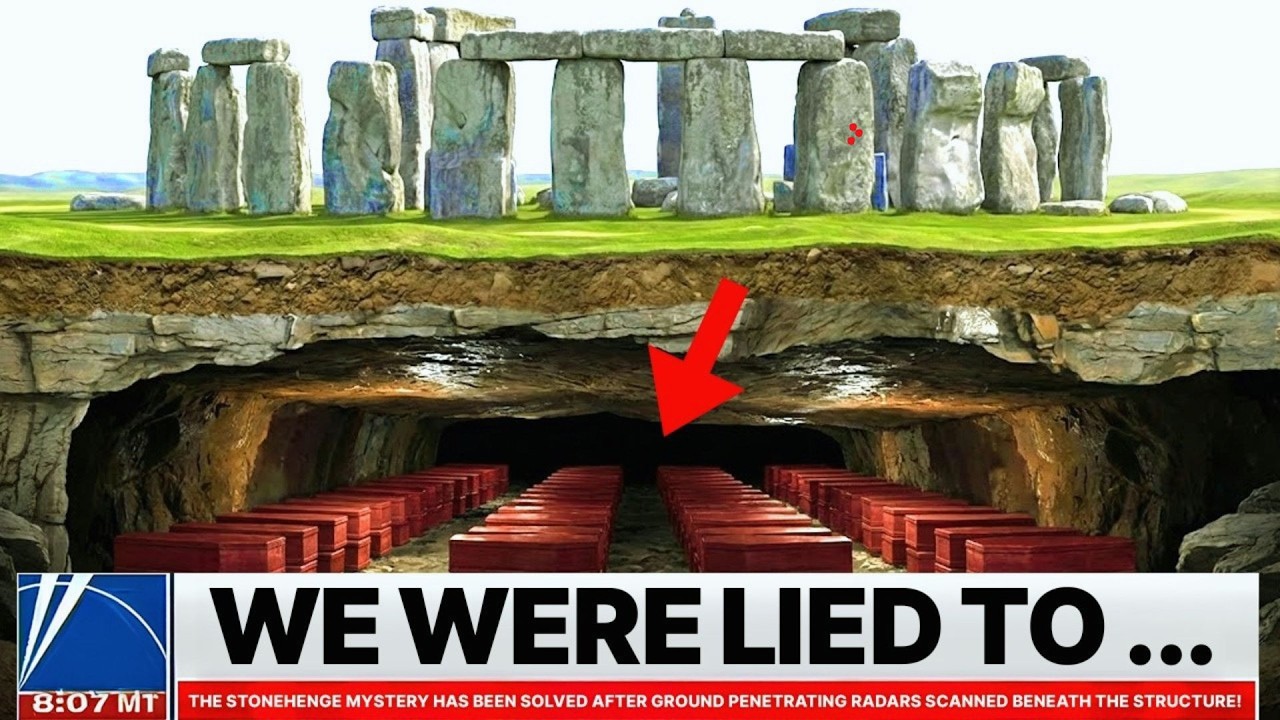
Beneath Britain’s iconic Stonehenge, a groundbreaking discovery has shattered centuries of assumptions. Advanced radar technology has unveiled a sprawling, hidden ritual landscape stretching for miles—17 previously unknown monuments, intricate processional routes, and an engineered system far beyond a simple stone circle. This revelation rewrites Stonehenge’s entire story.
For over 5,000 years, Stonehenge stood silent on England’s windswept plains, its mysteries debated but never fully uncovered. Archaeologists examined its surface obsessively, yet the ground beneath remained untouched—until now. The Stonehenge Hidden Landscapes Project deployed cutting-edge ground-penetrating radar and remote sensing to peer ten feet deep, capturing secrets long buried.
Led by Professor Vincent Gaffney and international collaborators, the project mapped several miles around Stonehenge—without excavation or damage—yielding the most detailed archaeological map ever produced. The result 𝓮𝔁𝓹𝓸𝓼𝓮𝓭 that the famous standing stones are just a fragment of a vast, carefully designed Neolithic complex, unrecognized for centuries.
The most astonishing find was not beneath Stonehenge’s iconic stones but in nearby Durrington Walls. What was once dismissed as natural anomalies revealed an immense shaft ring and multiple previously invisible ritual monuments—timber structures, geometric pits, and a ceremonial processional route channeling participants toward the stone circle.
This newly mapped landscape changes everything. The monuments aren’t isolated relics but components of a single orchestrated system spanning miles. Previously scattered sites now connect into an integrated ritual environment, demonstrating unparalleled planning and social organization in Neolithic Britain—far more sophisticated than previously imagined.
Simultaneously, acoustic engineering research has transformed our understanding of Stonehenge’s function. Professor Trevor Cox’s model of the site unveiled that the stones were arranged to optimize sound inside the circle, amplifying voices and music intimately for a few, while isolating them from outside listeners—signaling deliberate control over experience and access.
This acoustic evidence contradicts notions of Stonehenge as a communal gathering spot open to all. Instead, it was likely restricted for elite ceremonies, where the voices within carried power. The circle’s precise stone placement eliminated echoes yet prolonged reverberation, creating an immersive soundscape that ancient builders engineered without modern acoustic knowledge.
Geological breakthroughs have rewritten the monument’s construction story. The central altar stone, long assumed to derive from nearby Wales, originates from the Arcadian Basin in northeastern Scotland—over 700 kilometers away. Analysis disproved natural ice transport, revealing a monumental human effort to haul this six-ton sandstone across vast distances without metal tools or wheels.
Such extraordinary stone transportation demands revisiting the scale and sophistication of Neolithic society. Researchers theorize complex marine and overland routes implemented by an organized workforce—reflecting unprecedented logistical capability for the era. This new evidence dispels old images of simple, scattered tribes and points to centralized, authoritative leadership directing vast labor over generations.
Astronomical research complements these discoveries. Beyond the well-known summer solstice alignment, Stonehenge encodes precise lunar cycles—specifically the 18.6-year major lunar standstill. Scholars documented how station stones align with the moon’s extreme rises and sets, marking systematic, multi-generational celestial observation requiring meticulous record-keeping without written language.
This celestial precision, linked with the buried monuments and pathways, confirms Stonehenge as a monumental astronomical observatory covering the landscape. The coordinated solar and lunar alignments reinforce the monument’s role as a symbol and tool of power, integrating earth, sky, and human activity in a complex, engineered environment unlike any other prehistoric site.
The cumulative evidence compels a profound reassessment of prehistoric Britain’s society. The vast hidden landscape, acoustic control, impossible stone transport, and advanced astronomy indicate a civilization wielding authority, knowledge, and organizational strength far beyond that credited by traditional history and archaeology.
No longer a romanticized symbol of communal spirit, Stonehenge emerges as a monument sustained by hierarchical power. Thousands labored over centuries to construct a landscape where only a select few experienced the full ritual and cosmic design—echoing a society structured around control, exclusivity, and sophisticated ceremonial practice.
Professor Gaffney encapsulates this seismic shift: the world’s most studied archaeological site revealed itself to be mostly unknown beneath the surface. The standing stones represent only a visible fragment of a sprawling, engineered ritual landscape invisible to the naked eye until technology 𝒄𝒂𝓊𝓰𝒉𝓉 up with ancient secrets.
This new Stonehenge is not a primitive wonder built by simple hands but a breathtaking testament to Neolithic ingenuity and ambition that challenges assumptions about prehistoric humans’ capabilities, vision, and social complexity. The radar has only begun to peel back the layers of a civilization long underestimated.
With every discovery, Stonehenge’s silent stones speak louder and clearer. They reveal an elaborate cultural and technological masterpiece, a monument designed for power, precision, and mystery. The breaking revelations compel both awe and urgent reevaluation of human history’s earliest monumental achievements.


