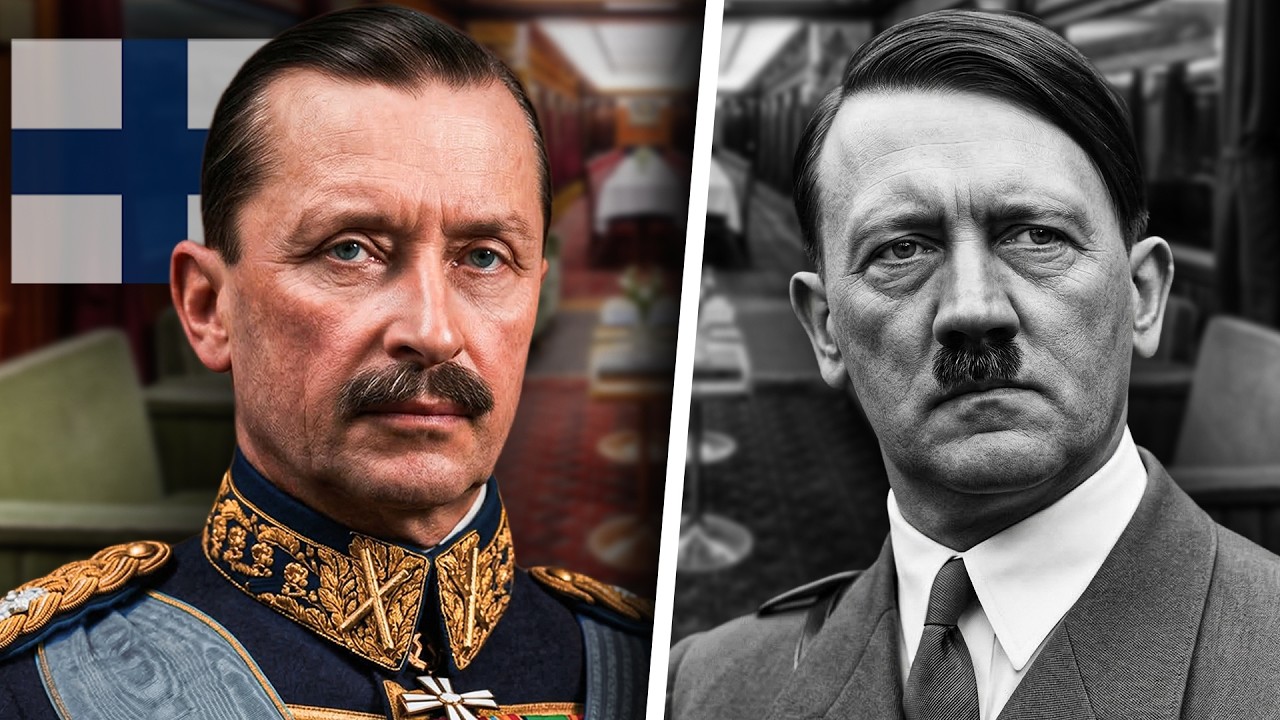
In a stunning revelation of World War II history, Finnish engineer Thor Damen secretly recorded Adolf Hitler’s private conversation with Finnish Field Marshal Carl Gustaf Emil Mannerheim aboard a railway car in 1942, capturing 11 minutes of unguarded, unprecedented audio that exposes Hitler’s candid views and Mannerheim’s strategic silence.
The covert recording reveals a rare glimpse into the private dialogue between two colossal figures of wartime Europe. Damen’s hidden microphone immortalized Hitler speaking freely about his miscalculations on Soviet military strength, exposing vulnerabilities never publicly admitted before. This single, secretive moment reshapes our understanding of the fraught Finland-Germany relations in the Second World War.
Carl Gustaf Emil Mannerheim, the stately 75-year-old Finnish leader, engaged with Hitler in a curt exchange marked more by what he withheld than what he said. Renowned for his military acumen and political deftness, Mannerheim’s silence was as powerful as Hitler’s words, underscoring Finland’s cautious stance amid global conflict.
The story behind this meeting begins decades earlier with Mannerheim’s complex background: expelled from Finnish military training as a youth, he mastered Russian and carved a prestigious career as a cavalry officer in the Imperial Russian Army. His multicultural roots positioned him uniquely at the crossroads of three empires.
Through the First World War and Finland’s brutal civil war, Mannerheim’s leadership forged a nation’s survival. His command during the Winter War against the Soviet Union highlighted his intimate knowledge of terrain and strategy, holding the notorious Soviet forces at bay despite overwhelming odds and brutally harsh conditions.
Finland’s tenuous position between Nazi Germany and the Soviet Union transitioned into carefully guarded diplomacy. Despite aligning against the USSR after Soviet bombings in 1941, Mannerheim resisted deep military cooperation with Hitler’s regime, steadfastly refusing to join Germany’s broader war aims or violate Finland’s pre-war borders.
By June 1942, tensions culminated in the extraordinary visit: Hitler’s air arrival at Immola airfield to personally congratulate Mannerheim invited an idyllic setting—yet beneath it lay intense scrutiny and political calculation. The clandestine nature of the recording transformed a routine encounter into a historic document.
Hitler’s unguarded admission to Mannerheim, expressing shock over Soviet armaments and workforce mobilization, starkly contradicted his public bravado. His regret over underestimating Soviet might added a chilling retrospective lens to Nazi Germany’s subsequent military calamities on the Eastern Front.
Mannerheim’s measured responses and deliberate silences spoke volumes. He neither embraced Hitler’s boasts nor yielded to pressure for Finland’s full alignment with Nazi objectives. Instead, these 11 minutes accentuate his role as a tactician balancing Finland’s survival above all else in a war engulfing Europe’s fate.
The aftermath solidified Mannerheim’s legendary status in Finland. On that same day, the Finnish government honored him with the singular title “Marshal of Finland,” cementing his place as the nation’s paramount military leader and symbol of independence amid overwhelming geopolitical forces.
While the recording lay sealed in Finnish archives for years, its 1957 public unveiling by the national broadcaster shocked the world with the private tone of Hitler rarely captured anywhere else. The audio serves as a haunting archive reflecting the human complexities behind wartime roles and decisions.
Following this pivotal moment, Mannerheim continued to navigate the treacherous waters of war, eventually presiding over Finland’s fragile peace and post-war sovereignty despite immense pressures from both Axis and Allied powers. His legacy is intertwined with Finland’s miraculous preservation of freedom during the most violent global conflict recorded.
This extraordinary recording by Thor Damen transcends mere historical curiosity; it is a vital testament to nuanced diplomacy, wartime psychology, and strategic restraint under fire. The clandestine moments captured resonate profoundly today, reminding us that even in war’s darkest hours, silence can wield monumental power.
The implications ripple beyond history buffs: they challenge assumptions about Hitler’s perceptions and Finland’s wartime agency, providing rare insight into a fraught alliance marked by resistance and realpolitik. For world history, these 11 minutes are a seismic audio thread weaving truth through years of propaganda and myth.
As new generations rediscover this artifact, the narrative of World War II deepens with complexity and urgency. Mannerheim’s guarded presence counterbalances Hitler’s 𝓮𝔁𝓹𝓸𝓼𝓮𝓭 vulnerabilities, an enigmatic confrontation frozen in sound, urging a reconsideration of alliance, leadership, and national identity under existential threat.
In delivering these unheard voices, Finland not only preserves its past but also illuminates the fragile nuances of international relations during war. The Mannerheim-Hitler recording remains a haunting, irreplaceable window into a volatile moment when history was being rewritten in whispers and silences.


