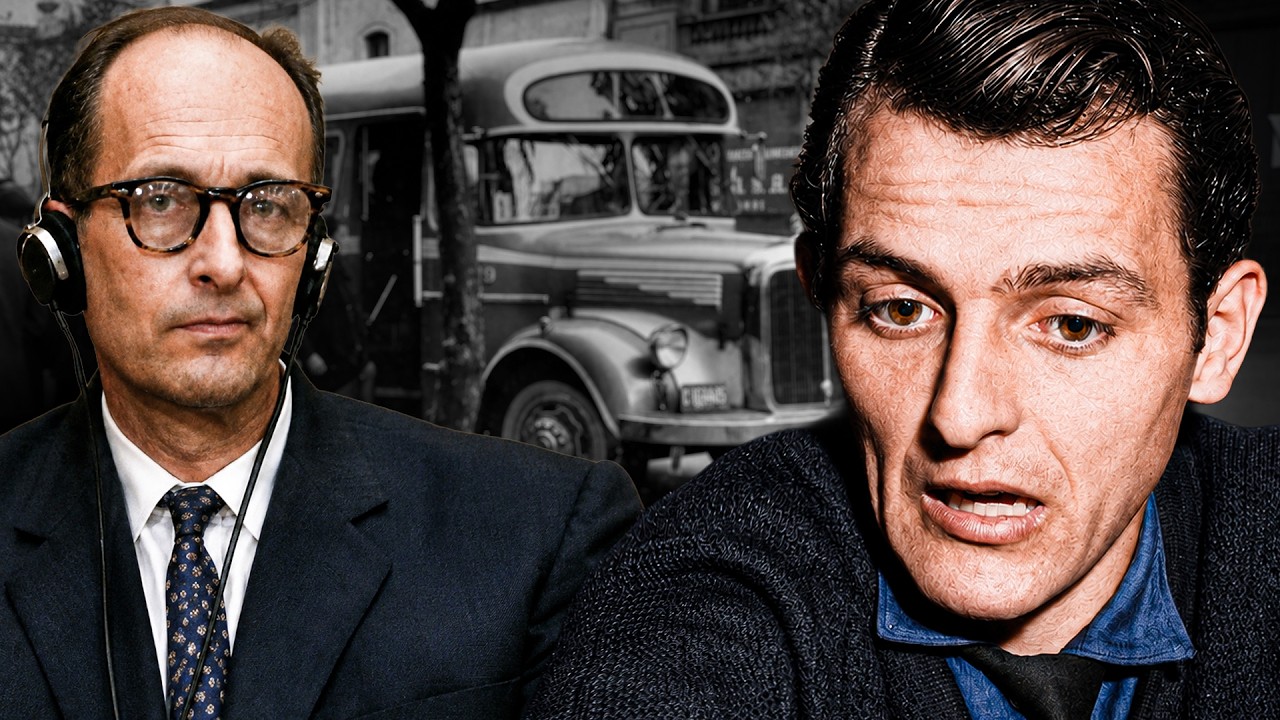
The dark legacy of Adolf Eichmann, Nazi architect of the Holocaust, erupted anew as the fates of his four sons came into sharp focus following his 1962 execution. Each son responded to their father’s infamy with divergent paths—defiance, violence, silence, and redemption—unfolding a harrowing tale that persisted more than half a century.
Adolf Eichmann’s capture in 1960 by Israeli agents in Buenos Aires reignited the world’s confrontation with Nazi atrocities. His four sons, born across Europe and Argentina, bore the weight of their father’s monstrous crimes, each carving out a life shadowed by the Eichmann name’s global notoriety.
Klaus Eichmann, the eldest, was unabashedly defiant. Born in Berlin in 1936, Klaus publicly defended his father even as the trial unfolded, 𝓈𝒽𝓸𝒸𝓀𝒾𝓃𝑔 global audiences with claims that the Holocaust accusations were propaganda. His brazen stance made headlines, leading to his deportation from the United States and deepening his ostracization.
In Argentina, Klaus and his brother Horst surfaced as lightning rods for extremist activities. Horst Adolf Eichmann, born in Vienna in 1940, fully embraced their father’s ideology. His denial of the Holocaust and participation in violent Nazi cells incited terror, including plans targeting Jewish institutions, culminating in police raids and jail time.
While Klaus bombarded media outlets to perpetuate his father’s innocence, Horst’s actions sparked a dangerous wave of anti-Semitic violence in Argentina. Groups like the Tacuara Nationalist Movement unleashed brutal attacks, including the torture of Jewish students, raising alarms domestically and internationally during the volatile 1960s.
Unlike his other brothers, Dieter Helmut Eichmann took a quieter route. Born in Prague in 1942, Dieter eschewed political notoriety, avoiding interviews and public scandals. Yet he privately held the belief in his father’s innocence, living between Argentina and Germany, building a career distant from the shadows of his heritage.
Ricardo Francisco Eichmann, born in Buenos Aires in 1955, chose a radically different road from his siblings. Only five years old when his father was abducted, Ricardo immersed himself in academia, studying archaeology and ancient history. He publicly rejected Nazi ideology and acknowledged his father’s guilt, seeking a life defined by truth rather than denial.
Ricardo’s 1995 meeting with Zvi Aharoni, the Mossad agent responsible for Eichmann’s capture, was a poignant moment of reconciliation. He described holding no resentment and affirmed that justice had been served, underscoring his break from the legacy of hatred and denial symbolized by his father’s actions.
Klaus and Horst, who spent decades defending and practicing their father’s twisted beliefs, died in 2015 within months of each other—Klaus in Germany and Horst in Argentina. Their deaths marked the end of the era of Eichmann sons who openly upheld Nazi ideology, though their pasts remain a chilling legacy.
The Eichmann family saga exposes how the burden of a heinous legacy can fracture lives. Klaus’s aggressive public defense stood opposite Ricardo’s scholarly repudiation, while Horst’s extremism contrasted sharply with Dieter’s silence, illustrating the complex aftermath of one of history’s darkest chapters.
Adolf Eichmann’s execution in 1962 did not erase the imprint of his crimes on his children. Instead, it scattered them across continents and convictions, demonstrating the long reach of history into the lives of those born under its darkest shadows, grappling with identity, culpability, and memory.
This unfolding story of the Eichmann sons continues to fascinate and haunt, revealing how the consequences of war crimes echo far beyond the initial act, shaping generations and challenging societies to confront uncomfortable truths about legacy, justice, and human nature.