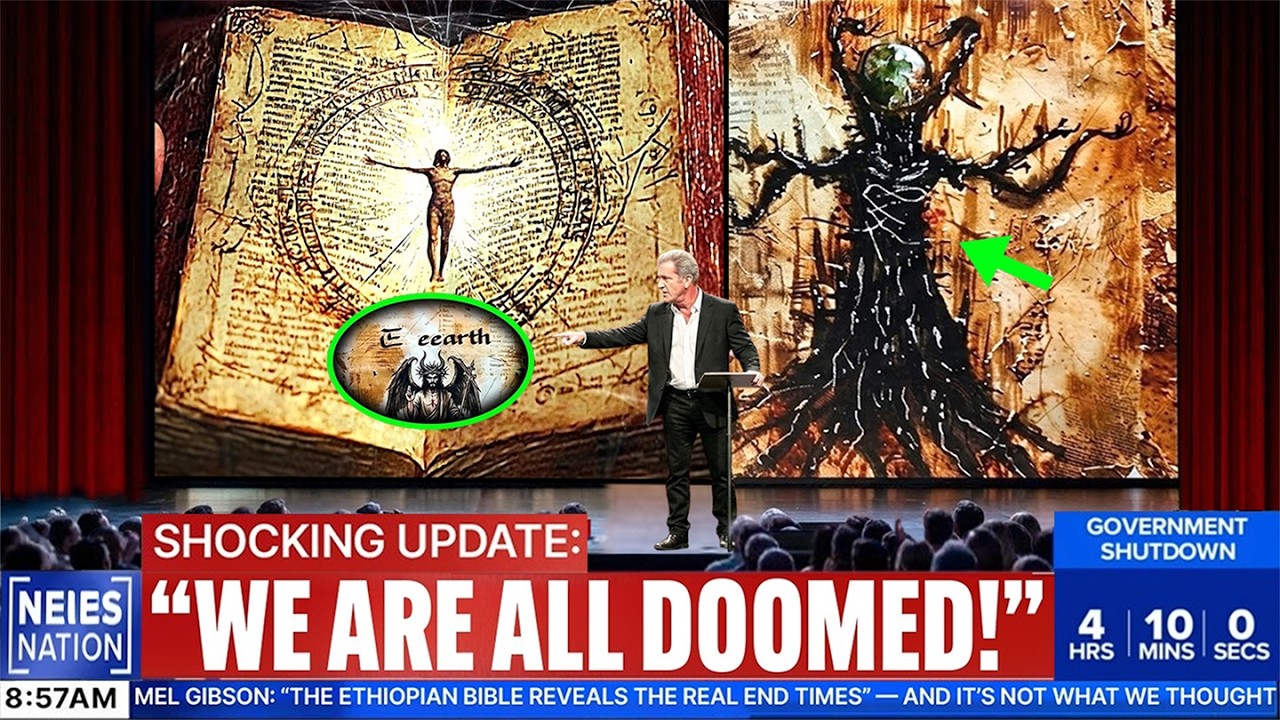
Mel Gibson is filming a groundbreaking new movie revealing an overlooked, intense portrayal of Jesus Christ drawn from the ancient Ethiopian Bible, challenging centuries of traditional Western narratives. This bold project merges lost sacred texts and hidden histories, promising a seismic shift in how the world understands Christ’s true story and cosmic role.
Mel Gibson, known for his provocative 2004 film The Passion of the Christ, is currently working on a sequel titled The Resurrection of the Christ. Filmed at Cinecittà Studios in Rome, this two-part epic aims for release on Good Friday 2027 and Ascension Day 2027. The film’s depiction of Jesus breaks radically from familiar Western versions.
Unlike conventional accounts, Gibson’s Jesus moves beyond earthly confines into multidimensional realms. The director revealed his film explores heaven, hell, the fall of angels, and encounters with powerful supernatural entities. This vision stems from ancient texts absent from mainstream Christianity for centuries, preserved only in rare Ethiopian manuscripts.
Central to Gibson’s inspiration is the Book of Enoch, a mysterious ancient text excluded from the Western biblical canon but cherished by Ethiopian Orthodox monks for generations. Enoch’s vivid descriptions of Christ portray him not merely as a gentle teacher but as a cosmic judge—a figure of overwhelming power and divine authority.
The parallels between the Book of Enoch and the New Testament’s Revelation are compelling. Both describe Christ with hair white as wool, eyes blazing like fire, and a voice resonating like thunder. These striking similarities suggest that mainstream Christianity may have selectively sidelined profound earlier visions of Jesus.
Ethiopian Christianity’s isolation preserved these extraordinary manuscripts across centuries. High in mountain monasteries carved into cliffs, monks painstakingly copied texts in Ge’ez, an ancient sacred language, protecting a wider and more complex biblical tradition that Western institutions excluded during ecclesiastical councils in antiquity.
This alternative canon contains up to 88 books—many absent from Protestant or Catholic Bibles—including the Ascension of Isaiah and Jubilee texts. These writings present spiritual dimensions and descriptions of Christ’s cosmic role that vastly differ from the more restrained, comforting images popularized in Europe since the Renaissance.
The Ethiopian Bible depicts Jesus as both savior and ruler, a radiant presence whose voice commands creation itself. His miracles restore cosmic order, emphasizing his authority over time, space, and the fabric of existence. This portrayal contrasts sharply with familiar Western icons of a mild, approachable Jesus and introduces a more formidable divine character.
Gibson’s new film draws upon this profound Ethiopian heritage, blending scripture, ancient prophecy, and mystical journeys into a cinematic experience likely unlike any cinematic resurrection story ever told. It confronts viewers with a Christ who transcends time and space, challenging long-held assumptions about biblical history and theology.
Scholars highlight how early Christian figures quoted the Book of Enoch as authoritative scripture before it was excluded from official canon in 363 AD. Early followers considered these texts integral to their faith, underscoring how exclusion shaped modern Christian understandings and obscured expansive theological concepts embedded in these ancient writings.
The Ascension of Isaiah, another key source for Gibson’s film, describes Christ’s descent through multiple heavens, gradually veiling his divine glory. This cosmology portrays Jesus’ earthly incarnation as a deliberate act of concealed majesty—only fully revealed after his resurrection—a narrative largely absent from most Western traditions.
The rediscovery of Ethiopian manuscripts like the Garima Gospels, dated as early as 330-660 AD, further confirms the advanced spiritual and artistic culture that thrived far from Mediterranean centers of power. These artifacts emphasize Ethiopia’s unique role in preserving diverse Christian beliefs unaffected by later doctrinal uniformity imposed elsewhere.
Gibson’s portrayal may usher in a revival of long-forgotten spiritual perspectives emphasizing personal illumination. Ethiopian texts describe humanity as “children of light,” highlighting an inner divine presence. This challenges Western narratives centered on original sin and institutional mediation, proposing instead a faith rooted in awakening innate holiness.
The film’s ambitious script reportedly includes a surreal, dreamlike version alongside a traditional narrative, signaling a bold departure from linear storytelling. By transcending conventional cinematic and theological boundaries, Gibson aims to dramatize multidimensional realities that ancient Ethiopian Christianity preserved but Western traditions largely suppressed.
Ethiopia’s Christian heritage, dating to the 4th century, predates much of European Christianity and remained a bastion during Islamic expansions across North Africa. Its geographical and cultural isolation protected sacred texts from ecclesiastical suppression, allowing monks to hand-copy brittle manuscripts for centuries despite harsh conditions and limited resources.
This secluded preservation reveals the layered complexity of early Christian thought. The Ethiopian tradition embraced a Christ who is majestic, cosmic, and awe-inspiring rather than only gentle and accessible. It confronts believers with divine mystery before comfort, a perspective offering fresh depth to spiritual dialogues worldwide.
The implications reach far beyond religious art or movie lore. Excluded texts hint that early Christianity contained radical ideas about authority, salvation, and the human-divine relationship. Recognizing these complexities urges a reexamination of dogma, history, and the boundaries of orthodox belief—topics Gibson’s film brings urgently into the spotlight.
Monks laboring in harsh, remote monasteries never sought fame or recognition. Their devotion preserved these manuscripts as sacred truths, safeguarded from centuries of political and theological shifts. Now, their hidden legacy is intersecting with global culture through Gibson’s project, raising profound questions about what else may have been lost or concealed.
The film’s arrival in 2027 promises a seismic cultural moment, potentially reshaping public perception of Jesus, biblical history, and Christian spirituality. It challenges audiences to envision Christ not as a fixed icon but a figure enveloped in mystery and cosmic significance, opening a new chapter in religious storytelling and scholarship.
Historians and theologians observe that Ethiopian scriptures and their preservation hint at vast, unexplored depths in Christianity’s earliest centuries. These traditions may transform scholarship and faith alike, inspiring inclusive dialogues on Christianity’s diverse roots and the possible continuities between ancient texts and lived spirituality today.
In an era hungry for authenticity and new perspectives, Gibson’s work may rekindle ancient wisdom—sparking urgent conversations about divine authority, spiritual experience, and sacred history obscured by centuries of institutional gatekeeping. The fusion of film and forgotten scripture could redefine how millions understand faith’s origins and future.
The narrative Gibson is shaping emphasizes resurrection as a cosmic event, surpassing physical rebirth. It envisions Jesus reclaiming his full divine stature across realms, a story that invites viewers to contemplate the interconnectedness of heaven, earth, and hell in ways seldom portrayed on screen or in scripture.
As this ancient knowledge emerges, it fuels critical reflection on canonical decisions and the political forces shaping religious texts. It invites inquiry into marginalized traditions and how theological boundaries have been drawn—offering a richer, more nuanced tableau of early Christian belief than the simplified accounts commonly known.
The convergence of Ethiopian manuscript preservation, Mel Gibson’s cinematic vision, and modern scholarly rediscovery forms a rare cultural crossroads. It highlights the enduring power of hidden histories to challenge dominant narratives, reminding the world that many sacred stories remain untold or waiting in shadows for their moment of revelation.
Gibson’s commitment to authenticity includes filming in original biblical languages—Aramaic, Latin, and Hebrew—rejecting Hollywood conventions for mass appeal. This dedication underscores the project’s seriousness and potential impact, signaling a painting of Jesus that echoes the ancient, complex, and awe-inspiring portraits found deep within Ethiopian Christian tradition.
Viewers anticipating The Resurrection of the Christ may encounter a Christ both terrifying and tender, majestic and accessible, bridging earthly experience and cosmic authority. This portrayal could redefine Christian iconography and spirituality, awakening worshippers and skeptics alike to a vast spiritual universe rarely glimpsed in mainstream media.
Ethiopian Christian art today continues to depict Christ with dark skin and radiant halos, emphasizing his all-encompassing lordship as Egziabher—Lord of the Universe. This vision contrasts with Western depictions, offering a powerful reminder that Christianity’s visual and theological traditions are culturally diverse and historically rich.
The film’s narrative aligns with Ethiopian cosmology and apocalyptic teachings, portraying Jesus as a breaker of cosmic boundaries—descending through heavens, confronting fallen angels, and descending into hell. This journey echoes scriptural and mystical trajectories preserved only in rare texts now intersecting powerfully with contemporary storytelling.
By drawing on these texts, Gibson’s film may restore visibility to spiritual perspectives lost for centuries—reminding the modern world that Christianity’s earliest centuries were theological landscapes of surprising diversity and profound mystery, not monolithic certainty. This revelation carries urgent implications for believers and historians alike.
The resurgence of Ethiopian manuscripts showcases the resilience of marginalized Christian traditions and emphasizes the importance of preserving all voices within religious history. It prompts new scholarship and public awareness about how cultural isolation paradoxically safeguarded a fuller scriptural landscape, now resurfacing with global significance.
As attention turns to this unfolding story, questions emerge: What other ancient texts lie hidden, waiting to reshape our understanding of faith? How might expanding the biblical canon affect theological doctrines, religious practices, and cultural identities around the world? This remains an open, urgent conversation sparked by Gibson’s bold cinematic endeavor.
Mel Gibson’s upcoming film arrives amidst a growing recognition that history is complex and layered, that sacred stories are multifaceted, and that faith may encompass far deeper mysteries than previously acknowledged. It asks viewers to reconsider boundaries, embrace wonder, and confront a vision of Jesus both ancient and revolutionary.
In sum, Mel Gibson’s dive into the Ethiopian Bible reveals a radical reinterpretation of Jesus—one that blends history, prophecy, and cosmic 𝒹𝓇𝒶𝓂𝒶. It challenges established ideas and illuminates a hidden heritage preserved through devoted monastic stewardship. This breaking news signals a paradigm shift in religious narrative for the 21st century.