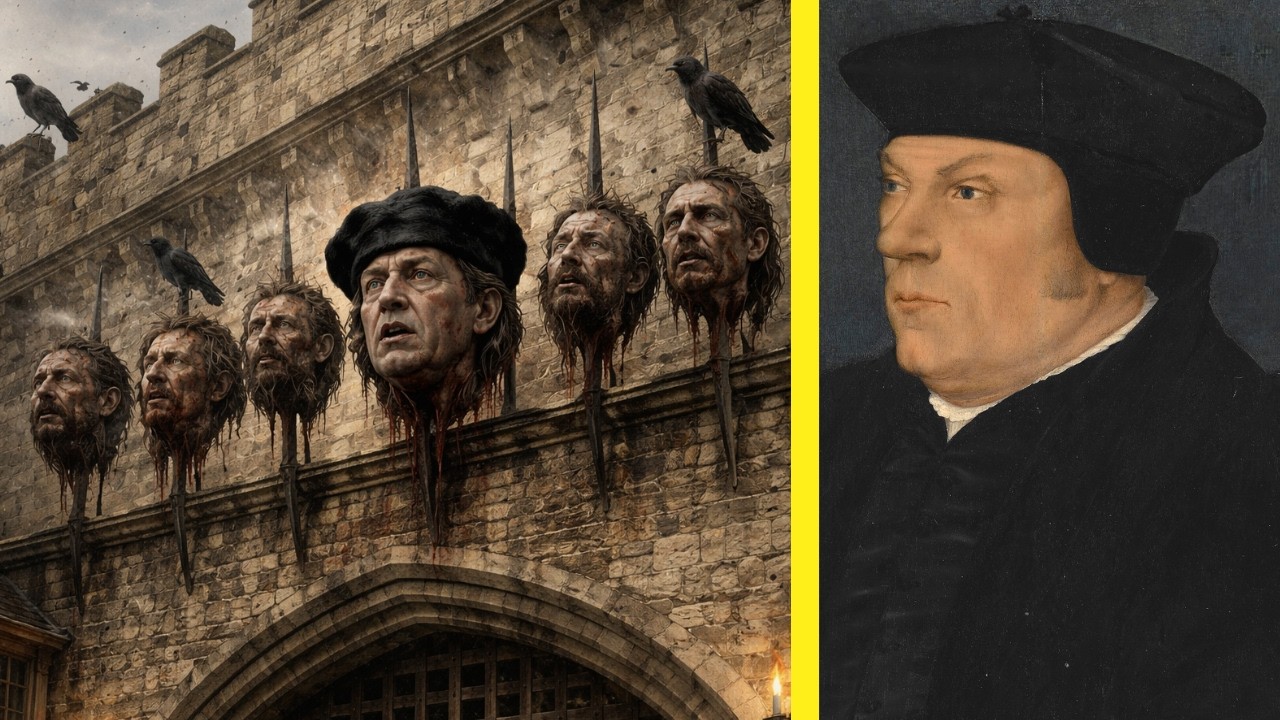
Thomas Cromwell, Henry VIII’s once-trusted chief minister and architect of the English Reformation, met a brutal end on July 28, 1540, executed for treason and heresy. His severed head was publicly displayed on London Bridge, while his unmarked body was quietly interred in the Tower of London’s Chapel of St. Peter ad Vincula.
Cromwell’s meteoric rise from humble origins to the king’s right hand made him one of Tudor England’s most powerful figures. Yet swift political shifts marked his downfall, ignited by the disastrous annulment of Henry VIII’s marriage to Anne of Cleves—an alliance Cromwell had orchestrated to secure Protestant support in Europe.
The king’s immediate disdain for Anne provided his political adversaries—noble conservatives and religious traditionalists—the perfect opportunity to oust Cromwell. Arrested during a council meeting in June 1540, Cromwell was stripped of titles and imprisoned in the Tower of London, bypassing a formal trial with Parliament’s bill of attainder condemning him.
On the grim morning of July 28, Cromwell was led from the Tower to the public execution ground at Tower Hill. Unlike other nobles sometimes executed privately, his beheading was a deliberate public spectacle, a harsh warning of the deadly consequences of falling from royal favor.
Before his execution, Cromwell addressed the gathering crowd, asserting loyalty to Henry and expressing repentance. His final words echoed the Tudor ideal of contrition, though the execution itself was traumatically botched, requiring multiple blows—an agony reflecting the brutal realities of Tudor justice.
Following his execution, Cromwell’s head was severed and readied for display, a stark emblem of Tudor punishment. His head was mounted on a spike atop London Bridge, a notorious site where the crowns of traitors were paraded to warn all entering the city of the cost of treason.
The exact duration of Cromwell’s head’s grim display remains unknown, lost in sparse records. Typically, such remains were left until decay or replacement, then discarded. This practice emphasized the Tudors’ ruthless focus on punishment over any form of remembrance or respect.
In stark contrast, Cromwell’s body was buried quietly within the Chapel Royal of St. Peter ad Vincula, inside the Tower. The chapel, final resting place for many executed figures, offered no monument or honor—only a simple, unmarked grave to erase Cromwell’s legacy from public memory.
The unceremonious burial aimed to prevent martyrdom. Authorities explicitly avoided marked graves to deny sympathizers a focal point. Cromwell’s body likely rested beneath the chapel floor in a shallow grave or basic coffin, a fate common for those condemned as traitors, reflecting Tudor ruthlessness.
Over centuries, the exact location of Cromwell’s grave has been lost. Restoration works in the 19th century disturbed Tudor burials, reinterring remains without individual identification. Thus, the final resting place of one of Henry VIII’s most pivotal ministers remains an enduring mystery.
Cromwell’s fate highlights Tudor strategies of state power: public spectacle to invoke fear, combined with obscured burial to silence memory. Displaying body parts was a political theater meant to uphold royal authority and suppress dissent, a grim reminder of the precariousness of court fortunes.
Despite his disgrace at death, historical perspectives on Cromwell have shifted. Formerly deemed a ruthless opportunist, today he is often seen as a masterful administrator and crucial reformer. His abrupt execution underscores the volatility of Tudor politics, where favor and downfall were perilously intertwined.
Intriguingly, Cromwell was executed on the same day Henry VIII married Catherine Howard. This stark juxtaposition—celebration and execution within the royal sphere—highlighted the king’s absolute power and the lethal fate awaiting those who fell from grace, no matter their past service or status.
Today, visitors at the Tower of London can see memorials in the Chapel of St. Peter ad Vincula honoring Cromwell among others. Though unmarked, the chapel symbolizes the complex legacy of these figures: powerful, fallen, yet central to England’s turbulent history and the Tudor saga.
Thomas Cromwell’s story is a chilling testament to Tudor justice and political brutality. His head on a spike and anonymous burial remind us how power, memory, and punishment intertwined in Henry VIII’s reign—where loyalty could end in execution and influence could vanish into obscurity overnight.