
Red Bull Racing has just sent shockwaves through the Formula 1 community with a stunning revelation that could dramatically impact Mercedes’ engine strategy. This upheaval stems from a surprising decision by the FIA, declaring Red Bull’s upcoming power unit as the current benchmark for the sport, a claim that has left many questioning the implications.
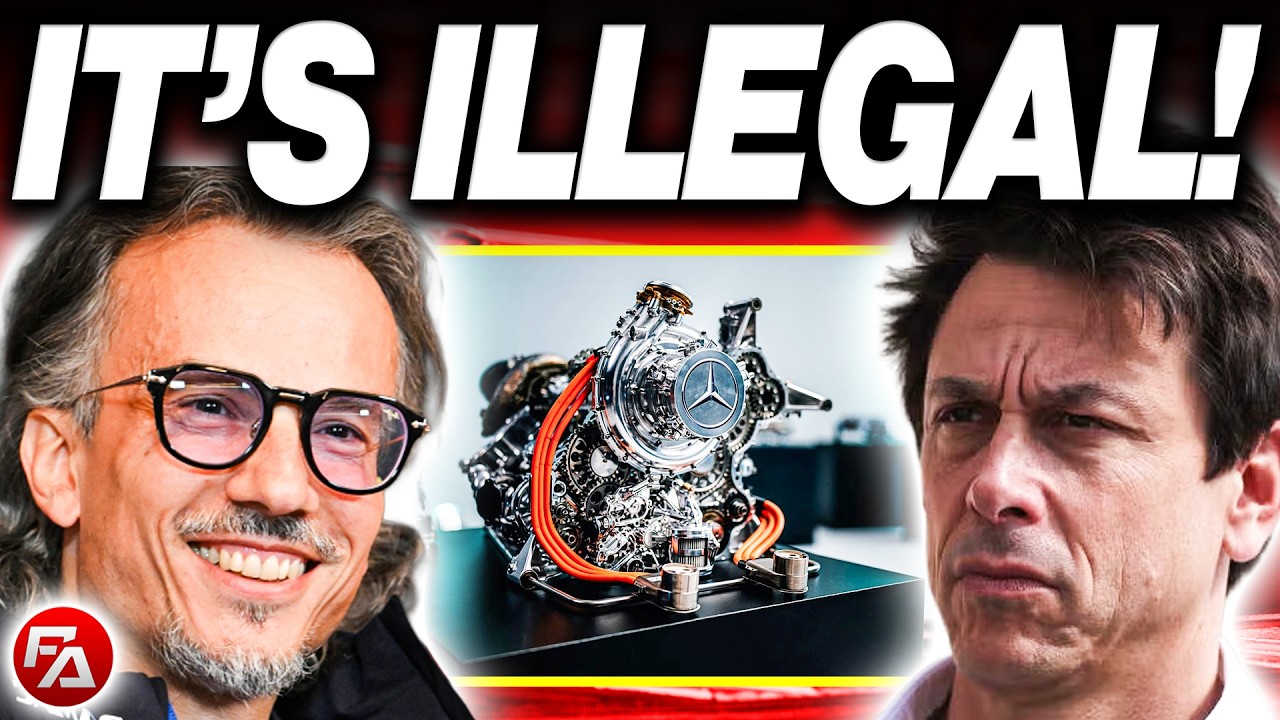
As Red Bull gears up to unveil its first-ever engine under the new 2026 regulations, the team is grappling with the reality of being deemed the standard-bearer. This ruling comes at a critical time when rival manufacturers, including Mercedes, are being granted opportunities to enhance their engines through the FIA’s additional development and upgrade system. In stark contrast, Red Bull finds itself without this crucial safety net, raising eyebrows even beyond the team’s camp.
The unexpected announcement caught the attention of notable figures in the sport. Lewis Hamilton, a seasoned driver for Ferrari, expressed his surprise at the FIA’s verdict, while 1996 world champion Damon Hill suggested that there might be strategic maneuvering at play among the manufacturers. Red Bull is not taking this ruling lightly; they are actively seeking clarity from the FIA. Team principal Laurent Mekies confirmed ongoing discussions, emphasizing the need for a thorough examination of the data that led to the benchmark designation.

“We are still exchanging data with the FIA,” Mekies stated, hinting at the complexity of the situation. “It’s progressing in a way that allows us to compare methodologies and potential discrepancies. We plan to have a catch-up next week outside of the race weekend to review the data together.” His comments, while measured, signal that Red Bull is determined to challenge the FIA’s assessment.
Being labeled as the benchmark is a double-edged sword. While it might seem like a compliment, it could pose significant disadvantages if the FIA’s data is flawed. The new Additional Development Upgrade Opportunity (ADUO) system was designed to prevent any one manufacturer from monopolizing the sport as the 2026 regulations take effect. Manufacturers identified as lagging behind receive extra development chances, while those deemed as leaders, like Red Bull, do not. Thus, the stakes are incredibly high for the team, which is stepping into uncharted territory as a new engine builder.

Meanwhile, Mercedes is contending with its own set of challenges. While Red Bull is embroiled in discussions about future engine development, Mercedes is focused on resolving reliability issues that threaten its championship aspirations. Team principal Toto Wolff acknowledged the painful setbacks this season but reiterated the team’s commitment to performance over safety. “We are a performance-oriented organization,” he affirmed. “I’d rather dial back a bit on something that is really good and fix some reliability issues than fall behind in performance.”

This aggressive stance has already cost Mercedes valuable points, as seen in recent races where drivers faced mechanical failures. Kimi Antonelli’s hopes for a top finish were dashed at Silverstone due to a wheel shield failure, and George Russell experienced a similar fate in Canada with a battery issue. Wolff noted that even during the last race, Russell faced mysterious issues that were difficult to diagnose, highlighting the ongoing struggle for reliability.
As both teams navigate their respective battles, the overarching narrative is one of tension and uncertainty. Red Bull is questioning the FIA’s engine verdict, while Mercedes is on a relentless quest for speed. The upcoming discussions between Red Bull and the FIA could have far-reaching consequences, potentially reshaping the landscape of the sport before the new regulations even take effect.
With the clock ticking down to the 2026 season, the 𝒹𝓇𝒶𝓂𝒶 surrounding Red Bull’s engine program is intensifying. As the team pushes for a reevaluation of the FIA’s ruling, they are acutely aware that every detail counts in this high-stakes game. The question remains: can Red Bull prove that their designation as the benchmark is justified, or will they find themselves at a disadvantage as they head into a new era of Formula 1?