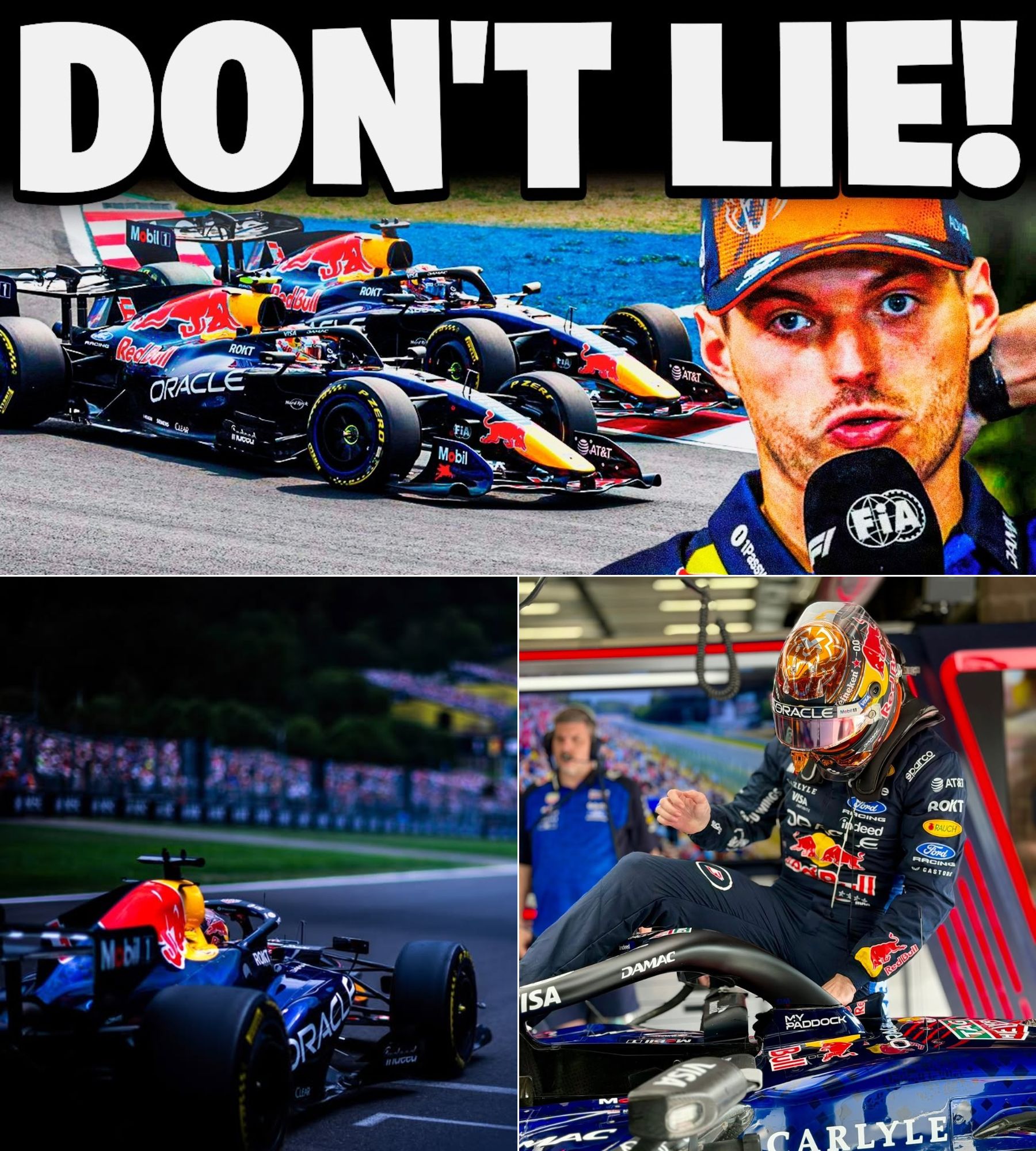
Telemetry data from Max Verstappen’s failed slipstream attempt at the Belgian Grand Prix has exposed a collision of three distinct problems, not a single driver error.
The reigning world champion’s lap at Spa-Francorchamps unraveled in a sequence of interconnected failures that Red Bull’s timing traces now confirm.

Verstappen had led first practice with a lap of 1 minute 47. 070 seconds. He later fell to third, 0.
472 seconds behind the fastest car.
That gap alone does not explain what happened. The real clue lies in where Red Bull appeared to stop gaining speed.
At Spa, a tow reduces air resistance and pulls the following car faster along the straight. But if the gap is too large, the benefit disappears.
If the gap is too small, disturbed air can damage grip through the corners. And if the electrical boost fades before the end of the straight, even a perfectly positioned car can suddenly stop closing.
That means Verstappen’s failed tow may not have been one mistake. It may have been three problems colliding at once.
The wrong distance, the wrong energy window, and a Red Bull setup forced to trade straight-line speed for stability.
Once those pieces are connected, the lap begins to tell a very different story.
To understand why the tow failed, you first have to understand what a tow is supposed to do.
The idea sounds simple. One car punches a hole through the air. The car behind follows through that disturbed air, meets less resistance, and gains speed along the straight.
At Spa, that can be extremely valuable. The circuit rewards straight-line efficiency.
A driver who enters the right slipstream can arrive at the braking zone with extra momentum without asking the car to create all of that speed by itself.
But here is the problem: a tow only works inside a very narrow window.
Too far away and the leading car has already disturbed the air too early. The following driver receives almost no useful benefit.
Too close and the following car enters heavily disturbed air before the corners. The straight-line gain may be real, but the grip loss can immediately give that time back.
That is why distance matters more than people think.
The following car cannot simply sit behind another driver and expect free speed. It has to arrive at the right point, at the right gap, with the tires prepared, the battery ready, and enough space to attack the next corner.
That is not one decision. It is a sequence. And if one part goes wrong, the entire tow can become useless.
Verstappen’s situation was especially difficult because Red Bull were already dealing with a complicated compromise.
The team had returned to a conventional rear wing after abandoning an experimental design following high-speed failures earlier in the season.
That gave the car stability, but stability often comes with more drag.
Drag is the resistance created when the car pushes through the air. Think of trying to run while holding a large board against the wind.
The board makes your body harder to move. A Formula 1 wing can create a similar effect.
It helps the car grip through the corners, but it can also slow the car on the straights. At Spa, that trait is brutal.
The driver needs confidence through the fast corners, but the car also spends a huge amount of time at full throttle.
So Red Bull could not simply remove all the downforce and hope Verstappen would manage the rest. They needed a balanced car, a stable car, a car that would not become unpredictable when he attacked.
The tow was supposed to recover some of the speed lost through that compromise. And this is where the plan started to become fragile.
Red Bull were asking the slipstream to solve a problem created by the setup. That meant the tow had to be strong enough to matter.
A weak tow would not be enough. A badly timed tow could actually make the lap worse.
 And a tow that arrived at the wrong part of the straight might give Verstappen speed when he no longer needed it.
That sounds strange, but the position of the gain matters. Extra speed early in the straight is useful.
Extra speed near the braking zone can be valuable too. But if the car gains too quickly, then runs out of electrical assistance before the end, the rival may still have the stronger final part of the acceleration.
This is where Red Bull’s energy concern becomes important.
Verstappen had already warned that Spa’s energy demand would be painful. That warning was not about the car suddenly losing all power.
It was about how long the electrical assistance could remain effective. A Formula 1 car uses stored electrical energy to support acceleration.
The driver presses the throttle, the engine works, and the electrical system adds extra force, but the battery cannot provide maximum assistance forever.
The team has to choose where to release that energy. Spend too much early and less remains later.
Save too much and the car may lose time before reaching the most important straight. That makes the tow much harder to evaluate.
Imagine Verstappen entering the slipstream and beginning to close. For a moment, the plan appears to work.
The gap reduces. The speed rises. Then the electrical support begins to fade.
Suddenly, the Red Bull stops closing as quickly. From the outside, it may look like the tow disappeared.
In reality, the tow may still be helping. It is simply no longer strong enough to overcome the loss of acceleration from the car itself.
And that distinction changes the entire story.
If the gap was the only problem, Red Bull could adjust the distance. If the setup was the only problem, the engineers could search for a different wing level.
If the energy deployment was the only problem, the team could move the electrical boost to another part of the lap. But when all three interact, every solution creates another weakness.
Move Verstappen closer to the car ahead and the tow grows stronger, but the disturbed air becomes worse in the corners.
Use more electrical energy on the straight and the car accelerates harder, but less energy remains later in the lap.
Reduce the rear wing and the Red Bull becomes faster in a straight line, but Verstappen loses stability where confidence matters most.
That is the trap. There is no free speed. Every gain must be paid for somewhere else.
Antonelli’s Friday benchmark had already shown how little margin Red Bull could afford to lose.
Verstappen had been fastest in the opening session with a lap of 1 minute 47.070 seconds. Later, he was third.
He finished 0.472 seconds behind the fastest time. That gap is not enormous, but in qualifying terms, it can cover several positions.
And when the deficit appears after the car looked competitive earlier, the team has to ask what changed.
Was the track evolving faster than Red Bull expected? Did Mercedes find a stronger setup?
Was Verstappen losing time in the corners? Was the electrical deployment becoming weaker near the end of the straights?
Or was Red Bull chasing a tow because ordinary straight-line performance was not enough?
Each question points toward a different answer, but together they reveal the real pressure inside the garage.
 Red Bull were not searching for one simple improvement. They were trying to make several imperfect pieces work at the same time.
That is why qualifying strategy can become desperate so quickly. The team sees a gap.
The engineers identify where some of the time might be recovered. The slipstream appears to offer an immediate solution.
Then the conditions change. The car ahead moves differently. The gap becomes too large.
The tires cool. The battery deployment does not align with the strongest part of the tow.
And the driver reaches the flying lap carrying a problem that began before the lap officially started.
This is what most people miss. A failed tow is not always visible as a dramatic mistake.
The driver does not have to lose control. The car does not have to run off the track. There does not have to be contact.
Sometimes the failure is quieter. The following car gains less than expected.
The corner entry becomes slightly compromised. The tires are not in the perfect window.
The energy release arrives at the wrong moment. Then the stopwatch exposes the damage.
A tenth here, another tenth there, a fraction lost under acceleration. A fraction lost because the front of the car does not respond cleanly in dirty air.
By the end of the lap, those tiny losses become the difference between pole position and disappointment.
And Verstappen cannot simply drive around all of them. He can compensate for a small balance problem.
He can take more risk through a fast section. He can brake later. He can commit earlier to the throttle.
But he cannot control the air left behind by another car. He cannot create unlimited battery energy.
And he cannot remove the drag from the rear wing while driving. That is why the tow placed so much responsibility on the Red Bull pit wall.
The engineers had to judge the gap. They had to watch the traffic.
They had to predict where Verstappen would catch the car ahead. They had to understand when the electrical boost would be strongest.
And they had to make all of those decisions while the clock continued moving. One late instruction could ruin the distance.
One unexpected slowdown ahead could destroy the tire preparation. One extra second spent creating space could leave Verstappen too far away to receive a meaningful slipstream.
That sounds small. It is not. At full speed, one second represents a huge amount of track.
The perfect gap can disappear almost instantly. And once Verstappen reaches the beginning of the flying lap, there is no reset button.
He cannot return to the garage and try the same plan again. He has to accept the conditions in front of him.
That is where strategy becomes trust. The driver has to believe the team has placed him in the right position.
The team has to believe the driver can adapt if the situation is not perfect. And Red Bull have relied on Verstappen’s ability to adapt many times.
He has built a reputation for producing extraordinary laps under pressure. He can find grip where others hesitate.
He can commit when the car feels nervous. He can rescue a result from a session that appears to be moving away from him.
 But that reputation creates a dangerous temptation. The team can begin believing that Verstappen will always recover the missing time.
That he will always overcome the imperfect gap. That he will always make the strategy look better than it really was.
But even Verstappen cannot create aerodynamic assistance that is not there. He cannot force the battery to deliver more energy than the system has available.
And he cannot undo a poor tow position after the straight has already ended. That is why the failed slipstream mattered.
It was not simply a missed opportunity for free speed. It exposed how many things Red Bull needed to go right.
The setup needed help on the straight. The energy system needed careful management.
The gap needed to be precise. The traffic needed to cooperate. And Verstappen still needed to deliver a nearly perfect lap.
The more conditions a strategy depends on, the less secure that strategy becomes. That is the deeper lesson.
Red Bull were not beaten because the tow itself was a foolish idea. A tow at Spa can be powerful.
The danger came from needing it too much. Once the slipstream became a necessary part of the lap rather than a useful bonus, Red Bull lost control over the outcome.
And the next question becomes even more uncomfortable. If Verstappen could not receive the full benefit of the tow over one qualifying lap, what would happen in the race?
In the race, energy deployment, dirty air, tire temperature, and repeated attacks would make the same weakness even harder to hide.
And this is where the word telemetry can become misleading. Telemetry sounds final.
It sounds like proof, a clean answer hidden inside lines, traces, speed curves, throttle positions, and energy deployment.
But telemetry only reveals the truth when the correct data is actually available. Without Verstappen’s full speed trace, throttle trace, electrical deployment, distance to the car ahead, and sector-by-sector comparison, nobody can honestly reduce the failed tow to one dramatic mistake.
The missing information matters because several completely different problems can create the same result on the timing screen.
A weak tow can look like poor energy deployment. Poor energy deployment can look like excessive drag.
Excessive drag can look like a bad corner exit. And a bad corner exit can make the entire straight appear slower even when the slipstream itself was working.
That is why the first few seconds after the corner are so important. The car does not begin the straight from zero.
It carries speed from the previous turn. If Verstappen loses even a small amount at corner exit, that loss travels with him.
Down the entire straight, that deficit magnifies. The tow then has to overcome a disadvantage it was never designed to fix.
The telemetry traces from Spa now show exactly that pattern. Red Bull’s data reveals a car that was losing time before it ever reached the slipstream zone.
The corner exit speed, the battery state, and the gap to the car ahead all converged at the wrong moment.
The result was a lap that looked slower than the sum of its parts. And that is the truth the timing sheets cannot explain.
Verstappen’s failed tow was not a single error. It was the consequence of a championship-leading team operating on a razor’s edge.
One miscalculation in distance, one mismatch in energy deployment, and one aerodynamic compromise collided to produce a result that left Red Bull scrambling for answers.
The data is clear. But the solution is not.