A decade after a heat camera revealed a suspicious rectangle in King Tutankhamun’s tomb, archaeologists remain locked in fierce debate over what lies behind the plastered wall. Despite cutting-edge scans and imaging, no one has dared to breach the barrier that might conceal Egypt’s lost queen, Nefertiti. The mystery endures.
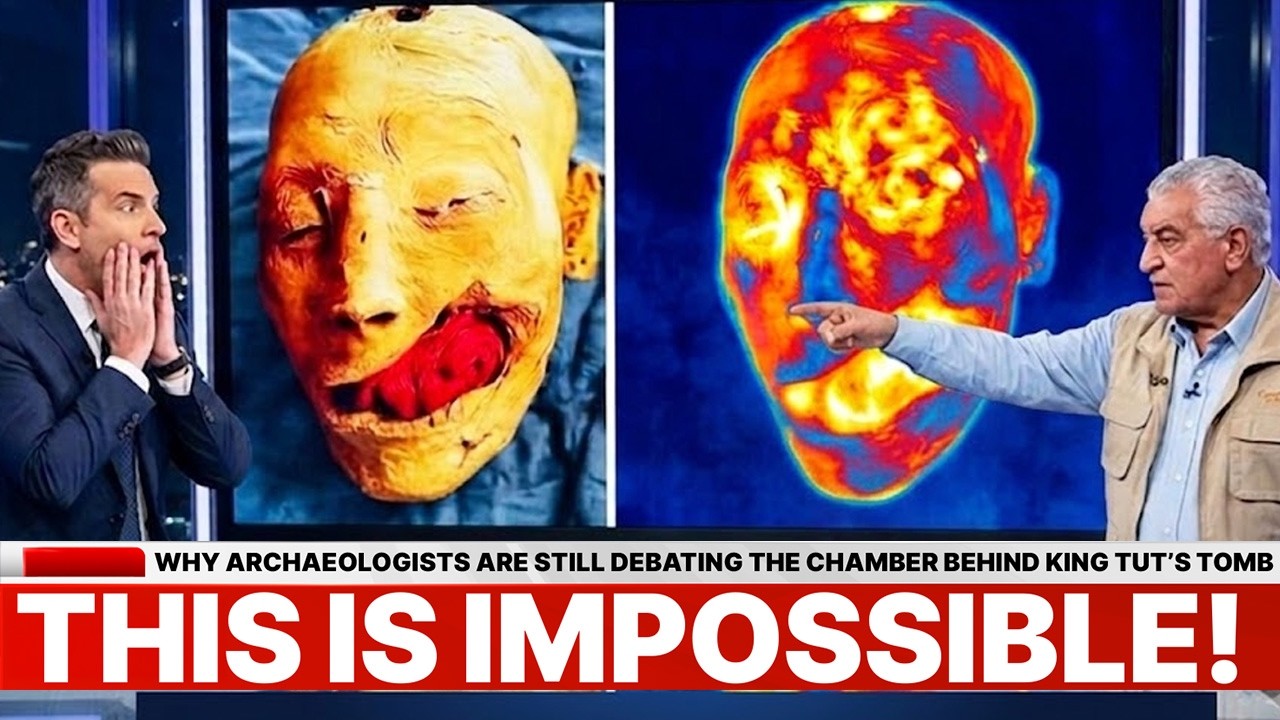
On November 5th, 2015, a team of engineers armed with heat-sensing cameras uncovered an anomaly in the north wall of Tutankhamun’s burial chamber. A glowing rectangle, perfectly sized to hide a sealed doorway, sent shockwaves through the archaeological community. This discovery suggested a hidden chamber, untouched for over 3,000 years.
Since that night, scientists have deployed every investigative technology imaginable. Infrared thermography, highly specialized Japanese radar, and an exhaustive Italian ground-penetrating radar campaign have scoured the tomb’s walls. Yet consensus remains elusive. Some instruments show empty surfaces; others hint at concealed voids. The debate rages with no resolution in sight.
Why then has no one opened that door? The answer is a complex tangle of scientific doubt, preservation concerns, political rivalry, and raw fear of destroying priceless ancient art. Experts warn that drilling risks irreversible damage to walls decorated with sacred 18th Dynasty paintings, masterpieces of religious and historical significance.
British Egyptologist Nicholas Reeves first ignited the controversy in 2014 by identifying ghostly door outlines beneath the paint. He argued the tomb, long presumed to be exclusively Tutankhamun’s, was originally built for Queen Nefertiti, the most elusive figure of Egyptian antiquity. According to Reeves, Nefertiti’s burial lies hidden just behind the north wall.
The theory drew immediate attention, especially after Egypt’s then-Minister of Antiquities, Mamdouh Eldamaty, embraced the search for the lost queen. Eldamaty’s academic background in Egyptology fueled unprecedented collaboration between archaeologists, engineers, and physicists aiming to reveal Nefertiti’s final resting place without destroying the tomb.
Initial findings seemed promising. Infrared scans revealed thermal irregularities consistent with hollow space. Reinforced by radar data from renowned Japanese expert Hirokatsu Watanabe, the world was led to believe two voids could be lurking beyond the painted plaster. Metallic and organic signals further suggested a chamber containing artifacts.
However, skepticism swiftly mounted. Italian physicist Francesco Porcelli’s 2018 radar super-study, backed by the National Geographic Society, detected no voids. His team concluded radar signals were distorted by the tomb’s painted surfaces, creating phantom cavities where none existed. This comprehensive report called the existence of hidden chambers into serious question.
The official verdict came swiftly. In May 2018, Egypt’s Supreme Council of Antiquities declared no secret chambers existed behind Tutankhamun’s tomb walls. The investigation was effectively closed, and Eldamaty lost his ministerial position months earlier, replaced by Khaled El Enany, who insisted on “100% certainty” before any physical exploration would be permitted.
Yet, the mystery deepened. Eldamaty, undeterred after leaving office, conducted a 2020 surface radar study around KV62’s entrance. He claimed discovery of a long corridor-like void running parallel to the tomb’s passage, potentially connected to the burial chambers. This enigmatic anomaly, reported in the journal Nature, has neither been confirmed nor refuted by peer review.
Meanwhile, the ongoing public and academic feud between Eldamaty and Zahi Hawass—former antiquities chief and vociferous skeptic of the theory—has polarized the field. Hawass attributes the tomb’s layout to Pharaoh Ay, not Nefertiti, and argues the missing queen was buried elsewhere. Neither side has yielded ground, fueling further controversy.
Adding intrigue, Reeves revealed in November 2022 an altered painting beneath the well-known image in the tomb’s north wall. He identified a prior depiction of Tutankhamun performing funerary rites for someone else, possibly Nefertiti herself. This painted-over scene hints at a revised narrative, suggesting the wall may be more than just a physical barrier.
Despite these revelations, no one has attempted to physically breach the wall. Experts cite the unprecedented risks to irreplaceable art—18th Dynasty frescoes portraying Tutankhamun’s journey into the afterlife. Disturbing the plaster could destroy millennia-old religious iconography, compromising historical and cultural heritage.
Political considerations also weigh heavily. Openly challenging Hawass’s authority or endorsing a disruptive excavation could end careers. No official has stepped forward to sanction drilling that might prove the theory wrong and spark public backlash. The fear of failure stalls action, freezing the debate into a stalemate.
Commercial motivations subtly influence the silence, too. The wall’s mystery continues to draw throngs of visitors to the newly opened Grand Egyptian Museum, where thousands of Tutankhamun’s treasures are displayed. The enigma behind the unbroken chamber fuels tourism and fascination, making an empty reveal commercially and culturally undesirable.
Remarkably, the ultimate non-invasive technology capable of conclusively settling the dispute exists. Muon tomography, a cosmic ray imaging technique, was successfully used in 2017 to locate hidden voids inside the Great Pyramid of Giza without damaging the structure. This method can detect cavities behind solid stone, preserving every detail of the tomb’s sanctity.
Despite muon tomography’s success nearby at the Khafre Pyramid, it has never been deployed on King Tut’s tomb. The reasons remain unspoken but appear to combine caution, bureaucracy, and the politics surrounding this high-stakes archaeological question. The device could provide definitive answers without drilling a single hole.
Thus, after 11 relentless years of scanning, theorizing, and political wrangling, the northern wall of KV62 remains sealed. It conceals either emptiness or one of ancient history’s greatest mysteries: the lost resting place of Queen Nefertiti. The world waits, breath held, as the question endures without resolution.
Do we finally have the courage and vision to apply revolutionary technology and end this archaeological saga without damage? Or will the tomb’s secret continue to starve for answers, locked away to safeguard reputations and relics alike? The fate of Egypt’s greatest mystery hangs on a razor’s edge.
As million-strong crowds flock to marvel at King Tutankhamun’s glittering treasures, the unresolved wall behind him looms as Egypt’s silent riddle—impossibly close, yet stubbornly distant. History’s most tantalizing locked door continues to defy discovery while its silent watchers debate what truly lies beyond.
The question now propels the global archaeology community toward a critical crossroads. Will future generations inherit a bold breakthrough or a perpetuated enigma? The ancient stones guard their secret patiently, while modern science waits poised to illuminate what has been hidden for over three millennia.
As of mid-2026, the supposed chamber remains untouched. The silence around the wall speaks volumes, echoing the complex interplay of science, politics, and preservation. Resolving this will require more than technology—it demands willpower, consensus, and respect for the delicate balance of history.
For now, the tomb of Tutankhamun keeps its secrets, a monument to unresolved pasts and unmet possibilities. The mystery, preserved behind 102 centimeters of plastered limestone, remains the most compelling unresolved question haunting Egypt’s Valley of the Kings.
This story is far from over. The world watches, waiting for the moment when curiosity, technology, and conviction converge to finally open the door sealed nearly 3,300 years ago—and reveal the truth behind Egypt’s greatest archaeological puzzle.