
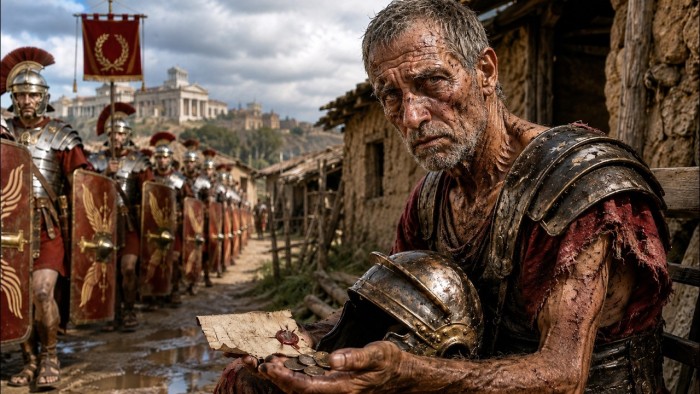
Er hat 25 Jahre gedient. Er hat mindestens drei blutige Feldzüge überlebt, zwei Flussüberquerungen unter feindlichem Pfeilhagel, eine fünfschwere Wochen dauernde Belagerung und einen unbarmherzigen Winter in einem Lager an der Donau, bei dem ein Drittel seiner Kameraden an Seuchen verendete. Nun steht er da: 47 Jahre alt. Im ersten Jahrhundert nach Christus ist das ein Alter, das die wenigsten Männer seiner Generation je erreichten.
Sein Rücken schmerzt chronisch. Sein linkes Knie knirscht seit den Kämpfen in Gallien bei jedem Schritt. Das volle Marschgepäck, das er mit zwanzig mühelos durch den Schlamm trug, schafft er nicht mehr. Doch heute ist sein Tag. Heute bekommt er seine Entlassung.
Das Schlachtfeld hat seine Chronisten, die Feldzüge ihre Historiker und die Kaiser ihre Biografen. Aber der Mann, der mit Ende dreißig oder Ende vierzig den Panzer ablegte – dieser Mann und sein weiteres Schicksal sind aus der populären Vorstellung fast völlig verschwunden. Dabei ist seine Geschichte das größte soziale Aufstiegsprogramm der Antike.
Die Entlassung eines Legionärs war kein formloser Händedruck an der Lagertür. Es war ein hochoffizieller, juristischer Akt: die Honesta Missio, die ehrenvolle Entlassung. Der Veteran erhielt ein Militärdiplom – meist zwei miteinander verknotete, gravierte Bronzetafeln. Dieses Dokument war unbezahlbar. Es war der unumstößliche Beweis dafür, wer er war und welche Rechte ihm nun zustanden.
Und diese Rechte hatten es in sich. Erstens erhielt der Veteran die Praemia Militiae, die Entlassungsprämie. Unter Kaiser Augustus entsprach das für einen einfachen Legionär 3.000 Denaren – das Äquivalent von rund 13 Jahresgehältern – oder einem beträchtlichen Stück Land. Zweitens genoss er Privilegien: Befreiung von Sondersteuern und dem verhassten Frondienst der Provinzen. Drittens – und das war für Angehörige der Hilfstruppen (Auxilia) lebensverändernd – erhielten sie und ihre Kinder das volle römische Bürgerrecht. Das Militär war die mächtigste Integrationsmaschine des Imperiums.
Wohin ging ein Mann, der sein halbes Leben im Dienst verbracht hatte? Die überraschende Antwort: Viele blieben schlicht dort, wo sie gedient hatten.
Wer zwanzig Jahre an der rheinischen oder donauischen Grenze verbracht hatte, war dort verwurzelt. Er sprach ein paar Brocken der lokalen Sprache und lebte oft schon inoffiziell mit einer einheimischen Frau zusammen – denn Legionären war das Heiraten während der Dienstzeit verboten. Nach der Entlassung wurde die Beziehung formalisiert. Der Veteran kaufte Land, gründete eine Familie und baute ein Haus. Seine Söhne wuchsen zweisprachig auf, erzogen in römischer Disziplin, und traten oft selbst in die Legion ein.
So entstanden über Generationen hinweg Veteranenfamilien an den Rändern des Reiches. Diese Männer waren die wahren Träger der Romanisierung. Nicht die Senatoren in Rom oder die Statthalter in ihren Palästen brachten die römische Kultur nach Britannien, Gallien oder Nordafrika – es waren die entlassenen Soldaten. Sie sprachen Latein, wandten römisches Recht an, bauten nach römischem Vorbild und prägten das Gesicht Europas nachhaltig.
Doch nicht jeder hatte einen klaren Plan. Manche Veteranen verkrafteten die plötzliche Freiheit schlecht. Wer 25 Jahre lang in einer straffen Militärstruktur gelebt hatte, die jeden Atemzug regelte, trank oder verspielte seine Prämie rasch an gerissene Geschäftemacher. Einige kehrten als Evocati – reaktivierte Veteranen mit Sonderstatus und höherer Bezahlung – zügig in die Armee zurück. Die Legion war das einzige Zuhause, das sie noch kannten.
Für andere plante der Staat direkt vor. In gezielten Veteranenkolonien (Coloniae) wurden Tausende Soldaten angesiedelt, um strategische Regionen zu sichern. Städte wie Lugdunum (heute Lyon), Colonia Claudia Ara Agrippinensium (heute Köln) oder Carnuntum an der Donau verdanken ihnen ihre Existenz. Diese Städte wurden von Männern erbaut, die Jahrzehnte lang Legionslager errichtet hatten. Deshalb glich der Grundriss einer frühen Kolonie meist verblüffend einem dauerhaften Militärlager – entworfen und hochgezogen von denselben Ingenieuren und Handwerkern.
Egal ob Koloniegründer, Handwerker in der Heimat oder Bauer an der Grenze: Jeder Veteran trug den Preis seines Dienstes unübersehbar an und in sich. Anthropologische Untersuchungen an Skeletten auf römischen Veteranenfriedhöfen zeichnen ein schonungsloses Bild.
Gelenkverschleiß an Schultern und Knien von jahrzehntelangem Tragen der schweren Rüstung, Knochensporne an den Füßen vom ständigen Marschieren, degenerative Wirbelsäulenschäden und verheilte, oft schief zusammengewachsene Knochenbrüche waren die Regel. Der Körper des Veteranen war eine Landkarte des Schmerzes. Die Prämie und das Land waren die Entschädigung des Staates für einen Körper, den die Maschinenerie des Krieges verbraucht hatte.
Wer 25 Jahre Militärdienst überlebte, besaß zwar ein robustes Immunsystem, doch die Lebenserwartung im Ruhestand war überschaubar. Ein Grabstein, der einem Veteranen mit 60 oder 65 Jahren gesetzt wurde, zeugte von einem erfüllten, langen Leben. 70 Jahre zu erreichen war eine absolute Ausnahme.
Heute liegen ihre Überreste verstreut auf Provinzfriedhöfen von Schottland bis Syrien. Auf ihren Grabsteinen stehen ihre Namen, ihre Einheiten, ihre Dienstjahre und die Orte, an denen sie starben. Keine großen Historiengemälde erinnern an sie. Nur schlichte Inschriften von Männern, die gekämpft, gebaut, überlebt und schließlich mit einem Bronzediplom und einem schmerzenden Knie ihr Stück Land bestellt haben. Doch auf dem Fundament dieser vergessenen Ruhestände wurde das Europa gebaut, das wir heute kennen.

![[Vollständige Geschichte] Meine Schwester rief um 6:30 Uhr an: „Papa ist letzte Nacht gestorben. Du bekommst nichts.“ – Mein Vater saß hinter mir …](http://s.hardtopis.com/wp-content/uploads/2026/07/Elderly_man_walks_into_funeral_202607281008.jpeg)
