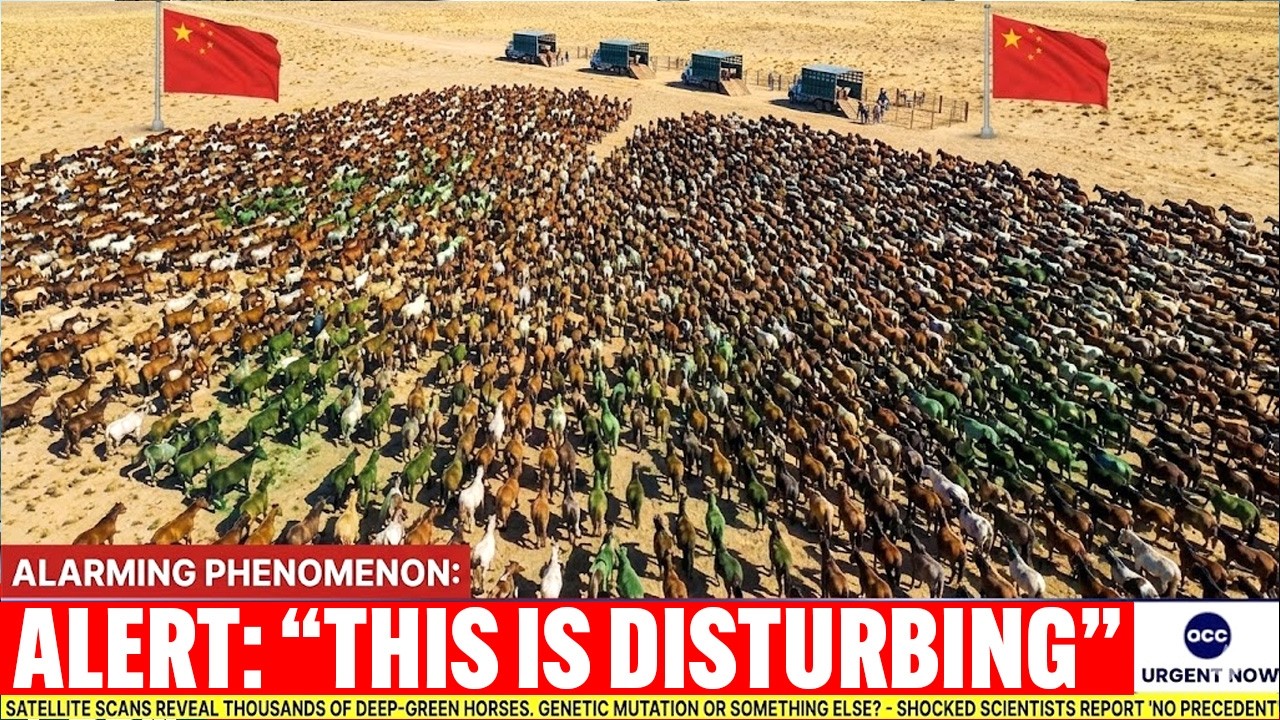
In a bold and unprecedented ecological experiment, China released eleven endangered Przewalski’s wild horses into a barren desert in 1986, a terrain deemed lifeless and inhospitable by experts worldwide. Three decades later, the once doomed landscape has astonishingly revived, challenging scientific assumptions and heralding a groundbreaking environmental triumph.
China’s release of these wild horses into the Junggar Basin—a desert so desolate that locals had abandoned it as barren wasteland—was initially dismissed as reckless and doomed. Experts warned the horses would perish in the extreme heat, freezing winters, and absence of water. The initial skepticism was so strong that even a BBC documentary team left after two days, expecting a failure.
Yet, against all odds, the Przewalski’s horses thrived, unlocking the secret to resurrecting a desert devastated by decades of ecological collapse. These uniquely wild horses, genetically distinct and the last true wild horse species, had vanished from this region by 1969. Their disappearance transformed the soil into “biological concrete,” inhibiting plant life and accelerating desertification.
The once-vibrant Junggar Basin became a dead zone, with nitrogen levels plummeting to the point scientists compared its soil to lunar dust. Wind carried the desert’s topsoil hundreds of kilometers, blanketing Beijing in choking dust storms that caused respiratory crises. Traditional efforts, like China’s massive Great Green Wall tree-planting program, failed spectacularly as water tables dropped and planted trees died.
Enter Yong Jianming, a visionary ecologist who convinced the government to abandon hopeless afforestation attempts and instead reintroduce the desert’s original ecosystem engineer: the Przewalski’s horse. The plan was audacious—transport pampered zoo-raised horses with no survival skills across continents to a landscape hostile beyond imagination.
Experts assigned the horses a 15% chance of surviving the first winter, given their captive upbringing and the brutal -42°C temperatures. This harsh winter proved critical. Horses faced botfly infestations, frostbite, and starvation risks. Yet inexplicably, ancient instincts reemerged: the horses learned to break ice for water, shield each other from icy winds, and find grass beneath thick snow.
Their hoof beats shattered the hardened desert crust, creating tiny reservoirs that trapped rainwater and allowed seeds to germinate. Their grazing patterns carved the land into a mosaic that supported new insects, plants, and animals. Their manure—a natural seed dispersal system—reintroduced lost plant species and vital soil microbes, reigniting the desert’s once-frozen life.
Over three years, nitrogen levels surged, and biomass increased 43% on grazed land versus untouched patches. Remarkably, dormant seed species re-emerged, and soil moisture retention improved by 23%. The once dead basin was awakening from a decades-long slumber, proving the horses were ecological engineers reshaping the very foundation of this land.
With each passing year, the horses survived ensuing winters and expanded their range, drawing back nearly all forms of life. Insects and dung beetles returned in millions, followed by birds, small mammals, and finally predators like foxes and wolves. A complex, balanced ecosystem was rekindled—generated not by humans, but by nature’s original architects.
By 2001, 27 horses were fully released without fences or human intervention into the vast Kalamaili Nature Reserve. Among them was Hong, a young stallion who defied all expectations. On day eight, Hong led his harem 30 kilometers to a hidden water source unknown even to scientists, demonstrating a deep ancestral knowledge thought extinct in captive-bred animals.
The broader environmental impact was staggering. Satellite images revealed green patches radiating from horse territories. The water table stabilized in 2003, reversing decades of decline. This natural restoration outperformed China’s $47 billion, 66-billion-tree Great Green Wall initiative, which ironically exacerbated desertification by depleting groundwater.
Ecological economists calculated each horse’s annual value at approximately $47,000, factoring in soil restoration, seed dispersal, water retention, carbon capture, and biodiversity support. From eleven original horses in 1986, their descendants numbered 534 by 2023, managing over 26,700 hectares and generating $25 million in ecological benefits annually.
Inspired by China’s success, Mongolia and Kazakhstan reintroduced Przewalski’s horses in their steppes, producing similar land recovery. Russia closely studies these projects, all reinforcing one revolutionary truth: living ecosystems must be rebuilt from the bottom up by reinstating nature’s lost engineers, not through artificial human constructs.
China now plans to expand the Kalamaili Reserve by 350 square kilometers, aiming to support 2,500 wild horses by 2040. Projections show this herd could restore over 100,000 hectares, sequester 43,000 tons of carbon annually, and revive over 300 plant and animal species currently missing from the region.
This remarkable saga overturns decades of ecological dogma. It proves that evolutionary honed behaviors embedded in wild species hold the key to healing devastated landscapes. Attempts to fight nature with human machinery and monoculture plantations pale in comparison to the patient work of these hoofed engineers shaping their environment over millennia.
The question now looms large for conservationists and policymakers: how many environmental crises could be reversed by reinstating original ecosystem architects wiped out by human expansion? The bison of North America, wolves of Europe, and elephants of Africa stand as reminders of species that quietly maintain entire ecosystems.
China’s bold experiment shines as a beacon of hope in an era defined by ecological collapse. It demonstrates that sometimes, the greatest scientific breakthroughs come not from laboratories or engineering feats—but by listening to nature and trusting the ancient wisdom contained within wild species.
As the green tide slowly pushes back the desert sand, the world watches in awe and urgency. The wild horses’ story is far from over—it’s a clarion call to rethink how humanity approaches the repair of the planet we have so grievously damaged. Nature already built the solution; we must simply let it take the reins once more.