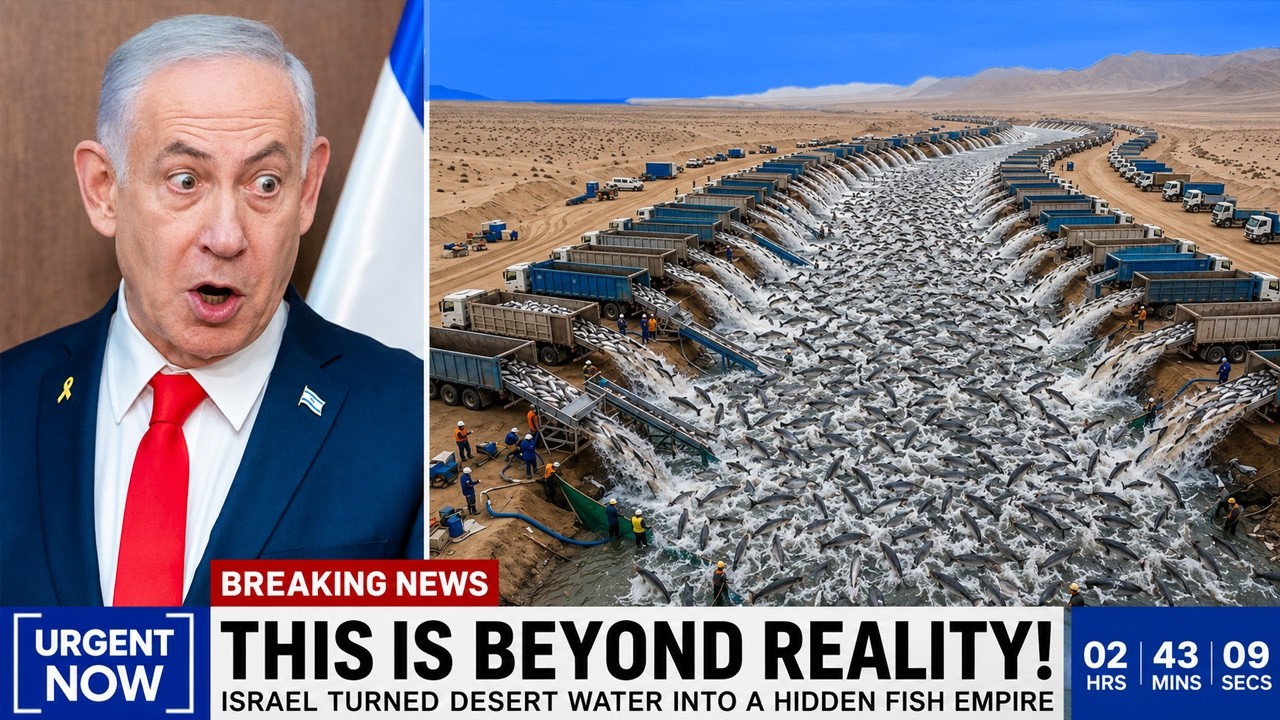
In the heart of the Israeli desert, a revolutionary aquaculture empire quietly thrives, transforming barren sand into a thriving hub of tropical fish production fed by ancient, mineral-rich waters. This groundbreaking achievement redefines agriculture in arid lands, offering a potent solution to global food and water scarcity crises.
Beneath the sun-scorched Negev Desert lies an unexpected underwater treasure: fossil water last 𝓮𝔁𝓹𝓸𝓼𝓮𝓭 during the Ice Age. Trapped thousands of feet below the surface, this warm, salty water flows through intricate wells, creating a hidden ecosystem perfectly suited for breeding sea bass and other brackish-water fish.
Decades ago, international powers deemed the Negev a wasteland—unfit for farming or habitation. Yet, post-1948 Israel defied expectations, drilling deep to tap this underground ocean. Hydrologists initially dismissed the steaming, salty water as unusable, but persistent research revealed a key opportunity for innovation in aquaculture.
In a modest university conference room in the late 1970s, researcher Samuel Applebaum proposed the daring idea of desert fish farming. Despite skepticism, he identified species like barramundi and tilapia that could thrive in the desert’s geothermal, brackish water—species perfectly adapted to these unique conditions.
This visionary concept evolved into a pioneering industry. Kibbutzim sprang up across the region, leveraging hot, mineral-loaded water pumped from a thousand meters underground to nurture vast ponds of sea bass. The experiment, once ridiculed, rapidly demonstrated immense potential for productivity and sustainability.
The ingenious system’s brilliance lies in its closed-loop design. Fishponds’ nutrient-rich wastewater irrigates adjacent olive groves, jojoba fields, and date palms, enabling multiple crops from a single water source. This cascade of fish and agriculture turns scarce water into continuous food and economic output.
Ram Farm exemplifies this synergy, using minimal water to produce huge fish yields while simultaneously fertilizing 120 hectares of crops. Meanwhile, Aquatec Fisheries operates at massive scale, producing thousands of tons annually with solar-powered, recirculating aquaculture systems that maintain optimal conditions in the harsh desert environment.
Israel’s fish farming industry now sustains over ten super-intensive operations, collectively contributing tens of thousands of metric tons of fish per year. Barramundi harvested before dawn appears in supermarkets by noon, supplying fresh, premium protein far faster than imported alternatives long assumed to dominate the market.
Beneath this impressive output is a relentless, 24/7 operation finely tuned to preserve water quality and fish health. Continuous aeration combats low oxygen in hot water, while digital monitoring systems detect and respond instantly to any threats, underscoring the high-tech precision embedded in this desert fish empire.
This success stems not only from technology but from Israel’s holistic water management strategy. Treating water as a national security priority fosters unparalleled recycling rates—90% of wastewater is reused—and fuels innovation to maximize every drop in a country with no room for waste or error.
Globally, arid regions are beginning to take notice. From North Africa to the American Southwest, countries faced with dwindling freshwater supplies are exploring adaptations of Israel’s model. The prospect of harnessing fossil aquifers for high-efficiency fish and crop production offers a new paradigm for food security in dry climates.
Yet, the path to replicating Israel’s achievement remains complex. Deep, costly drilling and intensive engineering challenge newcomers. Unlike regions blessed with surface water, Israel’s lack of alternatives forced innovation, backed by dedicated institutions like Ben-Gurion University and a cooperative kibbutz system supporting risk-sharing and research.
The environmental footprint of desert fish farming is startlingly low compared to coastal aquaculture. By recycling every liter of water and converting waste into fertilizer, the system flips traditional aquaculture’s pollution problem into a model of circular sustainability. It’s a testament to engineering that turns hostile landscapes into food-producing powerhouses.
Barramundi’s biology is a perfect fit for this water’s unique chemistry, growing rapidly at ideal temperatures and salinity levels. This biological compatibility was the linchpin for success, enabling the production of protein-rich fish with efficiency surpassing that of chicken, pork, or beef in feed-to-flesh conversion ratios.
Behind the scenes, this vast operation demands vigilance from skilled technicians who monitor countless variables around the clock. Even minor deviations in oxygen or salinity can trigger catastrophic stock losses, requiring immediate intervention at any hour. This human dedication and adaptive management define the industry’s resilience and reliability.
The transformation of the Negev Desert challenges conventional maps of arable land and resource use. It reveals the hidden potential beneath supposedly worthless terrain, illustrating that underground water reserves can redefine agriculture in ways previously unimaginable. The desert’s green ponds are proof of this profound paradigm shift.
Israel’s desert aquaculture empire remains largely invisible to the public eye. Consumers routinely buy fresh barramundi with no idea it was farmed deep inside a desert aquifer system, underscoring a silent revolution in local food supply chains that bypasses long-distance imports and fragile ecosystems.
Economically, the Negev’s fish farms contribute significantly to rural communities through shared infrastructure and knowledge, sustaining multiple communal settlements. This collective approach prolonged experimentation and absorbed risks that private enterprises might not endure, enabling maturation of techniques and technologies now enviably advanced worldwide.
The lessons learned here carry strategic importance. In a world where freshwater scarcity threatens global stability, Israel’s ability to generate valuable protein from salty desert water elevates national food security to a new level. Countries mastering this art gain crucial self-reliance with implications far beyond agriculture.
As more nations seek solutions to climate change, population growth, and dwindling water supplies, the Negev model offers a replicable blueprint. Its combination of deep water tapping, selective species farming, closed-loop irrigation, and renewable energy integration constitutes a breakthrough approach for sustaining agriculture on the planet’s most challenging terrains.
The emerging international interest in Israel’s desert fisheries signals a tipping point. From Saudi Arabia to Australia, projects inspired by the Negev’s innovations are taking shape, though none have yet matched its scale or institutional support. The export of knowledge and expertise is a key catalyst accelerating this global movement.
Still, skepticism and technological hurdles persist. The arduous drilling depths, complex water chemistry control, and high operational demands require patience, precision, and investment. Israel’s decades-long commitment and unique circumstances made it possible—a caution for others eager to replicate success without similar foundations or incentives.
This desert aquaculture revolution forces a profound question: what other overlooked resources exist beneath seemingly barren lands worldwide? The Negev story compels reexamination of “worthless” terrains and challenges reliance on superficial assessments of land usability, urging innovation driven by deep geological and biological understanding.
Ultimately, the hidden empire of fish swimming beneath Israeli sands exemplifies human ingenuity confronting environmental adversity. It showcases how perseverance, science, and community can convert historical desolation into productive abundance, rewriting the narrative of deserts from uninhabitable wastelands to vital food-producing frontiers.
As global pressures on agriculture intensify, the Negev’s green oasis stands as a beacon of hope and proof that sustainable, high-yield aquaculture can thrive where it was once deemed impossible—turning ancient underground waters into lifeblood for an enduring, desert-born food empire.