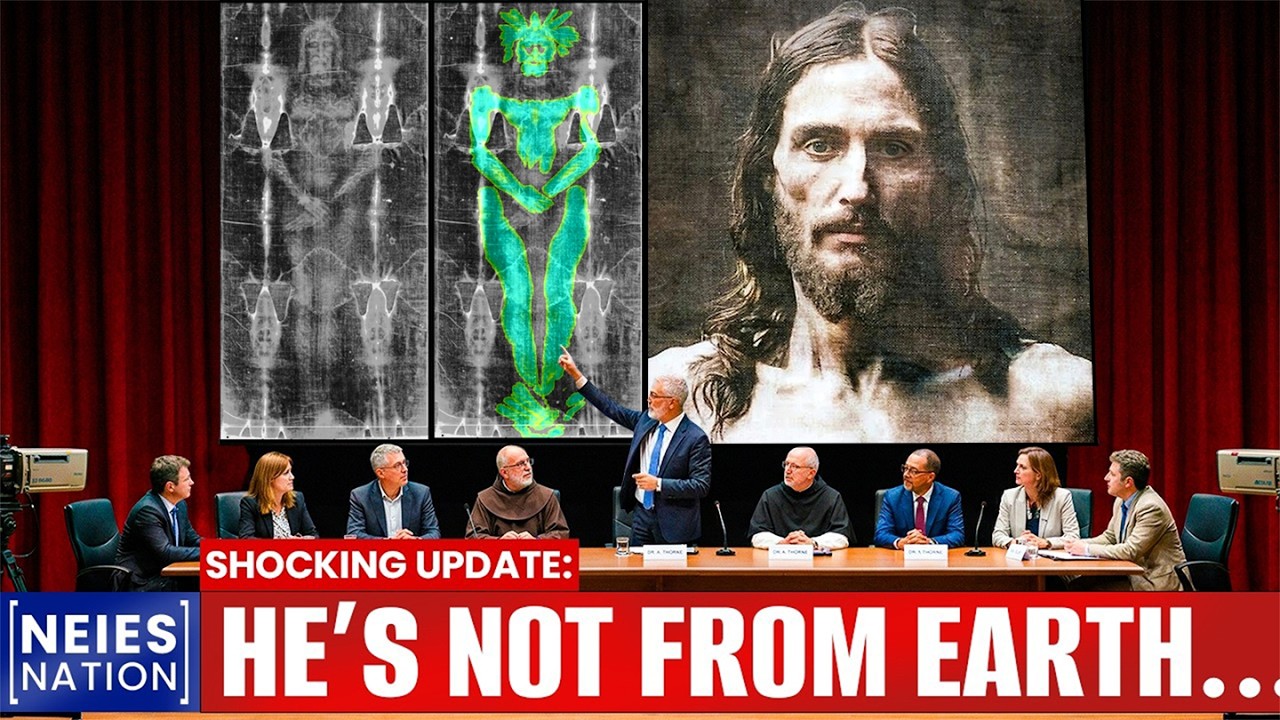
Scientists have uncovered DNA on the Shroud of Turin that defies explanation—it is not solely human, but a complex genetic mosaic spanning continents and millennia. This discovery shatters existing theories about the relic’s origin, suggesting an ancient journey crossing Eurasia and Africa, rewriting history and science simultaneously.
The Shroud of Turin, long revered and debated, has now thrust itself back into the global spotlight. This ancient linen cloth, widely believed to bear the imprint of Jesus Christ after his crucifixion, now harbors genetic evidence so baffling that experts are stunned. The DNA extracted is unlike anything previously encountered on supposed medieval relics.
For centuries, the shroud’s authenticity has been contested fiercely, split between faithful believers and skeptical academics. Until now, scientific inquiry was limited by technology, leaving the shroud tangled in mystery and mistrust. Today’s breakthroughs redefine the narrative, employing cutting-edge genetic sequencing and forensic analysis that read the cloth not just as fabric, but as a biological and historical archive.
Using next-generation sequencing, researchers identified mitochondrial DNA from humans and plants embedded deep within the linen fibers. Far from a simple origin, this DNA reveals traces of populations from the Middle East, Europe, Asia, and Africa — a biological map reflecting thousands of years of travel and veneration. The evidence flatly contradicts claims of a 14th-century European forgery.
Genetic markers from distinct groups—such as the Druze of the Levant, European haplogroups, and even those typical of China and India—were all found intertwined in the shroud’s threads. These findings suggest the cloth journeyed along ancient trade and pilgrimage routes, accumulating genetic material in layers over centuries.
Pollen analysis strengthens this unprecedented claim. Scientists discovered over fifty species, including plants unique to the Jerusalem-Jericho corridor. Among them, Gundelia tournefortii, a thorny desert plant linked to the biblical crown of thorns, was strikingly abundant, reinforcing historical accounts with tangible, microscopic proof that could never be forged.
Chemical and microscopic blood analyses revealed that the stains are genuine human blood, not paint or pigment. Identified as blood type AB, it exhibits markers of catastrophic trauma consistent with crucifixion—signatures of bruising, scourging, and fatal physiological stress detectable only through modern biochemistry. No artist’s brush could replicate this.
The 1988 radiocarbon dating that previously declared the shroud a medieval 𝒻𝒶𝓀𝑒 has been discredited. Scientists discovered that the test sample came from a heavily repaired, contaminated corner, not the original cloth. Novel methods like wide-angle X-ray scattering now date the fabric back to the first century A.D., coinciding exactly with the historical timeframe of Jesus Christ.
Beyond age verification, high-resolution imaging techniques revealed the shroud’s image behaves like no ordinary photograph or painting. It is a three-dimensional negative, formed by an unknown burst of energy, barely a billionth of a second long, imprinting a detailed human form with anatomical precision invisible to medieval artistry.
Coins over the eyes, consistent with those minted by Pontius Pilate, appear in the imaging, a detail rediscovered through digital enhancement that would have been impossible for any medieval forger to intentionally reproduce. These revelations move the shroud beyond religious icon to a forensic document, silently chronicling momentous events in ancient Jerusalem.
The shroud’s journey traced through history matches documented movements—from Jerusalem to Edessa, Constantinople, and finally Western Europe—reflecting a convergence of cultures and peoples recorded at the microscopic level. This intricate biological layering on one cloth is evidence of an extraordinary historical pilgrimage inaccessible to medieval fabricators.
This stunning convergence of biology, chemistry, physics, and history positions the Shroud of Turin as an unparalleled relic—a silent witness preserving the trauma and faith of two millennia. Each thread contains whispers of ancient hands and distant lands, challenging the limits of science and faith alike.
While the scientific community grapples with these revelations, one profound question lingers: how did the image imprint form with such exactness and unexplained energy? Current physics cannot fully explain the phenomenon, leaving the shroud as a boundary between the known and the mysterious, a testament to an event that changed humankind’s course.
The Shroud of Turin emerges from centuries of debate as neither forgery nor mere relic, but as a living document encoded with undeniable biological and historical truth. It compels science to rethink the origins of this artifact and offers believers a tangible connection to their faith’s foundational moment.
As investigations continue, the shroud stands as a powerful testament at the intersection of science and spirituality. The world watches as researchers peel back layers of contamination, myth, and time to reveal what may be the most profound archaeological mystery ever uncovered.
This discovery demands urgent reexamination of how humanity preserves and perceives its history. Every fiber of the Shroud of Turin tells a story not only of suffering but of a shared and interconnected world stretching across continents and ages.
The shroud’s genomic legacy has transformed it into a biological gospel, encoded with DNA from populations once thought disconnected, proving that the past is far more interwoven than previously understood. It urges reappraisal not just of a cloth, but of the narrative of civilization itself.
Science has stripped away centuries of assumption, exposing the shroud’s deep complexity. It is both a forensic record of agony and a map of human history’s vast tapestry, impossibly preserved in linen. The truth it carries defies explanation, awaiting further discovery and understanding.
As this breaking news reverberates worldwide, it challenges researchers and believers alike to confront the shroud anew—not as myth or artifice, but as an enigmatic witness holding secrets still beyond our grasp. The DNA, the blood, the pollen, and the image form a cohesive case unprecedented in historical science.
Ultimately, the Shroud of Turin reminds us that some mysteries defy immediate understanding, standing between science and faith. Its biological enigma insists that history is not fixed but alive, inviting exploration that could reshape how humanity views its origins.
The revelation of non-human and extraordinary DNA on the shroud forces a reckoning with past skepticism and opens doors to new realms of investigation. It demands a pause, a moment to reconsider what is possible and to respect the profound unknown.
In the face of this genetic and physical evidence, the Shroud of Turin transcends the realm of the ordinary. It is no longer simply a relic or legend but a living archive, its threads woven with the lives and travels of countless individuals across time and space.
This story is not merely about a piece of cloth but about a global, historical journey preserved in microscopic detail. The shroud testifies not only to faith but to science’s power to reveal what was once hidden—and the mysteries that endure.
We stand at a new frontier of understanding. The Shroud of Turin challenges assumptions, defies modern physics, and encodes a collective memory that could rewrite the fabric of history itself. Its secrets beckon, demanding urgent, relentless inquiry.
As researchers delve deeper, the question remains not only what the shroud is but why it exists—and how knowledge of its origins might transform humanity’s understanding of the past and the miraculous.
The Shroud of Turin’s strange DNA and forensic evidence now demand they be regarded not just as relics of religious significance but as vital data for global history, biology, and the uncharted territory between faith and reason.
This monumental discovery ushers in a new era of interdisciplinary research, merging genetics, archaeology, theology, and physics to confront a puzzle that resists all conventional explanation yet captivates the human spirit.
In revealing a biological mosaic never before seen, the Shroud upends medieval forgery theories and beckons a reassessment of ancient history, its journeys, and the people whose lives are mysteriously entangled in its fibers.
The Shroud of Turin remains silent in its vault, but now more than ever, its revelations roar loudly across scientific and religious communities, heralding a paradigm shift in how we understand relics, authenticity, and the passage of time.
As study continues, the global community watches—held in rapt attention by a single piece of cloth whose threads hold the secrets of a world both vast and intimately human, ancient yet urgently alive.
The Shroud’s story is far from complete. Every discovery raises new questions as the line between legend and science blurs, demanding patience, rigor, and awe in equal measure from all who seek its truth.
For now, the Shroud of Turin stands as a testament to the enduring mystery of history, holding within its weave the echoes of a man, a moment, and a miracle that science has only just begun to unlock.