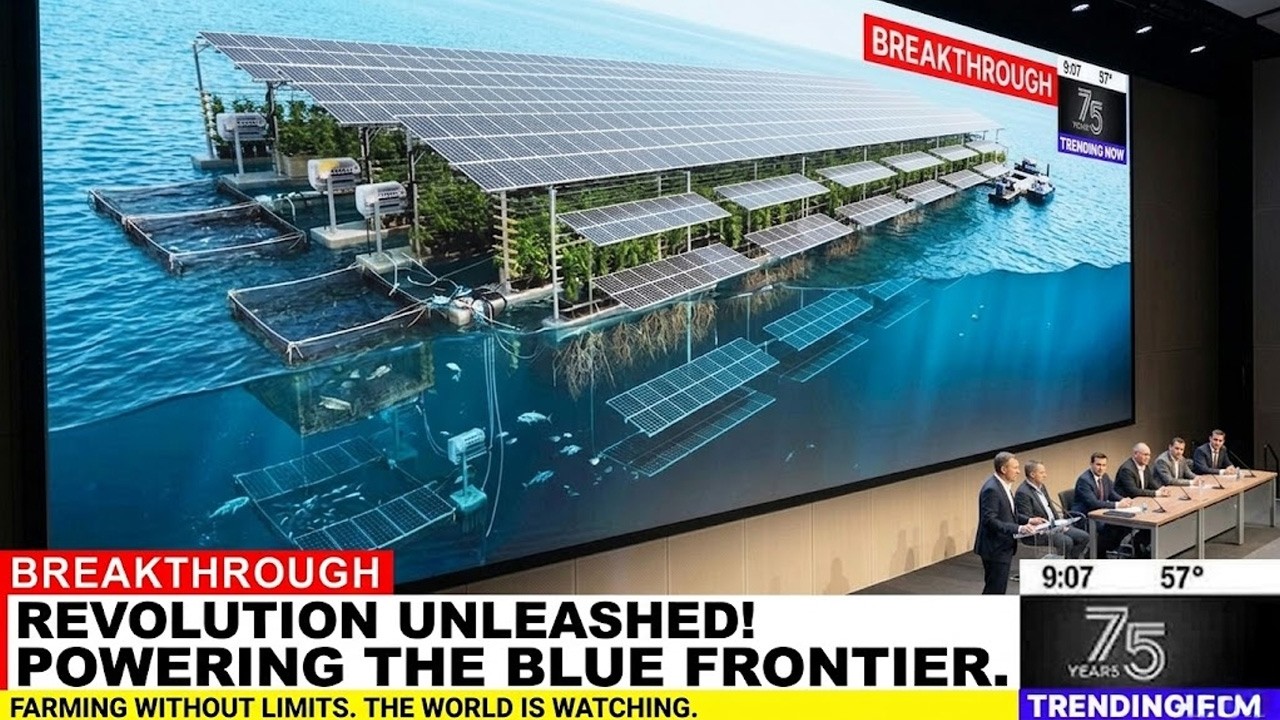
A revolutionary solar farming system is rapidly transforming global agriculture by enabling simultaneous crop growth and clean energy production on the same land—shattering decades-old assumptions about farming and energy competing for space. This breakthrough technology is accelerating adoption far beyond expert predictions, promising to reshape food and power production worldwide.
For years, solar power and agriculture waged a quiet war over arable land. In the United States alone, over four million hectares could be repurposed for solar energy by 2050, 𝓉𝒽𝓇𝑒𝒶𝓉𝑒𝓃𝒾𝓃𝑔 valuable farmland. Traditionally, solar farms required vast, contiguous plots, displacing crops and livestock. This created a zero-sum game: either energy or food, never both.
Now, a 40-year-old concept called agrivoltaics is rewriting that script. By elevating solar panels high enough to grow crops beneath, the same fields can yield food and electricity simultaneously. This dual-use innovation breaks the long-held tradeoff, enhancing land-use efficiency by up to 70%, according to Germany’s Fraunhofer Institute. It’s a paradigm shift gaining momentum faster than anticipated.
The origins date back to 1981, when German scientists Adolf Goetzberger and Armin Zastrow first proposed integrating farming and solar energy. Their visionary plan languished for decades, stalled by technological and economic hurdles. But mounting climate pressures and soil erosion crises have driven rapid advancements, finally unlocking its vast potential.
Agrivoltaic systems differ fundamentally from conventional solar farms. Panels are mounted three to five meters above ground, creating open space for tractors and harvesters. These installations often utilize bifacial panels that capture sunlight from above and below, boosting power output. Sophisticated AI and sensor arrays dynamically adjust panel angles, optimizing conditions for both crops and energy generation.
Surprisingly, shade provided by panels benefits certain crops, especially in hotter climates. Plants like lettuce and tomatoes suffer heat stress and water loss under intense sunlight. Agrivoltaics moderates temperature and conserves soil moisture, reducing irrigation needs by up to 50%. Trials in Europe demonstrated crop yields under panels matched or exceeded those in open fields during extreme heat waves.
One dramatic test took place on a raspberry farm near Germany’s border. Initial designs blocked too much light, 𝓉𝒽𝓇𝑒𝒶𝓉𝑒𝓃𝒾𝓃𝑔 fragile fruit yields. Engineers swiftly adapted panel spacing to increase sunlight penetration. The result? Raspberry harvests not only survived but thrived, while overhead panels shielded crops from damaging storms, saving hundreds of thousands in losses.
Beyond science, agrivoltaics delivers economic resilience to farmers. By selling surplus electricity back to the grid, landowners diversify income streams, insulating themselves from volatile weather and market swings. For beleaguered family farms often making under $100,000 annually, even modest solar installations represent lifelines amid rising costs and climate uncertainty.
Meanwhile, in the deserts of Inner Mongolia, China is scaling the concept to unprecedented proportions. The Great Solar Wall—a colossal installation spanning thousands of square kilometers—combines solar arrays with grazing sheep. Elevated panels provide shade for vegetation growth in barren regions, while flocks manage underbrush, minimizing maintenance and fire risks. This massive deployment underscores agrivoltaics’ adaptability across diverse environments.
Engineering these mega-farms demands innovative solutions. In shifting desert sands, millions of steel foundation piles anchor the panels against extreme temperatures and wind. Automated, waterless cleaning robots maintain panel efficiency by removing dust accumulation daily. This robotics-driven upkeep extends system longevity and maximizes energy output over decades.
Despite its promise, agrivoltaics faces significant hurdles. Local opposition often stems from fears about industrializing farmland or community disruption. Regulatory frameworks lag, struggling to classify dual-use land for subsidies and ownership. Higher upfront costs—10 to 20% above traditional solar farms—require careful balancing of power generation and crop viability to avoid compromising either.
Yet the technology’s accelerating deployment proves these barriers are surmountable. Each success story—from a small European fruit farm to vast Asian deserts—pushes agrivoltaics closer to mainstream adoption. As global land, water, and energy resources tighten, this integrated approach emerges as a critical solution to multiple crises converging.
Agrivoltaic systems also promote sustainability beyond yield. By reducing reliance on fossil fuels and shrinking carbon footprints, they enhance rural energy independence. The synergy between crops and panels—cooling each other through moisture exchange—demonstrates a natural feedback loop rarely seen in human agriculture or energy production, hinting at truly holistic environmental stewardship.
The model is expanding in unexpected ways, too. In the United States, tens of thousands of hectares of solar farms now host sheep grazing beneath panels, a practice growing faster than traditional herbicide and mowing industries anticipated. This integration lowers operating expenses while supporting livestock products, embodying a next-generation prototype for multi-functional farmland.
This rapid transformation challenges long-standing assumptions about land use, climate adaptation, and energy strategy. What once seemed a distant ideal now unfolds as immediate, actionable reality. Scientists, farmers, and engineers witness a convergence where food and energy no longer compete but collaborate, revealing a blueprint for resilient, efficient agricultural futures.
Looking ahead, widespread adoption will require coordinated policy updates, community engagement, and investment in advanced designs capable of optimizing dual outputs. However, the pattern of underestimated growth suggests the momentum behind agrivoltaics is unstoppable. It marks a critical pivot point in humanity’s effort to sustainably feed and power a growing population.
From historic fields in Europe to sprawling deserts in Asia, agrivoltaics is delivering on its promise with startling speed. As climate challenges intensify, this technology holds the key to unlocking more than just energy and food—it offers hope for preserving the very soil beneath our feet.
The world now confronts urgent questions: Should every new solar farm integrate farming beneath its panels? Are there regions where tradeoffs still outweigh benefits? The answers will shape landscapes and livelihoods for decades to come, as agrivoltaics reshapes the future of agriculture—and the planet’s clean energy capacity.