At eighty years old, Pattie Boyd has finally broken her silence on the harrowing realities of her marriage to Eric Clapton, a union long romanticized as the ultimate rock and roll love story. The iconic model and muse of the 1960s is now exposing the painful truth behind the fairy tale, leaving fans and admirers stunned by her candid revelations.
The woman who once inspired some of the most celebrated love songs in music history—including “Layla” and “Wonderful Tonight”—has revealed that the reality of her life with the legendary guitarist was far from romantic. Instead, it was marked by betrayal, addiction, and profound emotional devastation that would take decades to overcome.
 Boyd’s revelations come at a time when she has fully reclaimed her own narrative. After years of being defined by her relationships with two of rock music’s most iconic figures, she is now speaking openly about the suffering that lurked beneath the surface of her seemingly glamorous life.
Born Patricia Anne Boyd on March 17, 1944, in Taunton, Somerset, England, she rose to prominence as one of the most sought-after models of the Swinging Sixties. Her distinctive look—characterized by long hair, wide eyes, and an innate youthful charm—graced the covers of Vogue and other leading fashion publications, making her an icon of her generation.
But her entry into the world of rock and roll would change her life forever. In 1964, during the filming of “A Hard Day’s Night,” Boyd met George Harrison, and their rapid romance culminated in marriage on January 21, 1966.
At the heart of Beatlemania, Boyd’s life seemed like a dream come true. Yet the reality of her marriage to Harrison was fraught with challenges. His increasing devotion to Eastern spirituality created an emotional distance between them, while his infidelities—including a devastating affair with Maureen Starkey, the wife of Ringo Starr—eroded her trust and sense of self-worth.
Boyd found herself trapped in the role of “the little wife sitting at home,” unfulfilled and isolated. The breaking point came when she discovered Harrison’s affair with Starkey, finding her at their home lying on a mattress while Harrison dismissed her presence with indifference. It was a humiliation Boyd would never forget, forcing her into painful introspection about her own worth.
Amidst the turmoil of her marriage to Harrison, another figure had entered the scene: Eric Clapton. Clapton, a close friend and creative collaborator of Harrison, had become obsessed with Boyd, and his pursuit would set the stage for one of rock music’s most complicated and destructive love triangles.
Clapton’s obsession with Boyd was so intense that it bled into his music. The iconic song “Layla” was inspired by his unrequited love for her, and “Wonderful Tonight” captured moments they shared together.
But the romance that Boyd eventually entered into with Clapton would prove to be even more devastating than her marriage to Harrison. Before his relationship with Boyd took hold, Clapton’s personal life was already marked by chaos.
His relationship with Alice Ormsby Gore was dominated by substance abuse, with both partners succumbing to heroin addiction. Clapton himself later admitted that their life together was defined by dependency and instability rather than genuine love.
Even more complicated was Clapton’s brief relationship with Boyd’s younger sister, Paula. After meeting at a concert in Liverpool in December 1969, Clapton became involved with Paula, but his heart remained fixated on Pattie.
 Paula would later discover that “Layla” was inspired by her sister, a painful realization that eroded her self-esteem and led to the end of their relationship. This entanglement highlighted the deeply interwoven and destructive nature of the relationships within this circle of rock royalty.
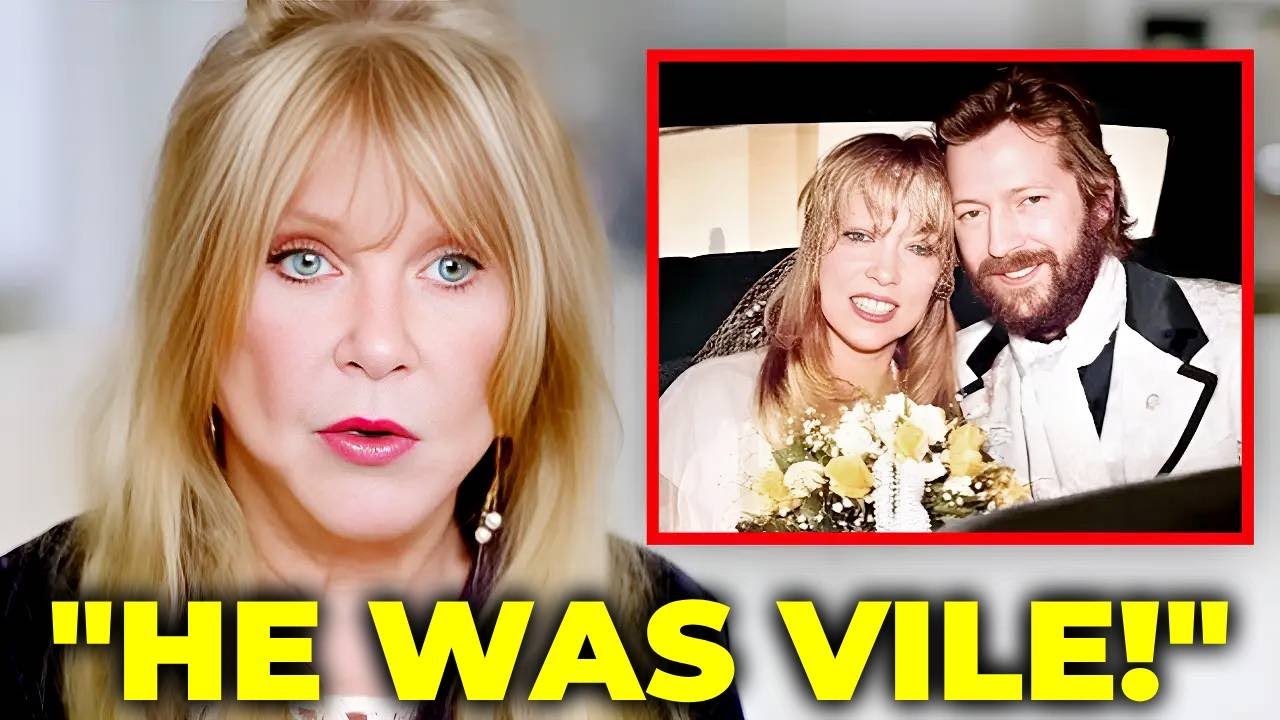
When Boyd finally separated from Harrison in 1974 and divorced in 1977, she began a relationship with Clapton. They married on March 27, 1979, in Tucson, Arizona. The wedding was notable for Harrison’s presence, who humorously referred to himself as their “husband-in-law,” suggesting a level of camaraderie that belied the complicated history between them.
But the marriage that followed was far from the passionate romance that had been imagined. Clapton’s struggles with alcoholism and substance abuse took a severe toll on their relationship, causing Boyd considerable emotional distress. She would later reflect on the difficulty of maintaining any semblance of stability in their lives together.
Perhaps most devastating was the couple’s struggle to have children. Clapton had long expressed a desire to have a family with Boyd, and they underwent multiple attempts at in-vitro fertilization. Each failed attempt deepened Boyd’s sense of loss and frustration.
The emotional toll of these unsuccessful procedures, combined with Clapton’s personal struggles, placed an unbearable strain on their marriage. Boyd has described the IVF process as emotionally taxing, with each failed attempt deepening her sense of loss.
But the true devastation came in 1985 when Boyd discovered Clapton’s infidelities. She learned that Clapton had fathered a daughter named Ruth with another woman. In 1986, he fathered a son named Connor with Lori Del Santo.
Boyd was informed about Connor’s existence while she was still married to Clapton, a revelation that she described as a “stab in the heart.” The timing of these discoveries made the betrayal even more painful.
Boyd had been enduring the emotional and physical toll of IVF treatments, dreaming of building a family with Clapton, all while he was seeking fulfillment outside of their marriage. The revelation shattered her and deepened her emotional wounds, leading her to question her very self-worth.
Following their divorce in 1989, Boyd found herself grappling with a profound crisis of identity. She later reflected, “I was no longer Mrs. Famous George or Mrs.
 Famous Eric, so who am I? I am no one.”
These words captured the depth of her loss and the extent to which she had been defined by her relationships with famous musicians. The aftermath of her marriages forced Boyd to confront the painful reality of her life.
She sought therapy to process the emotional pain from both marriages and to reclaim her sense of self. As part of her healing process, she turned to photography and writing, creative outlets that allowed her to rediscover her identity outside the confines of her associations with iconic musicians.
Boyd’s photography, which she had begun exploring during her years in the rock and roll world, eventually gained international recognition. Her exhibitions around the world helped establish her as an artist in her own right, offering intimate glimpses into the lives of the musicians and cultural figures she had known.
In 2007, Boyd published her autobiography, “Wonderful Tonight: George Harrison, Eric Clapton, and Me,” which became an international bestseller. The book provided a candid look into her personal life and professional journey.
Through her memoir, Boyd reclaimed her voice and her identity, moving beyond the narratives that had long defined her life and career. It was a powerful act of self-assertion from a woman who had been objectified and idealized for decades, often at the expense of her own happiness.
The revelations about her marriage to Clapton are particularly significant because they challenge the enduring myth of the romantic rock and roll muse. Boyd’s story is not one of glamour and romance, but of survival—a woman who endured betrayal, addiction, and emotional devastation, and who emerged with her dignity intact.
At eighty years old, Pattie Boyd is no longer willing to let the world romanticize her suffering. Her candid revelations about Eric Clapton serve as a powerful reminder that the fairy tale narratives we construct around celebrities often obscure the painful realities of their lives.
Boyd’s legacy extends far beyond her status as a muse to famous musicians. She is a cultural icon who represented the freedom and individuality of the 1960s, a fashion pioneer whose influence continues to resonate across generations.
 Mary Quant herself once suggested that women should aspire to look like Boyd, a testament to her enduring impact on style and beauty. But her most important legacy may be her courage in speaking her truth.
At an age when many might choose to remain silent, Boyd has chosen to shed light on the darker aspects of her life, giving voice to the pain that was hidden behind the facade of rock and roll glamour. The story of Pattie Boyd and Eric Clapton is a cautionary tale about the dangers of romanticizing toxic relationships.
Clapton’s obsession with Boyd was never truly love—it was possession, fueled by addiction and an inability to find fulfillment within himself. Boyd, caught in the orbit of two brilliant but deeply flawed men, paid the price for their emotional immaturity.
As she looks back on her life, Boyd’s revelations serve as a reminder that the truth is often far more complex and painful than the stories we tell ourselves. Her willingness to share her experiences, even at eighty years old, demonstrates a remarkable strength and a commitment to authenticity that is truly inspiring.
The world may remember Pattie Boyd as the woman who inspired “Layla” and “Something,” but her own story is far more significant. It is a story of survival, healing, and ultimately, of reclaiming one’s identity in the face of overwhelming odds.
Her photographic work and memoir have cemented her status as an artist and author in her own right, distinct from the men who once defined her public persona. She has transformed her pain into purpose, using her experiences to illuminate the hidden costs of fame and the importance of self-worth.
For fans who grew up idolizing the romanticized image of Clapton and Boyd, these revelations are a sobering correction. The reality of their marriage was a cycle of addiction, betrayal, and emotional exhaustion, far removed from the tender lyrics of the songs Clapton wrote for her.
Boyd’s decision to speak out now, at eighty, is a powerful statement. She is no longer the young model swept up by the charisma of rock stars. She is a survivor who has come to understand that the greatest love story she could ever be part of is the one she has with herself.