My Parents Pushed My Daughter Back Into the Burning House—Then Panicked When They Saw the News
Ten weeks before the fire I still believed our Sunday dinners proved I had kept the most important promise of my life.
Owen arrived at 4:20 on the same bus he had taken for nearly five years. Maisie reached the door first and threw her arms around him. “Dad, you made it.” Owen smiled over her head. “The bus made it too. I helped by sitting in it.” Maisie laughed. His humor was plain enough to miss if you were not listening, but it made her laugh every time.
He opened his hand and showed her a little black wheel with a silver pin through the center. “Found it under the potting bench. Marcus said it was trash. I said scientists decide what is trash.” Maisie held it up to the light. Her school STEM showcase was less than two weeks away. Half our dining table had disappeared beneath rulers, felt, sandpaper, and masking tape.
Owen knelt beside the ramp while Maisie fitted the wheel onto the model. His fingers were rough from handling soil and garden trays at the nursery, but he held the tiny pin with patient concentration. When it clicked into place she set the car at the top. “Three, two, one,” Owen said. The car shot down the ramp, crossed the felt, and rolled under the sideboard.
My parents arrived without knocking. Glenn still had a key then. Patricia carried a covered casserole and gave me the careful smile she used whenever she wanted credit for making an effort. Conversation began easily until Glenn leaned back and said, “Good thing he brought his traffic controller.”
My fork paused. “Dad, do not call her that.”
He raised his hands. “It was a joke. She keeps him going in the right direction, does she not?”
Maisie looked at Owen’s plate. Owen looked at her, waiting to see whether he had done something wrong. I should have stopped the dinner. Instead I softened the moment. “Maisie understands Owen better than any of us. That does not make her his traffic controller.”
Patricia smiled. “Your grandfather chose the wrong words. What he means is that you are unusually mature. Most children would not have your patience.”
That familiar word settled over the table—mature. I had heard it throughout my own childhood, usually after I swallowed something I wanted to say or repaired a mood I had not broken. The recognition passed too quickly for me to catch.
Later I found Maisie arranging blank presentation cards beside a list she had written for Owen: Keep your ticket in the blue pocket. Use your quiet voice. Do not touch the display. If you feel upset, tell me first. Do not leave without me. Wait until I say it is okay to talk.
At the bottom, underlined: Do not make people look.
Her own presentation cards were still blank.
The showcase was held on a Thursday evening in the school gym. Maisie barely looked at the other projects. She checked exits, restrooms, and her phone twice to confirm Owen’s bus schedule. When he arrived in the blue shirt she had chosen, she smiled—then vanished the moment he reached toward the model car. “Do not touch that one yet. The axle is loose.”
Owen pulled his hand back immediately.
Patricia kissed Maisie’s cheek and lowered her voice. “Everything depends on how well you pay attention tonight.”
When the judges approached, Owen became overwhelmed by the printed program. Glenn pressed it on him. Color climbed from Owen’s collar into his cheeks. Maisie touched his wrist twice. “I need outside,” he said. She tried to follow. I caught her arm. “Stay with your project. I will help him.”
She pulled against my hand. “He needs me.”
“He needs an adult and I am here.”
Patricia stepped closer. “Claire, do not make a scene. Let her calm him down.”
That sentence stopped me. Not help him. Calm him down.
Maisie’s voice rose. “If I do not fix it, Dad will lose the Sundays.”
The space beside her table went silent. “What did you say?”
Tears filled her eyes. “Grandma said if I do not keep Dad good, people will see he cannot come anymore.”
Owen had returned to the doorway. His face went still.
I packed Maisie’s display without asking her to present again.
On the drive home Owen asked quietly, “Who said I only get to be your dad if you keep me good?”
Maisie lifted her eyes to mine in the rearview mirror. “Grandma said Mom was not hard enough to tell you.”
That night she told me the full list of duties she had carried for more than two years: check the blue pocket, touch his wrist if he grew loud, apologize if he made someone uncomfortable, take him outside before Grandpa got mad. If she failed, adults would stop the Sundays.
I called my parents the next morning and told them to come without Maisie or Owen. I repeated everything. Patricia sighed. “Claire, we were trying to preserve the relationship you insisted on keeping.”
“You told a child she would lose her father if she did not control him.”
Glenn crossed his arms. “We did what you refused to do. You keep pretending love makes him capable.”
I held out my hand. “I need the house key.”
Patricia placed it on the counter. The sound was small, but every favor she had used to keep herself necessary seemed to fall with it.
Removing them from the house did not remove their lesson from my daughter. I tried to take over every responsibility myself. Owen noticed. “You do not let Maisie be the grown-up anymore, but now you make me the child.”
The day that proved how deep the conditioning ran began with a road closure. Owen was supposed to meet us at the library after science club. Maisie saw the same service alert I did. When he did not answer, she left school without telling anyone and found him at the temporary stop. She had given up the district presentation selection meeting to “fix” him.
That night Owen called. “I do not want Maisie to be my helper anymore. But I do not know how to need somebody else and still be her dad.”
We brought in Marcus, the support worker Owen already trusted. Together they built clear boundaries: Marcus handled bus changes and emergencies. Maisie was his daughter, not his manager. We made a simple safety card with colors and short instructions. Eyes on color. Go with an adult. Meet outside. Do not go back.
The system felt unnatural at first. Freedom did not arrive with the relief I expected. Maisie still checked clocks and bus apps. She asked what she was supposed to do instead of managing Owen. For years adults had praised her for being useful. Removing those duties had taken away the role that made her feel necessary.
Then my mother wrote. She apologized for going too far, admitted she should not have made Maisie responsible for whether Owen visited, then slid back into the same justification: Owen needed more help than I was willing to acknowledge, and Maisie had always understood him better than anyone. She asked for one supervised dinner.
I set strict rules. No one would be alone with Maisie. No one would ask her to calm, watch, or speak for Owen. Owen could leave any room. I could end the visit the moment a boundary was crossed. Both parents agreed.
On the afternoon they returned I checked the house as if preparation could turn trust into something measurable. The blue marker by the front entrance and the yellow marker by the kitchen door were still in place. Maisie arranged the surfaces for her rebuilt STEM project on the floor.
Owen arrived early, checked his key, and placed his bus card in the blue pocket without looking at Maisie. When the doorbell rang her smile disappeared.
Dinner began quietly. Maisie sat beside her project rather than between Owen and my parents. When Owen dropped his napkin, Glenn looked at her by reflex. She kept eating. Glenn bent and picked it up himself.
Later Owen struggled with a word on her chart. Glenn corrected him twice, more slowly each time. “He understands the chart without saying every word perfectly,” I said.
“I am helping,” Glenn replied.
“No,” Owen said. “You are making me say it for you.”
Patricia entered carrying another plate. Her gaze settled on Maisie. “You know what helps your father when he gets like this.”
I pushed back my chair. “That is exactly what you agreed not to say.”
Owen stood. “I need outside.”
I went with him. Maisie started to rise. Owen looked directly at her. “You stay with your car.”
We stepped onto the patio. Through the glass I saw Patricia return to the range. I believed she was moving the pan off the heat. Only later did I learn she had turned the burner back on, lowered another cutlet into the oil, and then followed Glenn into the dining room.
The smoke alarm sounded for one second. Then orange light flashed across the kitchen window. Flames climbed above the stove and caught along the underside of the cabinets. Heat drove me back.
I screamed Maisie’s name. The kitchen route was already blocked. Owen and I ran around the side of the house. By the time we reached the front, my parents stood on the lawn. The heavy front door was almost closed but not latched. Smoke escaped through the narrow gap.
Maisie was not with them.
“Where is she?”
Glenn turned toward me, face red from heat and coughing. “She ran back inside looking for Owen.”
Owen reached my side. The man Maisie had supposedly run inside to find was standing beside me, breathing hard.
Patricia pressed one hand to her chest. “Everything happened too fast. She panicked.”
Owen stared at the door. “Maisie does not run into fire.”
“She was afraid for you,” Patricia said.
“She knew I was outside.”
Sirens sounded in the distance. Owen took one step toward the door. I caught his sleeve. “You cannot go inside.”
He looked at me. “She thinks I am her job.”
I released him. “Stay low.”
He pulled his shirt over his mouth, crouched, and pushed the door open just far enough to enter. Smoke swallowed him.
Later he told me what happened. He stayed low, followed the blue marker until smoke covered it, and called her name. The bathroom door near the foyer was open. Maisie was on the floor trying to crawl in the wrong direction. He touched her shoulder. She fought him at first. Then he used the words from the safety card: “Eyes on color. Go with an adult.”
They made it back toward the foyer before the smoke thickened. Firefighters found them there.
From the lawn I saw two figures appear behind the men at the doorway. One firefighter carried Maisie; another supported Owen. Both were coughing. Paramedics fitted oxygen masks. Owen reached toward her. “She thought she had to find me.”
At the hospital Maisie opened her eyes once during the ambulance ride. “Dad?”
“He is alive. He is in another ambulance.”
When she was stable enough to speak, she held my hand. “They said he was inside.” Her fingers tightened. “They said Dad was my job.”
I asked one question. “Did they make you go back inside?”
She nodded.
Patricia tried to follow into the room. “She is confused. The smoke and medication can make people remember things incorrectly.”
I rose without letting go of Maisie’s hand. “You are not coming into this room.”
Glenn appeared. “Do not destroy this family over a few words from a child who can barely stay awake.”
“She is not destroying anything. You did not see what happened.”
“Then you cannot know.”
“I know my daughter told me you sent her back.”
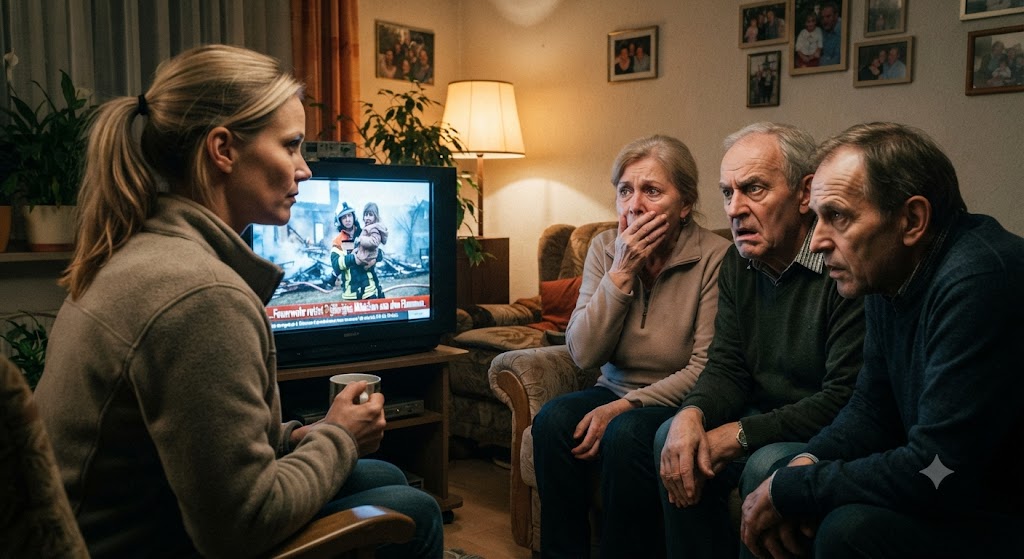
That night the local news showed the report. The grandparents had stated that Maisie panicked after reaching safety and ran back inside on her own. Then the station played the neighbor’s footage. The timestamp matched the emergency response.
The front door opened. Maisie stumbled onto the porch—already outside. She pointed toward the side of the house. Patricia seized both her shoulders and turned her back toward the doorway. Glenn stepped behind her and pushed. Maisie disappeared across the threshold. Glenn pulled the door almost closed as smoke rolled through the opening. Seconds later I appeared from the side yard with Owen beside me.
Patricia’s smile vanished. Glenn stood so quickly his chair struck the wall.
I left them with the television and returned to Maisie’s room.
We never went back to the house. The fire destroyed the kitchen and damaged the electrical system. Smoke and water reached nearly every room. Insurance and emergency aid covered a furnished apartment and immediate needs. Maisie’s STEM project was not among the recovered materials.
The first night the apartment’s smoke alarm flashed a green light above the hallway. Maisie stared at it until I covered the light with paper. When the building tested its alarms three days later, she crawled beneath the dining table. I sat on the floor several feet away and waited until she could hear my voice. I did not tell her she was safe. Safety was no longer a sentence I could prove. I told her where we were, which exit was closest, and that I was staying with her until the alarm stopped.
Owen recovered in his own apartment with Marcus helping him manage medication and follow-up visits. People at the nursery called him brave. A reporter asked whether he wanted to describe the rescue. He declined. “I do not want to prove I can go into fires. People will think I can do everything now. I still need help.”
The first Sunday after both of them were home, we met in the furnished apartment. Marcus came because the bus route had changed again. Maisie checked the clock twice. The third time Owen noticed. “My medicine is at seven. Marcus has an alarm.” He picked up his phone and called across the room. “Marcus, I need you to help me remember the medicine.”
Marcus raised the phone in acknowledgment.
Owen turned back to Maisie. “Your job is getting better. I picked an adult to help me.”
She looked at the unfinished car they were assembling from donated materials. “Can I still remind you about normal things?”
“If you want to, and if I want you to.”
“That sounds complicated.”
Owen nodded. “Being people is complicated.”
She laughed despite herself.
Over the following weeks the old system did not disappear all at once. It simply lost power each time one of us chose differently. Maisie returned to science club in April. She rebuilt the data she had lost and constructed a heavier model. In June she was offered a place in the district STEM presentation.
Owen came with Marcus and sat two rows behind me. Halfway through Maisie’s explanation someone dropped a metal display stand near the rear doors. The crash echoed. Owen covered one ear. His breathing changed. Maisie saw him. Her voice stopped. She looked ready to abandon the table.
I kept my hands in my lap. I did not signal for her to continue.
Owen raised two fingers toward Marcus. Together they moved toward the exit. Owen did not look back for Maisie.
She watched the door close behind them. Then she looked down at her model car. “The roughest surface produced the shortest stopping distance,” she continued, “but changing the weight also changed how much distance the car needed.”
Her voice shook on the first sentence. It steadied on the second. She finished the presentation and answered the judges’ questions.
When it was over we found Owen and Marcus in the hallway. Owen was sitting on a bench, breathing normally again. Maisie stopped in front of him.
“You left.”
“I needed outside.”
“I saw. Marcus helped.”
Owen looked toward the lecture hall where people were still gathered around her display. “I asked a grown-up for help.”
Maisie followed his gaze. “I know.”
For the first time she did not need to check.