
My Paralyzed Daughter Spoke After 3 Years—Then I Learned Who the Janitor Really Was
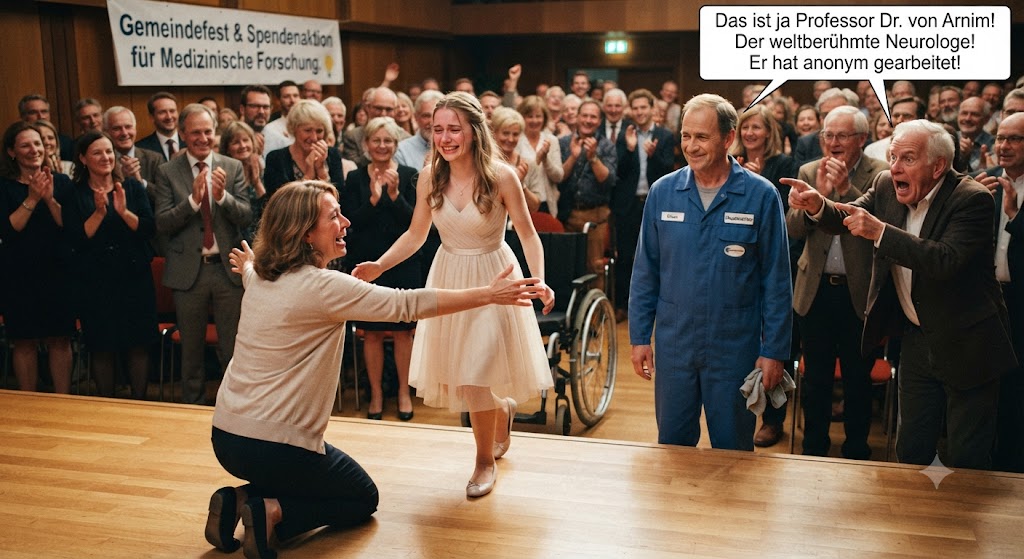
For three years my eleven-year-old daughter Maisie had lived in a wheelchair without speaking a single clear word—not to doctors, not to therapists, not even to me. Then one afternoon at her rehabilitation center she watched a janitor kneel beside a frightened child, wait for permission before touching him, and whispered, “He’s different.”
The room froze.
A few minutes earlier I had been answering for her. We were waiting in the pediatric rehabilitation lounge for Doctor Nina Patel. Maisie’s communication tablet sat mounted beside her chair. I held up her water bottle and asked whether she wanted apple juice or water. Her eyes moved toward the water icon, but not quickly enough for me.
“Water,” I said, tapping it for her. “You always want water after therapy.”
Maisie looked at me. The small tightening near her left eye meant irritation. After three years of studying every blink and breath, I told myself I was fluent in her silence.
Across the room a younger boy named Caleb sat in a molded wheelchair. When his elbow knocked his large red call switch to the floor, a therapy aide hurried over and reached under his arms. Caleb stiffened. His feet kicked.
“That’s making him scared,” I murmured.
Maisie’s eyes were already fixed on him.
Before I could call out, the janitor pushed his supply cart around the corner. I had seen him twice that week—gray at the temples, name patch that read Ray. He stopped when he saw Caleb struggling. The aide glanced over. “His switch rolled under there. I just need to lift him for a second.”
Ray set his mop handle against the wall. He did not reach for the boy. Instead he lowered himself until his face was level with Caleb’s.
“Can I move the cart?” he asked.
Caleb’s breathing stayed fast. Ray waited.
The aide shifted impatiently. “He can’t answer you.”
Ray did not look away. “Then I’ll give him time.”
He rested two fingers against the metal frame of his cart and tapped twice, paused, then tapped once more—longer than the first two. Tap. Tap. Silence. Tap.
Caleb’s eyes moved toward the cart.
Ray nodded as if the boy had spoken aloud. He rolled the cart aside, picked up the red switch, and placed it where Caleb could see it. “Can I put it back?”
Caleb blinked once. Only then did Ray attach the switch. He tested it, waited for Caleb to press it, and returned to his cart without correcting the aide or making a show of being right.
That was when Maisie spoke.
“He’s different.”
The words were faint and rough, more breath than voice, but they were words. Her words.
For one second I could not understand what I had heard. Then the water bottle slipped from my hand.
“Maisie—” I moved closer so fast my knee hit the footplate of her chair. “Say it again, sweetheart. Please.”
Her shoulders pulled inward. The sound was gone.
Doctor Patel appeared in the doorway. “Laura, stop.”
“Nina, she spoke. She said an entire sentence.”
“I believe you. Give her room.”
For the next twenty minutes no one asked her to speak again. Ray returned to wiping the far handrail, glancing toward Maisie without approaching.
Then his gaze dropped to her right foot.
“Her right foot,” he said. “I thought I saw her big toe move.”
I looked down. Maisie’s legs rested inside padded supports. I had watched those feet through years of tests. I had seen spasms, reflexes, and movement that meant nothing.
“It does that sometimes,” I said. “The doctors called it random.”
Ray nodded. “Maybe it was.” He turned slightly toward Maisie. “May I try something?”
I answered before she could. “Yes.”
Ray looked at me, not unkindly. “I asked her.”
Heat rose into my face. Doctor Patel brought Maisie’s tablet closer and opened the yes-and-no screen. “Maisie, Ray wants to make a sound on the cart again. Do you want him to try?”
Maisie stared at the screen. Five seconds passed, then ten. Every part of me wanted to tap yes for her. At last her gaze settled on the green square.
“Yes,” the tablet said.
Ray placed two fingers on the metal frame. Tap. Tap. A pause. Tap.
We waited. Nothing happened at first. Then, after several long seconds, Maisie’s right big toe moved inside her sock. Tiny. Barely more than a tremor.
Ray changed the pattern—one tap, a pause, then two quick taps. Nothing. He returned to the original rhythm. After the same long delay her toe moved again.
I gripped the back of her chair. “Maisie, move it for me. Move your toe for Mommy.”
The toe stayed still.
Ray stepped back. “She answered once. She needs to do it again so Doctor Patel can see.”
Doctor Patel was already watching Maisie’s face. “She is tired.”
“We have waited three years,” I said, sharper than I intended. Maisie flinched.
Ray’s voice remained quiet. “Ask her first.”
Doctor Patel positioned the tablet. “Do you want to try one more time?”
Maisie looked at the green square, then the red one. Finally she chose no.
No one tapped for her.
That night I positioned Maisie beside the kitchen table with warm tomato soup she barely touched. When I asked whether she wanted crackers, I caught myself before selecting the answer for her. The pause felt unnatural. Finally the device said “No.”
It should not have felt like an achievement to let my own child refuse crackers. I hated what that realization said about me.
The next morning Doctor Patel stopped all my fantasies before the formal evaluation began. “This test answers one question: can Maisie produce a repeatable response under controlled conditions? It does not tell us what recovery will look like.”
Sensors were attached over the muscles connected to Maisie’s right foot. Ray stood near the wall in clean work clothes. Doctor Patel faced him. “You will make the sound. Nothing else. No coaching, no touching, and no changing the timing unless I tell you.”
Maisie chose yes.
Ray tapped the original pattern. At thirteen seconds the monitor line changed and her big toe drew slightly inward.
They tried the second pattern. Nothing. They played no sound at all. No movement. They returned to the target rhythm. The signal returned.
“This appears to be a voluntary response,” Doctor Patel said at last.
Voluntary meant Maisie had chosen it. Voluntary meant the motion belonged to her.
I pressed both hands over my mouth. Maisie watched me, wary rather than joyful.
“I saw you,” I told her.
Doctor Patel removed the sensors. “It means we have a reliable signal worth studying. Our first goal is communication. If she can use this consistently, she gains another way to say yes, no, stop, or choose.”
By the end of that week Ray had become part of Maisie’s short assessment sessions—not as a therapist, but as the provider of a familiar cue. I was beginning to learn that my job was not to turn every response into a test of how much more my daughter could do.
I was not learning quickly enough.
On Thursday I had already written the number four at the top of a page in my notebook—the number of correct responses the day before. I wanted five. When Maisie selected “stop” after three successful attempts, the disappointment hit before I could hide it.
Ray noticed the notebook. He did not comment.
Later, when a metal tray crashed in the hallway, Maisie’s body jerked. Her breathing turned shallow and fast. Ray placed two fingers on the metal plate and gave the familiar rhythm. He waited. Her shoulders began to lower. Her next breath was deeper.
He had not commanded her to calm down. He had given her something predictable inside the noise.
That afternoon Maisie began building words on her tablet. The first one she fixed on was dark.
Ray’s hand slipped from the edge of the table. He looked at Maisie as if the word belonged to a place neither Nina nor I could see.
Doctor Patel stopped any questions about the accident during therapy. “We wait until she chooses to tell us.”
The word followed me home.
Then the center announced its annual community mobility showcase, which would also include a short remembrance for people affected by the highway accident three years earlier. Nearly four hundred guests had registered, including families, therapists, first responders, and road workers.
When Beth from community outreach mentioned the state road maintenance crews, Ray’s hand stopped halfway to his paper cup.
Maisie selected “participate” and then built a goal: walk to mom.
Doctor Patel was careful. “Exploring is not promising. Before any public attempt you would practice weight shifts and individual foot placements in private.”
Maisie agreed. When asked who she wanted near her, she selected one word: hand.
Ray’s fingers tightened around a chair. He left the room.
Later Nina told me privately that Ray might have been part of the highway crew at the accident. He was not certain, and she had not allowed that possibility to be placed in front of Maisie as a memory.
I demanded answers. Ray eventually told me he had worked road maintenance for the state. His crew had been near the accident. He had been at the scene before everything was cleared. He had called for help and stayed until emergency crews took over.
He would not interpret Maisie’s words. He would not tell me what she remembered.
I went to the roadside memorial with him and asked only about his actions. He answered carefully. When I pressed about the rhythm, he stopped me. “That question crosses into what happened with her.”
At the center, tension grew. During a private rehearsal Ray quietly said, “One sound at a time.” Maisie’s head turned toward him so fast the harness straps pulled tight. Recognition—or something like it—passed between them.
I followed him into the hallway and demanded the full truth. Maisie heard us from the doorway. She selected “both stop.”
Nina cancelled the next rehearsal. Maisie’s participation in the showcase was no longer confirmed.
For four days I did exactly what Maisie asked: nothing. No mention of the showcase. No questions about Ray. No notebooks on the table. Restraint was not the absence of care. It was care without a demand attached.
Then Maisie requested a meeting with Ray, Nina present, and me farther away. Ray apologized for deciding what would protect her without asking. He offered to tell her what he did that night if she ever wanted—nothing about what she felt or remembered.
She kept him near, not beside.
She also chose to restore the showcase goal, but on her terms: a shorter distance, only specific therapists allowed to touch her, no counting aloud, Ray near the aisle, no public mention of her new words or the accident. Success did not require a step. Success did not require standing.
I agreed.
On the day of the event nearly four hundred people filled the main hall. Maisie sat in the quiet room behind the stage in the yellow shirt she had chosen. When my name was announced I spoke about the years after the accident without claiming I remembered every part of that night.
Then Elena rolled Maisie into view. The applause made her shoulders tighten. Elena waited until the noise settled. Maisie selected yes. The support system lifted her. Her shoes settled against the floor.
I stood at the point she had marked during rehearsal—several feet away, well before the center of the floor. I wanted to encourage her. Instead I stood still.
Maisie shifted her weight. Her left foot slid forward less than an inch. Then again. The harness supported her. The braces stabilized her knees. Two therapists guarded each movement. None of that made the direction less hers.
When she reached the place she had chosen, she stopped. The space between us was still wide enough that I could not touch her without stepping forward. I stayed where I was.
Elena asked whether she wanted another step. Maisie declined.
I lowered myself until my face was level with hers. “You stopped where you chose.”
The hall erupted. I waited until Maisie selected yes before placing my hand on the side of her chair.
Then someone called Ray’s name. Across the hall, Owen Brooks—the former maintenance supervisor—turned sharply. He accepted the portable microphone.
“I haven’t seen this man in three years. He worked on my highway maintenance crew the night of the Mercer crash. Before the rescue crews could reach one side of that vehicle, Ray crawled into the damaged section himself. He stayed in there with the child for nearly twenty minutes. I heard him tapping on the metal while he watched for a response.”
Every face turned. The rhythm. Dark. Hand. Stayed. Maisie had not spoken because Ray possessed hidden medical knowledge. Her body had answered a signal it already knew.
Owen looked at Maisie. “That was you. You were the little girl.”
Maisie’s breathing became shallow. Someone still expected an answer. I could have asked the question that would have completed everything. Instead I stepped closer, blocking as much of the audience’s view as I could.
“Stay or leave?” I asked.
Maisie selected leave.
We left four hundred people waiting for an ending.
In the quiet corridor Ray stopped at a distance. “There is one thing I can tell you. It belongs to what I did, not to what she remembers.”
I looked at Maisie, then at Ray. “Not until she says you can.”
A week later Maisie agreed. Ray sat where she placed him—near, not beside—and told only what he had done.
His crew had been working east of the curve. They heard the impact. He ran. The rear section of the van had been pushed against the barrier. Rescue had not yet reached that side. He got in from the right. He found a little girl awake but unable to answer. Before he touched her hand he told her he was going to stay where she could see him. There was too much noise outside. On road crews, when machinery swallowed voices, he sometimes used a simple tapping pattern. That night he told her, “One sound at a time.”
He tapped twice, waited, tapped once longer. Her hand moved a little. He could not tell whether it was intentional, so he waited and tried again. She moved after the same pattern.
He kept using the rhythm—not to make her do anything, but so she would know he was still there. Emergency crews reached them about eighteen minutes after he checked the clock. He moved when they told him to move.
That was all.
He did not say he saved her. He did not describe her face or give us words she had never chosen. He left the inside of those eighteen minutes closed.
At home the two notebooks remained on the kitchen shelf. The blue one held Ray’s account. The gray one still held only what Maisie had permitted me to record. When people asked about the accident I stopped saying I had never left her side. I said there was a part I did not remember.
A few days later, in the library courtyard, Maisie guided my finger onto the padded armrest of her chair and tapped the familiar pattern herself. Then she built two sentences on her tablet.
He stayed.
You stayed.
The sentence did not forgive every mistake. It did not return the missing hours or promise she would ever tell me more. It gave each kind of staying its own truth.
Ray had remained for eighteen minutes when I could not. I had remained through the three years that followed. Neither truth needed to erase the other.
Maisie returned to my earlier question about going inside. I expected her to choose the courtyard. Instead she selected the library, then added that she wanted the elevator rather than the ramp because the sparrow had already taken the last crumb.
I laughed and moved behind her chair only after she selected yes.
The answer had taken longer than I expected, and it was not the answer I would have chosen for her.
I did not fill the pause.
I let it belong to her.


