
My Entire Family Refused to Attend My Daughter’s Final Birthday—So I Sent One File to 200 Donors
On Thursday the 8th of October, the seat belt lay too heavily across my daughter’s narrow shoulder. I reached over at a red light and eased it away from her collarbone, careful not to disturb the paper pharmacy bag tucked beside her. Elsie opened one eye.
“Mom, don’t drive like you’re carrying a wedding cake. I’m not. You stopped so gently a squirrel could have finished college in front of us.”
Her voice was thin, but the joke was still hers. I laughed because she wanted me to.
The hospital had not sent Elsie home because she was better. Her cancer had stopped responding to treatment. There were no more curative options. We were coming home so the time she had left could belong to her as much as possible.
I had spent the previous night trying to make our house ready without making it look like a place where a child was expected to die. I moved a lamp. I cleared a path between the couch and the bathroom. I placed the medical supplies in a cabinet where Elsie would not have to see them every time she looked up. The only thing I had hidden completely was the birthday box.
A palliative care nurse met us at the house, quietly reviewed what I should watch for, and left. When the front door clicked shut, the house became ours again.
Elsie looked around the living room. “Where are the paper lanterns?”
I kept folding the blanket the nurse had left behind. “What lanterns?”
“The ones in the birthday box. The orange and pink ones that look terrible together.”
“You’re tired, sweetheart. We can celebrate quietly.”
“That sounds like something adults say before they turn off all the lights and start whispering.”
I stopped folding. Her ninth birthday was two days away. I had packed the decorations into the hall closet after a doctor used the phrase “limited time.” I had convinced myself that protecting Elsie meant reducing everything around her—fewer people, fewer plans, fewer chances to be disappointed.
She had noticed anyway.
“I want a birthday,” she said. “Not a room where grown-ups talk softly because they think I’m asleep.”
I sat beside her. “Then we’ll have a birthday. A real one.”
She studied my face long enough to make sure I was not editing the truth into something easier. That was what I did for work. I edited educational materials from home, smoothing clumsy sentences until they sounded clear and harmless. I had also done it for my family most of my life.
Elsie pushed herself a little higher against the cushions. “I only want six people.” She counted them on her fingers. “Nana Linda. Grandpa Robert. Aunt Valerie. Uncle Owen. Uncle Nathan. Aunt Tessa.”
There was no seventh name. Elsie’s father had left when she was very young. She did not ask for him.
I opened our family group chat and typed slowly so I would not make the invitation sound optional.
Elsie wants a small birthday at home Saturday evening. She will probably only have a short window when she feels awake enough. Please be here by 6:00.
Valerie, my older sister, replied first. She was running communications for a charity gala supporting families caring for seriously ill children. The gala was the same night. “Of course. The gala is Saturday too, but we’ll all leave after the opening introductions.”
Mom answered next. “We’ll find a way to do both.”
Dad sent a red heart. Owen wrote that he would make sure Valerie stayed on schedule. Tessa asked what she should bring. Nathan replied last with a joke about candles and smoke detectors.
Elsie smiled when I read it aloud. I typed another message. 6:00 matters. She tires quickly now.
Valerie responded with a thumbs-up. Mom wrote, “We understand.”
Elsie leaned against me while I held the phone. “Maybe we should put their names on the chairs so nobody steals Grandpa’s seat. So nobody forgets where they belong.”
“They won’t forget,” I said. It came out with more certainty than anything in the group chat had earned.
The next morning Elsie had enough energy to sit at the kitchen table for twelve minutes at a time. We learned that because she made me set the timer.
“Twelve minutes of art,” she said, arranging six pieces of colored card stock in front of her. “Then twelve minutes of being tragically horizontal.”
The place cards were small enough to fit in her palm. She had chosen orange, pink, blue, and yellow sheets because no two colors looked as if they belonged together. When I suggested using one color for all six, she looked at me patiently.
“They’re different people, Mom.”
She started with Nana Linda’s card and added a tiny window in one corner because Nana was always cold. Grandpa Robert’s card received a crooked wrench—he had once repaired the wheel on her wooden train. Valerie’s name took the longest; Elsie erased the first attempt because one letter leaned too far right, then added a narrow gold border. “Aunt Valerie likes things professional.” Owen’s card had a star. Nathan’s name was deliberately misspelled with the wrong vowel circled in red. Tessa’s card received a tiny tooth with an enormous smile.
By the time all six cards were outlined, Elsie’s hand had begun to tremble. I helped her to the couch and photographed the cards for the family group chat.
Elsie made these herself. 6:00 tomorrow. She is counting on all of you.
No one mentioned a firm time.
That evening Valerie called. “The appeal is the center of the evening. We need the family together when we talk about Elsie.”
“You need six people on a stage more than Elsie needs six people at her table.”
“It’s what the schedule is doing.”
Mom joined the call. “Standing together is something practical we can do for her.”
“Being here is something practical.”
“You’re reducing this to one evening. It is her birthday and the gala could help families for years.”
I could have demanded arrival times. Instead I imagined six adults saying grief had made me controlling. I wanted them to choose her without being forced.
So I said, “Just be here as soon as you can.”
Valerie softened immediately. “We will.”
Later that night Valerie texted that the main appeal had been moved back thirty minutes. Please don’t promise Elsie an exact time. We’ll come as soon as the program allows.
The change meant they could not finish the appeal, drive the twenty-five minutes from the downtown hotel, and reach our house by six. They all knew it. No one challenged Valerie.
Elsie watched me from the couch. “Are they still coming?”
I looked at the six names written in her colored ink and made the promise they had refused to make.
“They’ll be here.”
Saturday morning Elsie woke before I did and tried to get out of bed without calling me. I found her sitting on the edge of the mattress waiting for the dizziness to pass.
“You could have asked for help,” I said.
“I was testing my legs and they need tutoring.”
I helped her into the soft pink shirt with tiny silver stars she had chosen. By the time she was dressed she needed to rest again.
While she slept I moved the dining table closer to the living room. I placed seven chairs around it—one for Elsie and six for the people whose names she had written. I left my own place beside her without a card. I covered the supply cabinet with the orange and pink paper lanterns.
At 4:30 Elsie woke and insisted on inspecting the table. She touched each place card in order.
My phone buzzed. Valerie wrote that the program was running behind. Nathan said they had not reached the family segment yet. Tessa wrote “soon.”
At 5:38 Valerie wrote in the family chat: Everyone needs to stay through the full appeal. The family image is the point that closes the story.
I typed back that the party began at six and asked Mom, Dad, Nathan, and Tessa to leave immediately. The hotel was only twenty-five minutes away.
Dad answered first. I can head over now.
Then Mom replied: If one person leaves, the family presentation won’t look complete. We agreed to stand together for Elsie.
Nathan wrote that he might leave right after the appeal. Tessa said they would come once the total was announced.
At six I lit the small candle because Elsie had begun rubbing her eyes.
“Shouldn’t we wait?” she asked.
“We can relight it. Ohio allows two lighting attempts.”
We sat together while the candle burned for a few seconds. Then I pinched it out.
At 6:12 Nathan wrote that the appeal was beginning. A public live-stream link appeared. I should not have opened it. Elsie asked whether the gala looked fancy, and I thought showing her a few seconds might make the waiting feel less personal.
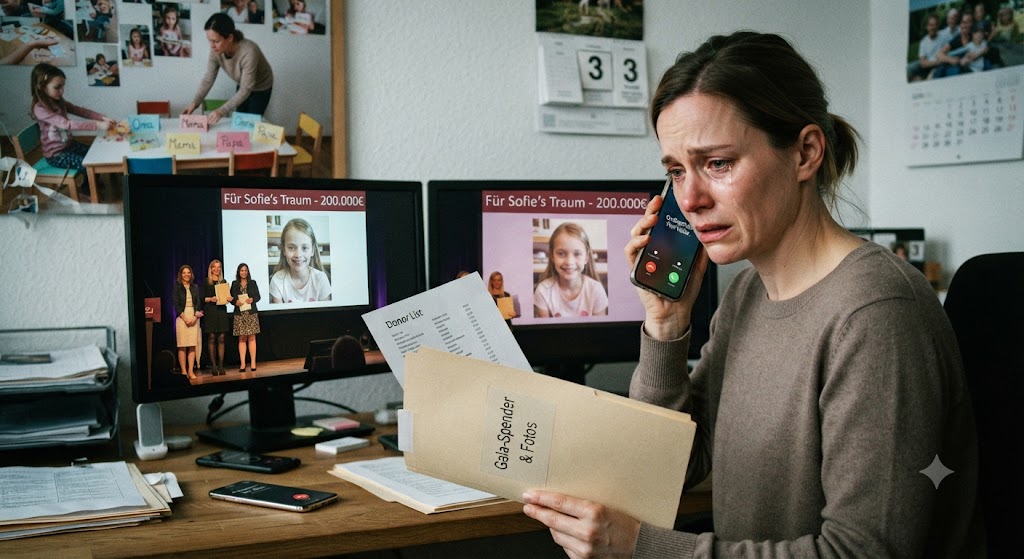
The hotel ballroom glowed in gold light. A large photograph of Elsie stood behind the stage—the portrait I had approved months earlier. Owen moved across the stage, guiding people into place. I watched Linda step beside Valerie. Robert stood at Linda’s other side. Nathan and Tessa joined them. Owen took the remaining position after checking the lighting.
All six.
Valerie approached the microphone and spoke about families standing together through the impossible. Behind her, Elsie’s photograph filled the screen. Beside her stood the six people Elsie had invited to sit at our table.
The room applauded.
My phone vibrated with a message from the family chat. The announced total had climbed quickly. Valerie wrote that they were close to $200,000 and asked everyone to remain in place until the number was confirmed.
I typed with both thumbs. Elsie is still awake. She is waiting for you.
Mom answered less than a minute later.
She won’t remember who came.
For a moment I heard nothing from the live stream. Not the applause, not Valerie’s voice, not the clink of glasses. I heard only the refrigerator humming behind me and Elsie breathing beside my shoulder.
No one moved.
On the live stream the number changed to $200,000. The ballroom erupted. Valerie covered her mouth with both hands. Linda hugged her. Robert smiled toward the audience. Nathan placed an arm around Tessa. Owen motioned for all six of them to face the camera beneath Elsie’s portrait.
A public photograph appeared online moments later. It showed my entire family standing together through the impossible.
At home the ice cream had begun to soften. The six chairs remained untouched.
I opened my mouth to tell Elsie the program had trapped them longer than expected. I had used versions of that sentence all my life. This time I stopped.
“They chose to stay there,” I said.
Elsie did not cry. She looked down at the cards she had made one by one as if checking whether she had written the wrong names. Then she glanced at the cake.
“Should we eat before the ice cream turns into soup?”
“Yes,” I said. “We should.”
She pointed to Linda’s place. “Can I have Nana’s part? She always says not to waste food.”
I cut the cake and gave Elsie a small piece from the side with the most orange dots. She rated the frosting seven out of ten because it looked better than it tasted. We watched twelve minutes of a movie about a talking dog that solved crimes badly. When she became tired I helped her back to the couch. Before she lay down she asked me to take a picture of the table.
“So I can remember the cards,” she said.
I photographed the six names and the cake between them. Elsie was not in the frame.
She fell asleep before 7:30. None of the chairs had been pulled away from the table, not even an inch.
Valerie sent a private message. The donors loved her story. We need to keep the momentum going.
I looked from her words to the six places my daughter had prepared. For the first time I did not try to explain my family to myself.
By Monday, exactly 200 donors and pledgers had opted in through the charity’s secure update channel. Because Valerie had assigned me as guest author, their replies appeared in my inbox. The first thanked our family for showing such strength. The second said the photograph of all six relatives together had brought the donor to tears. A third thanked everyone for surrounding sweet Elsie with love during her final birthday.
No one had surrounded Elsie. The six people in the photograph had surrounded a portrait.
Valerie drafted a response in my voice. It thanked our family for surrounding Elsie with love throughout her birthday weekend. It said the celebration had remained private because Elsie could not manage a crowded room. It described the gala as the family’s way of honoring her while supporting other children. At the bottom she placed my name.
Then she shared a folder and granted me editor access. Read everything before you decide to destroy this.
Inside I found a birthday draft created Friday afternoon—before the party—describing all six relatives gathered around Elsie’s table, sharing stories and laughter. Version history showed it had been edited Sunday morning and Monday afternoon. After everyone knew no one had come, the invented presence remained. Comments discussed framing the missing home photograph as a privacy choice I had made because Elsie was too tired.
Farther down were future scenes written in the past tense while Elsie was still alive. One described the morning after her death. Another left a blank for her last words, with three sample options already drafted.
I did not send the entire folder. I would not turn the most intimate parts of my daughter’s remaining life into material for strangers. Instead, with Elsie’s careful permission, I prepared one file.
I showed her the place cards. She allowed them. I asked about the photograph of the empty table. She allowed that. I asked about her face. “No,” she said immediately. “Not the tired ones. Not the hospital ones. Not anywhere people will look at me and feel sorry before they read.”
I asked about the private rating she had written on a scrap of paper after the birthday—cold pizza. “No. They won’t understand it.”
She gave me the shape of what I had to do. “You can tell the truth without telling them everything.”
The finished file was seven pages. It contained the original invitation and the replies. It contained my mother’s message: She won’t remember who came. It contained the photograph of the six place cards and the empty chairs. It contained one short redacted excerpt from the Friday draft claiming all six relatives had gathered at the table, and the timestamps proving the claim survived after reality changed. It contained one short excerpt from the future material written while Elsie was still alive. It ended with a request: do not share additional images, medical details, private statements, or future stories about Elsie. I was not asking anyone to withdraw support from families receiving help. I was asking that my living daughter no longer be presented through events that did not happen or words she did not say.
I pressed send.
The counter reached 200.
Replies began almost immediately. Who confirmed that all six relatives attended the birthday? Why was the paragraph about the family gathering still present in versions edited after the birthday? Who actually sat beside her that night?
Valerie demanded a retraction. She started a family group call. Mom repeated that I had restricted access. Dad, when asked whether he had sat in the chair with his name on it, answered, “No. I was not there.” Nathan admitted he had checked the time all night and chosen to stay. Tessa demanded her name be removed from every file that placed her in a room she had never entered. Owen paused every future post using Elsie’s image.
The shared story could no longer hold them together.
I turned off the sound on my phone. From the bedroom Elsie called my name.
“Did it stop?” she asked.
“The posts are down. They cannot use your picture again.”
“Can they still write tomorrow before it happens?”
I sat beside her and took her hand. “Not without you.”
Elsie died at home on Sunday the 25th of October. The room was quiet. I stayed beside her. It remained as private as she wanted it. There was no perfect final sentence. She did not give me instructions for the family, the donors, or the charity. She did not turn her last minutes into a lesson for anyone else. She was my daughter until the end.
Afterward Valerie asked whether the campaign could share one final photograph and a short statement from me. I refused both. I did not create a foundation in Elsie’s name. I did not become the public voice of grieving mothers. The support promised to other families continued without her face attached to it.
People sometimes asked what her final words were. I never answered.
There was also one ordinary morning during those last days when Elsie asked me to do something small and ridiculous. It was not brave, poetic, or suitable for a memorial. I did it badly and she laughed harder than her body could comfortably manage. My phone was lying within reach. I did not pick it up.
There is no photograph of that morning. There is no caption explaining why it mattered. No donor received it and no campaign was allowed to turn it into proof of anything.
Only I carry the whole memory. Its value has never depended on anyone else seeing it.


