
For My Daughter’s 6th Birthday, My In-Laws Sent Her a Cute Teddy Bear. I Looked at It and Went Pale.
Mia’s sixth birthday was supposed to be simple. Cupcakes, paper hats, three little girls shrieking in my living room like tiny opera singers raised entirely on glitter and spite. The problem with simple is that it requires your life to also be simple, and mine very much was not.
I was in the middle of divorcing Adam. The paperwork floated around like a bad smell. The tension was everywhere and nowhere, which is a difficult way to live when you’re trying to keep a six-year-old from noticing her world is being rearranged. So I compensated. I went full birthday mom. Streamers. Goodie bags. Cupcakes from scratch. I even invited the parents to stay, maybe out of guilt, maybe because I wanted witnesses in case I snapped and started eating frosting straight from the piping bag.
There were three friends that day—Mia’s best friends, which changed weekly. Their parents hovered with that awkward energy of people trying to be supportive without admitting they’d already asked their spouse, “So are Michelle and Adam… you know?” I smiled too much. I laughed too fast. Everything was fine. Mia was fine.
Then the mail came.
A neat pink box with a bow that looked measured and tied by someone who irons bed sheets. Janet and Frank. My in-laws. The type of people who believe presentation is character. There was a note taped to the top: For Mia. Open today. Of course they weren’t coming to this party. Mia was having another birthday with Adam a few days later—“Dad’s birthday,” as she called it.
We added the box to the pile. Kids opening presents is chaos in pure form. Mia ripped through stickers, squealed at a sparkly water bottle, held up a plastic unicorn like she’d discovered fire. Then she grabbed the pink box.
“This one is from Grandma and Grandpa,” she sang.
She opened it carefully, because Janet had taught her to be gentle—which sounds sweet until you realize “gentle” is just Janet’s word for obedient. Inside was a brown teddy bear with a little heart stitched on its chest. Mia’s whole face lit up. She loved stuffed animals. Anything soft and loyal and silent.
“Oh my gosh,” she whispered, hugging it like it had rescued her from a burning building.
The other girls crowded around. One of the dads said, “That bear is going to be her best friend.” I laughed the way you do when people say normal things at normal parties. Mia carried the bear off to play. The house went back to its usual birthday roar.
About twenty minutes later she appeared in the doorway, teddy bear in one arm, her little brow pinched the way it gets when she’s trying to do math.
“Mommy,” she called.
I turned, still mid-smile, performing “I’m fine” like it was my full-time job.
She stepped closer. She wasn’t crying. She wasn’t upset—just confused. Then she held up the teddy bear. There was a small opening near one of the seams, like a zipper hidden under fur. The kind you don’t notice unless you’re the kind of child who believes every object is a mystery waiting to be solved.
She squeezed the bear’s side and looked up at me. “Mommy,” she said very quietly. “What is it?”
Her voice did something to me, like a hand reaching inside my chest. I went still. I leaned in. My skin went cold.
Inside the bear, just barely visible through the opened seam, was something that definitely wasn’t stuffing. Something hard. Something not meant for a child’s toy.
My stomach dropped so fast I felt it in my knees. My first instinct was to shout, to demand, to call Janet and Frank and ask them what kind of deranged game they thought this was. But there were three little girls behind Mia. There were parents in my living room. There was a birthday cake with candles waiting to be lit. And there was Mia’s face looking at me like I was the final answer.
So I swallowed it. I made my voice soft.
“Oh,” I said, like she’d just shown me a loose button. “Let me see it for a second, sweetheart.”
Mia hesitated. “Is it broken?”
“No,” I lied. “I just want to check something.”
I took the teddy bear from her hands gently—so gently, like I was holding a bomb. “Go play. I’ll bring it right back.”
Mia nodded, because Mia is a good kid. Because Mia trusts me. Because Mia had no idea she’d just handed me the beginning of the end.
I walked down the hallway without rushing. Rushing would have made the parents look up, and I didn’t want questions. Not yet. I stepped into my bedroom—the room Adam and I used to share—and shut the door. My hands were shaking before I even realized I’d started breathing differently.
I sat on the edge of the bed with the bear in my lap and stared at that seam. Whatever this was, it wasn’t an accident. This bear wasn’t just a gift. It was a message.
I opened the seam a little more. My breath went thin. My face went pale. Outside the door I could hear the party—laughter, running feet, someone yelling about juice. In my lap a brown teddy bear sat like it was innocent.
It wasn’t.
I didn’t cry. I didn’t scream. I closed the seam, smoothed the fur, stood up, and put the bear somewhere safe where Mia couldn’t reach it. Then I looked in the mirror and practiced my smile like I was rehearsing for a play, because I still had a birthday party to finish and I wasn’t ready yet to let anyone see what had just changed.
I walked back out, served cake, sang happy birthday, clapped at the right moments. All the while one thought kept repeating: that teddy bear had already done its job, and I hadn’t even fully figured out what it was.
When the last guest left, I stood in the kitchen staring at a stack of paper plates. Mia was upstairs brushing her teeth, humming. She’d had a great day. I should have been relieved. Instead I felt like I’d run a marathon while carrying a secret in my mouth like broken glass.
Janet and Frank didn’t become my in-laws by accident. They came with Adam like a warranty you don’t read until it’s too late. When I first met him he was charming, funny, easy—the kind of man who could talk his way out of a speeding ticket and then convince you it was the officer’s fault. He wasn’t cruel. He wasn’t loud. He was slippery.
Money would disappear. Not dramatically. Just enough to make you double-check the account. A hundred here, two hundred there. He always had an explanation. Forgot to tell me about the car insurance. Grabbed groceries. Covered something at work. For a while I believed him, because that’s what you do when you love someone. You make their stories fit.
Janet and Frank were always around. Sunday dinners, random Tuesday visits, phone calls that started with “just checking in” and ended with “we’re worried about how you’re managing things.” They were obsessed with money the way some people are obsessed with morality. They’d ask questions that sounded casual but landed like inspections. How much are you putting away each month? What’s in your name versus Adam’s? If I hesitated, Janet would tilt her head and smile like I was a child hiding a report card. And Adam never stopped it. He’d nod along. “Mom’s just like that. She means well.” Sometimes he’d add, “Maybe they have a point.”
After Mia was born the money got worse. Adam started panicking about it like it was a personal insult. Staying out late. Taking calls in the garage. Online transactions that didn’t make sense. When I asked, he turned it into a fight about my tone, my timing, my trust issues. My trust issues weren’t imaginary. They were built slowly, brick by brick.
It took me longer than it should have to name it: gambling. Not a few bets with friends. Gambling in the way that makes money vanish and leaves behind nothing but excuses and debt. When I confronted him he swore it wasn’t that bad, wasn’t often, was under control. Janet and Frank’s response was not what you’d hope. They didn’t say “Adam, stop” or “Adam, get help.” They said things like “Michelle, you need to be more supportive.” “Money stress makes men do things.” “Maybe if you didn’t make him feel judged.” It was always somehow my fault. And Adam let them.
The final turning point came after my father died. He left me some money—not a fortune—and something else: a trust set aside for Mia. About $150,000. He trusted my judgment. It could be used for her if needed. But I didn’t want to touch it. I wanted to protect it like oxygen. College. A first apartment. A future where she didn’t have to start adulthood already behind.
Adam found out and the tone of our marriage changed overnight. First a suggestion: we could borrow a little. It’s for Mia anyway. Then sharper requests. A business opportunity. An urgent debt. I later learned those urgent situations were gambling losses he couldn’t admit out loud. When I refused, Janet and Frank cornered me at dinner. “A good mother uses every resource for her child.” “What’s the point of money if you won’t use it?” Adam sat there like a spectator at his own life.
That’s when I knew this wasn’t just about money. It was about control. And they wanted mine.
I filed for divorce. I offered 50/50 custody. I offered to split assets cleanly. I even offered to keep things peaceful around the inheritance. Adam acted like he agreed. We were almost settled. My lawyer, Angela Park—calm and sharp—said he hadn’t signed yet, but he played cooperative. I believed him because I wanted to. Because Mia deserved adults who could act like adults.
So when Janet and Frank mailed that bear and insisted it be opened early, part of me thought it was just them being them—a power move, a performance. I didn’t yet understand how far they were willing to go.
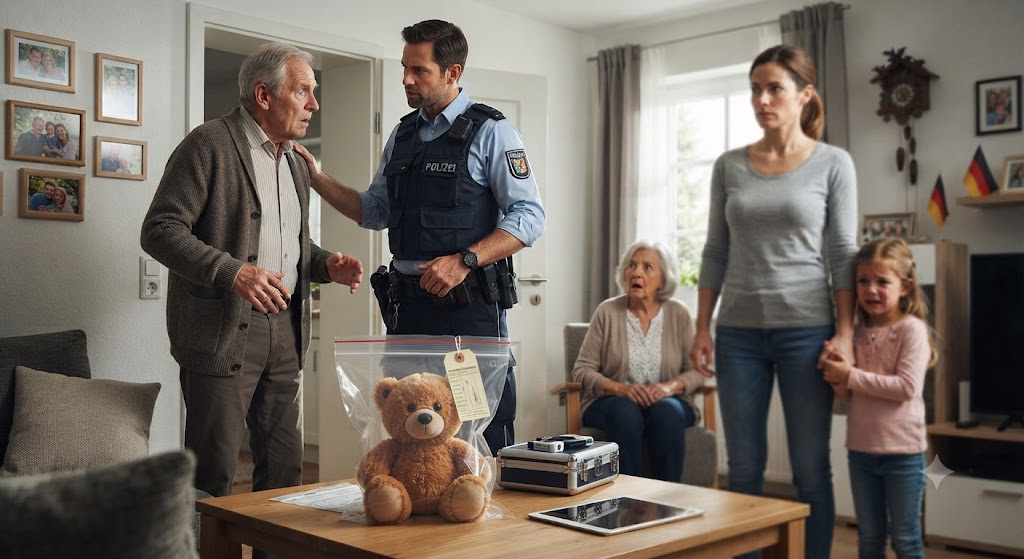
That night, after Mia was in bed, I opened the seam wider. Inside was a small device: hard plastic, wiring, something metallic. Not stuffing. Not a squeaker. I took pictures from every angle, then searched. The results didn’t feel real at first. A recording component. A location tracker.
They were trying to spy on us.
I put the bear back together as best I could, sealed it in a bag, and tucked it away. Then I sat in the dark thinking one simple thought: Adam is good with tech. Janet and Frank are good with guilt and control. But the tech was Adam’s.
The next morning I called Angela. I didn’t even try to sound casual.
“I need to see you.”
In her office I slid my phone across the desk. She studied the photos. Her eyes sharpened.
“Michelle,” she said very calmly, “this is serious.”
Then she told me something else. Adam had rejected the 50/50. He wanted full custody. He was alleging I was unstable. He was requesting control of decisions involving Mia’s finances and care.
There it was. The click. The reason. It wasn’t about Mia. Not really. Full custody meant access. Full custody meant a pathway to the only real money in this entire mess: Mia’s trust fund.
I had offered him fairness. He had answered by trying to wiretap my home and take my child.
Angela leaned forward. “Do you have evidence of his gambling?”
“Yes. Texts. Bank statements. Messages where he asked me to use the trust money.”
“Good. We’re going to need it. And this device—we need to treat it properly. File a police report. The device itself becomes evidence.”
I left her office with clarity. Adam hadn’t been playing fair. He’d been playing for keeps. And now so was I.
A few days later it was time for Mia’s second birthday—the one with Adam, the one with Janet and Frank hovering in the background. Every protective cell in my body screamed not to let her go. But I knew how it would look if I stopped it without proof. So I planned.
That morning I put a watch on Mia’s wrist. It looked like a normal kids’ watch—bright, simple. I crouched in front of her and kept my voice light.
“If you feel scared,” I said, brushing hair out of her face, “press this button. Sometimes grown-ups get mixed up. If you can’t find Daddy or you need me, you press it. Okay?”
Mia nodded. “Okay.”
Adam came to pick her up. He stood on my porch like a man who had rehearsed being harmless. He lifted Mia and spun her once like a normal dad. He handed me a slip of paper with an address and pickup instructions.
Then they were gone.
The hours crawled. When it was time to pick her up I drove to the address. It was a building, not a house. No cars I recognized. No music. No kids. No decorations. I called Adam. No answer. I texted. No reply. I walked the perimeter like a lost tourist. Slowly the rationalizations fell away and fear stepped forward.
Then my phone buzzed. An SOS alert. The location pinged: Janet and Frank’s house.
I drove fast but focused. I called the police while I drove, voice tight, factual. My daughter is six. I received an SOS from her watch. I went to the pickup point I was given and she wasn’t there. I can’t reach her father. I have her GPS location. Please send someone.
When I turned onto their street a patrol car was already there. I ran to the door. Before I could knock it opened and Mia burst out like she’d been held underwater. She ran straight into my arms and wrapped herself around me so tight her little fingers hurt.
“Grandma said you didn’t come,” she choked out. “She said you abandoned me.”
“I did come,” I said immediately. “I was there. I was looking for you.”
Behind her, Janet appeared with her hands clasped. “Oh, Michelle. This was all a misunderstanding.”
Frank stood behind her looking irritated, like my missing child was an inconvenience to his evening. An officer asked a few basic questions. Mia sniffled and repeated what she’d been told. Janet murmured that she’d been so emotional lately.
I didn’t argue on the porch. I lifted Mia into my arms and said, “We’re going home.”
Once we were inside I made hot chocolate—not because it fixes trauma, but because it gives small hands something warm to hold. I sat with her until her breathing slowed.
“I didn’t abandon you,” I told her quietly. “Never.”
Later, when she was asleep, I opened the watch app. There was an audio file attached to the SOS event. I pressed play.
Muffled fabric. A child’s breathing. Then Janet’s voice, clear enough to make my skin crawl.
“You see, your mommy didn’t come.”
Mia’s small voice: “She said she would.”
Janet again, softer now, like poison in honey: “Sometimes mommies say things and don’t mean them. You need to remember that.”
Frank in the background: “Stop crying. Big girls don’t cry.”
Then Janet’s voice again—this time not comfort. Instruction.
“If anyone asks, you tell them your mommy forgets things. You tell them she gets upset. You tell them she isn’t stable. You don’t have to like saying it. But it’s important. Daddy needs help. We need help. And your mommy… well, your mommy can’t take care of you the way we can.”
I stopped breathing.
This wasn’t a mistake. This was a plan.
I saved the file, backed it up, and sent it to Angela. Then I sat on the edge of my bed listening to the quiet house and thinking one cold, steady thought: they wanted proof. Now they’d given it to me.
Months later we had the hearing. By then it wasn’t one incident. It was a pattern. A teddy bear with a recorder and tracker inside it, sent by Janet and Frank, handled by Adam. A police report. A forensic result tying Adam to the device. And Mia’s SOS recording—my six-year-old’s voice trembling while adults coached her like she was a witness they could rewrite.
It wasn’t he-said-she-said anymore. It was their voices, their choices, their fingerprints.
The judge didn’t need me to be dramatic. I just had to tell the truth and hand over the evidence.
I got full custody. Adam got supervised visitation. On paper it was structured. In reality he barely used it. Every other week if he felt like it. Sometimes less. Sometimes he’d cancel last minute, like fatherhood was an optional subscription. Janet and Frank disappeared from our lives completely. Mia didn’t ask about them anymore. Not after that day. Not after the lies. Not after the feeling of being turned into a pawn and realizing it. Kids don’t always have the words for betrayal. They just stop reaching for the people who did it.
And financially—God, financially—I could finally breathe. My salary stayed in my household. No more money vanishing. No more emergencies that always required my sacrifice. Mia’s trust fund stayed untouched and invested. One hundred and fifty thousand dollars sitting exactly where it belonged: in her future, not in someone else’s appetite.
Sometimes late at night I think about how close I came to playing nice right into a trap. And then I look at my daughter—safe, sleeping, steady—and I know I didn’t go too far.
I went exactly far enough.


