
“We have all decided you don’t live here anymore,” my mom said. Leaving my daughter alone outside…
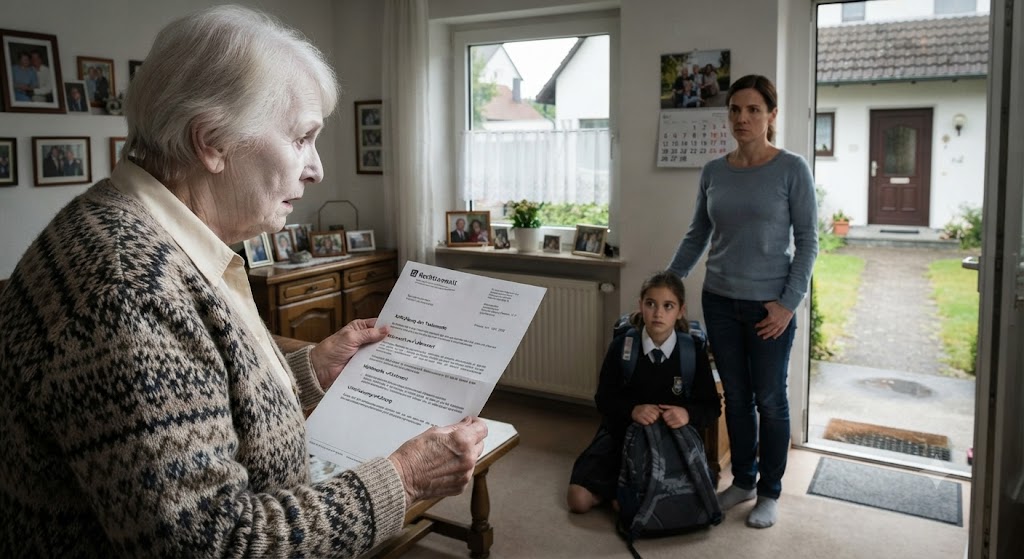
The words came out of my mother’s mouth like they had been rehearsed.
“We have all decided you don’t live here anymore.”
I was standing in the hallway of the house I had grown up in, holding a half-folded laundry basket against my hip. My daughter, Sophie, was five. She was in the backyard with her small pink backpack, waiting for me to come get her so we could walk to the park like we did every Saturday morning. I could see the top of her head through the kitchen window. She was sitting on the low brick wall near the gate, swinging her legs, talking to herself the way she always did when she was waiting.
I turned back to my mother.
“What did you just say?”
She didn’t repeat it. She didn’t need to. My father stood behind her with his arms crossed. My older sister, Rachel, leaned against the doorway to the living room, phone in her hand like she was ready to document whatever happened next. My brother-in-law hovered near the stairs, looking anywhere but at me.
“You’ve had months,” my mother said. Her voice was calm in the way people sound when they have already finished the argument in their heads. “We’ve been patient. We’ve given you space. We’ve paid for things. We’ve watched Sophie. And nothing has changed. You still don’t have a stable plan. You still don’t have a real job. You still bring the same problems into this house.”
I set the laundry basket down carefully.
“I have a job,” I said. “It’s part-time while I finish the certification. You know that. You said it was fine.”
“It was fine when it looked temporary,” Rachel cut in. “It’s been almost a year. Sophie needs routine. She needs a real home. Not this… temporary arrangement that never ends.”
Temporary arrangement. That was what they had started calling the fact that I lived in the house I had grown up in after my marriage ended and the apartment fell through.
Sophie had been two when her father left. He didn’t leave with a dramatic fight. He left with a text and a forwarded email from a lawyer. I had moved back home because the alternative was a shelter waitlist and a five-year-old who still woke up asking if Daddy was coming to breakfast. My parents had said yes. They had said family helps family. They had said of course.
For a while it worked. I took every shift I could get. I enrolled in the medical coding program that was supposed to turn the part-time hours into something that could actually support us. I cooked. I cleaned. I kept Sophie quiet when my father’s headaches were bad. I made myself small in the ways adult children do when they are living under someone else’s roof again.
But smallness has a way of becoming permanent if you let it.
The first real crack came when Sophie started kindergarten and needed after-school care on the days I had class. My mother said she could watch her “for a bit.” Then “for a bit” became an expectation, and the expectation became resentment. Rachel started making comments about how Sophie was always here, how the house never felt like it belonged to just them anymore. My father began referring to my room as “the guest room” again.
I tried to move faster. I applied for apartments I couldn’t quite afford yet. I picked up extra evening shifts. I kept telling myself that if I just held on a little longer, the certification would come through and I could leave with my head up.
I didn’t realize they had already held a family meeting without me.
“We’ve discussed it,” my mother said that morning. “All of us. It’s time. You need to find somewhere else. Today.”
Today.
I looked past her toward the kitchen window. Sophie was still on the brick wall. She had taken her backpack off and set it beside her. She was arranging small stones in a line on the wall the way she did when she was inventing a game.
“Sophie is outside,” I said.
“She’ll be fine for a few minutes,” my mother replied. “We’re not monsters. We’re trying to do what’s best for everyone.”
Rachel stepped closer. “You can take what fits in your car. We’ll box the rest and you can come get it once you have a place. We’re not throwing your things away.”
The generosity of people who have already decided you are leaving is a particular kind of cruelty. It sounds reasonable. It photographs well. It lets them tell themselves they were fair.
I felt something cold move through my chest.
“You’re putting us out,” I said. “On a Saturday morning. With no notice. While my daughter is sitting outside waiting for me.”
My father’s jaw tightened. “Don’t make this dramatic. You’ve known this was coming.”
I hadn’t. Not like this. Not with the door already closing behind the words.
I walked past them into the kitchen. Through the window I could still see Sophie. She had started humming. The gate was closed. The yard was fenced. She was safe for the moment. That was the only thing keeping me from screaming.
I turned back.
“I’m taking Sophie and I’m leaving,” I said. “Right now. You don’t get to keep her here while you decide what happens to me.”
My mother’s expression flickered. “No one is keeping her. We’re simply saying—”
“You’re saying I don’t live here anymore. That means she doesn’t either. She goes with me.”
Rachel made a small sound of impatience. “You’re being difficult. This doesn’t have to be a scene.”
I went upstairs without answering. My hands were steady while I pulled the two duffel bags from under the bed. I had packed them weeks earlier without fully admitting why—clothes for Sophie, clothes for me, her favorite stuffed rabbit, the folder with her birth certificate and the immunization records and the custody papers that still listed me as the only parent with physical custody. I had told myself it was just in case of an emergency. I had not expected the emergency to be my own mother standing in the hallway announcing that a vote had been taken.
I carried the bags down. No one tried to stop me. That was its own kind of answer.
In the kitchen I grabbed Sophie’s jacket from the hook and the small cooler bag with her snacks. My mother watched from the doorway.
“You’re going to regret making this uglier than it needs to be,” she said.
I looked at her. Really looked. At the woman who had once stayed up with me when I had night terrors. At the woman who had driven me to every appointment when I was pregnant and terrified. At the woman who was now telling me, in the calm voice of someone completing a chore, that I no longer lived in the only place my daughter had ever called home.
“I’m not the one leaving a five-year-old outside while I end her housing,” I said.
Then I opened the back door.
Sophie looked up and smiled the second she saw me. The smile was pure and unguarded the way only a child’s can be when she still believes the adults around her are on the same side.
“Mommy! I made a stone path. It’s for the ants so they don’t get lost.”
“It’s a good path,” I said. My voice came out almost normal. “Come on, baby. We’re going to the car.”
She hopped down. “To the park?”
“Not today. We’re going for a drive.”
She accepted that the way children accept sudden changes when they trust the person making them. She picked up her backpack and reached for my hand. I took it. Her fingers were cool from the morning air.
We walked around the side of the house to the driveway. No one followed us outside. No one called Sophie’s name. No one offered to help carry a bag or ask where we would go. The front door stayed closed.
I buckled her into her car seat. She was still holding the stuffed rabbit. She looked at the house through the window.
“Is Nana coming?”
“Not right now.”
“Is Grandpa mad?”
“I don’t know.”
She considered that. “Did I do something?”
The question landed the way it always did—straight and clean and worse than almost anything else.
“No,” I said. I made sure she was looking at me. “You didn’t do anything. This is a grown-up problem. It’s not yours.”
She nodded, but her eyes stayed on the house a second longer.
I got into the driver’s seat. My hands were shaking now that she couldn’t see them. I started the car and pulled out of the driveway. In the rearview mirror the house looked exactly as it always had—tidy lawn, clean porch, the kind of place people drive past and assume is full of ordinary family life.
Sophie hummed in the back seat for a few minutes. Then she said, “Mommy, where are we going to sleep?”
I had been asking myself the same question since the hallway.
“We’re going to figure it out,” I said. “You and me. That’s what we do.”
I drove to the library first because it was open and quiet and had a bathroom and chairs that didn’t require buying anything. I sat at a table near the children’s section while Sophie looked at picture books. I opened my phone and started making the calls I had been postponing for months—friends, a former coworker, the women’s resource center number I had saved and never used. Most people were kind. Kindness and a spare bedroom are not the same thing. By early afternoon I had a temporary answer: a former classmate had a basement room she would let us use for two weeks while I sorted the rest. It wasn’t home. It had a door that locked and a bed that fit both of us if we curled carefully. That was enough for the night.
We ate grilled cheese in the library café because Sophie said the ants on her stone path had made her hungry. She talked about kindergarten and a boy who always stole the blue markers. She did not ask about Nana again that afternoon. Children are good at reading the temperature of a room. She had felt the drop.
That night, after she fell asleep on the narrow basement bed with her rabbit under one arm, I sat on the floor with my back against the wall and finally let myself feel the full weight of what had happened. Not the practical part—the bags, the temporary room, the certification still three weeks from completion. The other part. The part where my mother had looked at me and said the family had decided I no longer lived there, and then left my daughter sitting alone outside while the decision was delivered.
I thought about every time I had swallowed a comment. Every time I had cleaned the kitchen before anyone could complain. Every time I had said “thank you” for help that came with conditions I was only now seeing clearly. I thought about the way Rachel had held her phone, ready. I thought about my father’s silence.
Then I thought about Sophie’s voice asking if she had done something.
I opened the notes app on my phone and began writing everything down while it was still sharp—the exact words, the order of events, the fact that Sophie had been outside alone when they chose to end our housing. I wasn’t sure yet what I would need it for. I only knew that memory has a way of softening when the people who hurt you start explaining themselves later.
In the morning Sophie woke up and looked around the unfamiliar room with the careful interest of a child who has already learned that places can change without warning.
“Is this our new house?” she asked.
“For a little while,” I said. “Then we’ll find a better one. Just us.”
She sat up, rabbit in her lap. “Can we still make stone paths?”
“We can make stone paths anywhere.”
She seemed to accept that. Children often do when the person they trust stays steady.
Over the next weeks the practical pieces moved slowly into place. The certification came through. The part-time hours became full-time. I found a small one-bedroom that would take a mother and child with limited credit and a letter from the resource center. It was nothing special. The kitchen was narrow and the bedroom barely fit a twin bed and a mattress on the floor for me. But the lease had my name on it. The door locked. No one could vote me out of it in a hallway conversation.
My mother called three times. I let the first two go to voicemail. On the third I answered.
“I hope you’re not going to be dramatic about this forever,” she said. “We did what was best. Sophie needs stability.”
“She had stability,” I said. “You removed it.”
“That’s not fair.”
“You left her sitting outside while you told me I didn’t live there anymore. That’s what happened. I’m not interested in the version where it was something else.”
She started to explain. I listened for thirty seconds and then ended the call. Some conversations only exist to make the other person feel better about what they already did. I was done carrying that weight.
Rachel sent a long text about how I had always been difficult and how the family was tired of walking on eggshells. I didn’t reply. My father never called. That silence said enough.
Sophie asked about them less and less. When she did, I told her the truth in words a five-year-old could hold: Nana and Grandpa decided we needed our own house. We have one now. It’s small but it’s ours. She would nod and go back to whatever she was doing. Sometimes she still arranged stones in careful lines on the apartment balcony. I never told her to stop.
Months later, on an ordinary Tuesday evening, Sophie was coloring at the little table we had found at a thrift store. I was heating leftover pasta. The apartment smelled like tomato sauce and the cheap candle I burned to make the place feel less temporary. Sophie looked up.
“Mommy,” she said, “are we still a family even if it’s just us?”
I turned off the burner and sat down across from her.
“Yes,” I said. “We’re the whole family. You and me. That’s enough.”
She studied my face the way she did when she was checking whether I meant it. Then she smiled—small, certain—and went back to her coloring.
Outside, the evening was ordinary. Cars passed. Someone laughed on the sidewalk. Inside, the room was quiet in the way rooms are when no one is waiting for permission to stay.
I watched my daughter color a sky that had too many stars in it and thought about the morning she had waited on the brick wall, swinging her legs, believing I would come get her.
I had.
I always would.
And this time, no one else got a vote.


