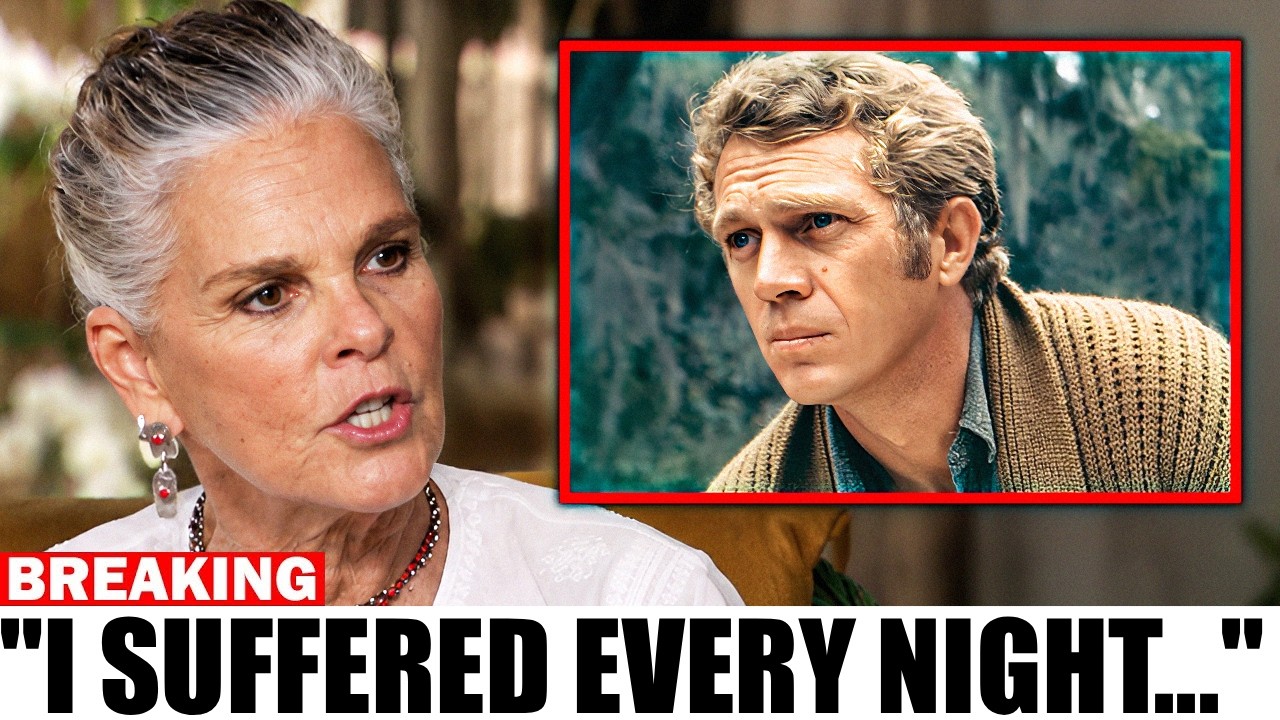
The love story that captivated Hollywood was built on a foundation of broken trust, and decades later, the wounds remain unhealed. Ali MacGraw and Steve McQueen appeared to have it all — fame, fortune, and an undeniable chemistry that lit up both the screen and the gossip columns. But behind the glamorous facade of their Malibu home, their marriage was quietly deteriorating under the weight of betrayal, control, and emotional devastation that neither of them could escape.
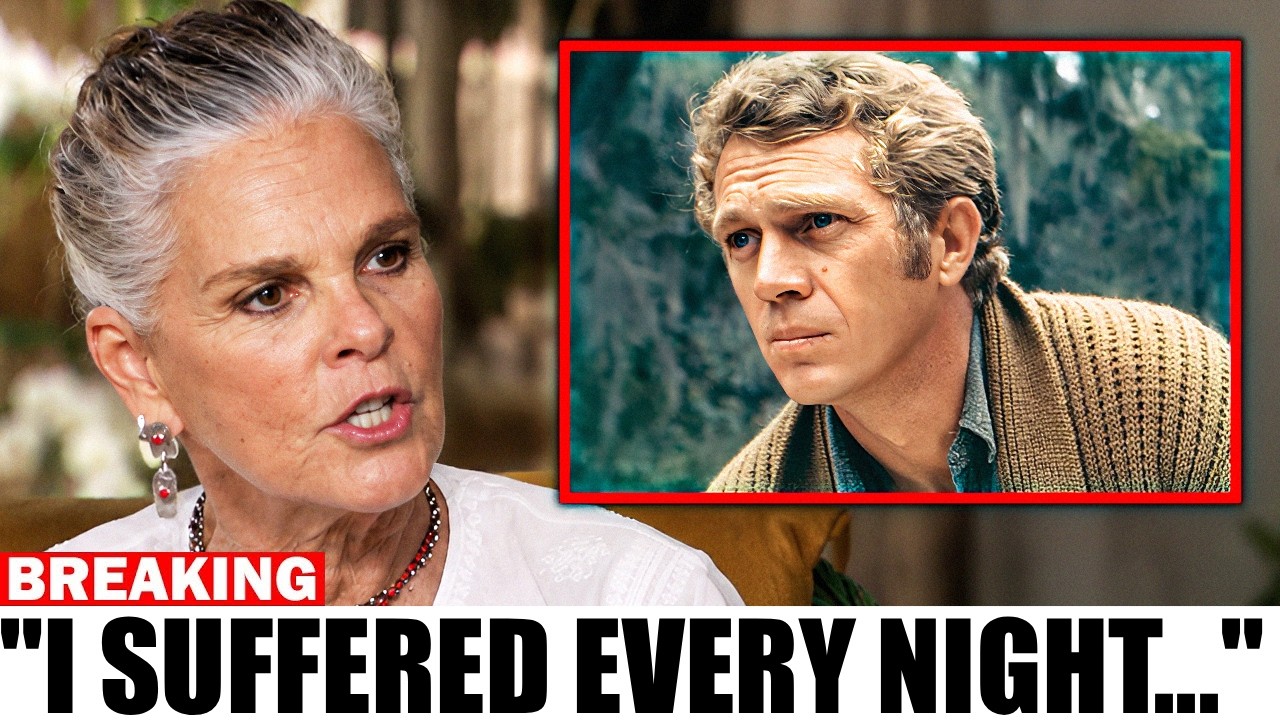
Their relationship ignited with explosive passion on the set of The Getaway in 1972. Both were married to other people at the time. Both understood the risks of crossing that line.
Neither could stop themselves from falling headfirst into an affair that would dismantle two marriages and redefine both of their public images forever.
What followed was a whirlwind romance that captivated the world, a 1973 wedding that seemed to seal their status as Hollywood royalty, and a slow, agonizing collapse that left MacGraw questioning everything she had sacrificed for the love of a man who could never fully commit to her.
Now, new details emerging about the inner workings of their marriage reveal just how deeply Steve McQueen’s betrayals cut into Ali MacGraw’s spirit — and why she could never truly forgive him for the pain he left behind.
To understand the depth of their connection and the devastation of its unraveling, one must first understand who these two stars were before they collided. Ali MacGraw, born Elizabeth Alice MacGraw on April 1st, 1939, in Pound Ridge, New York, grew up surrounded by creativity.
Her mother Frances worked as a commercial artist while her father Richard painted and taught. Art, beauty, and self-expression were woven into her childhood. But this creative upbringing was not without turbulence.
Her father’s difficult and unpredictable personality created tension at home, and the family faced constant financial struggles.
These early experiences shaped MacGraw into someone deeply attuned to the emotions of others — a quality that would later make her both a compelling actress and someone vulnerable to the intense emotional demands of a man like Steve McQueen.
After attending Wellesley College, MacGraw moved into the fashion world, working at Harper’s Bazaar before becoming a successful model. Her intelligence and natural elegance set her apart from the typical models of her era, and her calm confidence opened doors that would eventually lead her to Hollywood.
Her marriage to powerful Paramount producer Robert Evans in 1969 helped accelerate her career in ways she could never have achieved alone. Evans believed in her potential as an actress and opened doors that led to her breakthrough performance in 1969’s Goodbye, Columbus, which earned her a Golden Globe Award for Most Promising Female Newcomer.
Then came Love Story in 1970, the film that transformed her into an international sensation. Her portrayal of Jenny Cavalleri resonated deeply with audiences around the world, establishing her as a new kind of Hollywood actress — graceful, intelligent, and emotionally authentic. She represented a fresh image of fame, one that felt both glamorous and deeply relatable.

Steve McQueen’s journey to stardom could not have been more different. Born Terence Steven McQueen on March 24th, 1930, in Beech Grove, Indiana, his childhood was marked by abandonment and instability. His father left when Steve was young, and his mother Julian struggled with alcoholism, leaving young Steve to be passed between relatives and grandparents.
This constant upheaval bred deep-seated anger, defensiveness, and an inability to trust anyone. He learned early that relying on others led to disappointment. These wounds would define his personality, his relationships, and his approach to love for the rest of his life.
At 17, McQueen joined the Marine Corps, where the structure he desperately needed gave him discipline and purpose. After leaving the military, he discovered acting and studied at the prestigious Actors Studio in New York, developing the intense, minimalistic style that would become his trademark.
Television brought him his first taste of fame with Wanted: Dead or Alive, and then came films that cemented his status as the king of cool — The Magnificent Seven, The Great Escape, Bullitt, and The Thomas Crown Affair. His characters were calm, rebellious, and independent, and his genuine love of speed and racing made him feel authentic and untouchable.
When Ali MacGraw and Steve McQueen came together on the set of The Getaway, the chemistry was impossible to deny — for the actors and for everyone watching. But that chemistry came at an enormous cost. MacGraw was married to Robert Evans, the man who had championed her career and helped make her a star.
McQueen was married to Neile Adams, his wife since 1956 and the mother of his two children.
The affair that erupted on set was devastating for both of their spouses. Evans was publicly humiliated, having helped bring MacGraw and McQueen together in the first place, believing the film would expand her range. Instead, it destroyed his marriage.
The media reaction was especially brutal for MacGraw. Her carefully crafted innocent image, born from Love Story, was now being replaced with headlines questioning her character. She went from being America’s sweetheart to being judged for turning her back on the man who had supported her rise to fame.
McQueen, by contrast, was largely shielded from criticism. His rebellious bad-boy image meant that fans expected this behavior from him. The double standard was glaring, and MacGraw bore the weight of public scorn while McQueen continued on largely untouched.

Despite the backlash, MacGraw was convinced their connection was real. She believed that what she felt for McQueen was deeper than fleeting excitement. She left Evans, married McQueen in 1973, and moved into his world fully committed to making their life together succeed.
But the reality of their marriage was far from the fairy tale the public imagined. They settled in Trancas Beach, Malibu, a quiet and private location that matched McQueen’s desire to escape Hollywood’s social scene. He wanted a life focused on cars, motorcycles, and solitude — not premieres, parties, and industry obligations.
MacGraw was willing to embrace that life at first. She stepped away from acting, stopped pursuing new roles, and became focused on building their home. She told herself this was what she wanted.
She was deeply in love and believed that creating a peaceful home was the key to their happiness.
But slowly, painfully, she began to disappear. The independent, successful woman who had won a Golden Globe and starred in one of the most beloved films of the decade was now known only as Steve McQueen’s wife. The creative fulfillment she once had was gone, and the void it left inside her grew with each passing year.
She tried to adjust to his lifestyle. She cooked, kept their home, and organized her life around his needs and his moods. But McQueen was emotionally closed off in ways that made deep connection nearly impossible.
He struggled with vulnerability and never fully allowed her into the parts of himself that remained locked away since childhood.
The more MacGraw tried to reach him, the more isolated she felt. She began changing her behavior to avoid conflict, constantly walking on eggshells to keep the peace. She was living with a man who was physically present but emotionally unreachable, and the loneliness of that existence was destroying her piece by piece.
The infidelity that had plagued McQueen’s first marriage was also present in his marriage to MacGraw. He had never been faithful to Neile Adams, and despite the intensity of his love for MacGraw, he continued the same patterns. Affairs and rumors of affairs circulated throughout Hollywood, and the news inevitably reached her.
The betrayal was not just about the sexual infidelity — it was about everything MacGraw had given up to build this life with him. She had sacrificed her career, her independence, and her identity, and he was still choosing behavior that showed a lack of respect for what she had sacrificed.
 When she tried to confront him, he became defensive. He did not want to discuss his behavior. He avoided difficult conversations, retreated emotionally, and let the arguments fester.
MacGraw was left to deal with the pain alone, without any resolution or acknowledgement of the damage being done.
The 1970s party culture only made things worse. Hollywood in that era was defined by excess — late nights, heavy substance use, and constant temptation. McQueen’s already intense lifestyle became more chaotic, and his moods became more unpredictable.
MacGraw felt like she was losing the man she had fallen in love with to something she could not understand or fight.
Their arguments became more frequent. The same issues — his infidelity, his jealousy, his need for control, his refusal to address their problems — kept resurfacing without any meaningful resolution. Trust between them had been shattered so thoroughly that MacGraw no longer felt any security in their relationship.
By the late 1970s, MacGraw realized she had a choice to make. She could continue losing herself in a marriage that was steadily draining her spirit, or she could leave. She had already sacrificed so much, and she was beginning to understand that staying meant losing even more of who she was.
In 1978, their divorce was finalized. The end of their marriage made headlines around the world, but the headlines could not capture the complexity of what had happened between them. The public wanted answers, but the answers were deeply personal and painful — and MacGraw carried that pain with her.
McQueen was diagnosed with mesothelioma in 1979, a rare form of cancer linked to asbestos exposure that likely occurred years earlier, possibly during his time in the military or on film sets. He responded as he had to so many challenges in his life — by fighting desperately, refusing to accept the prognosis.
He pursued controversial alternative treatments in Mexico and remained determined that he could somehow survive. But the disease was aggressive, and on November 7th, 1980, Steve McQueen died in Ciudad Juarez, Mexico, at just 50 years old.
When MacGraw learned of his illness and his death, she was profoundly shaken. The years of pain, betrayal, and heartbreak could not erase the genuine love they had once shared or the importance he had in her life. He was both the source of her greatest joy and her deepest wounds, and his death left her with complicated emotions that would never fully resolve.
Steve McQueen was someone Ali MacGraw could never completely forget — and the pain he caused her was something she could never entirely forgive. Their love was real, but so was the damage. And years later, the question of forgiveness continues to haunt their story, a reminder that even the most passionate love can leave scars that never fully heal.