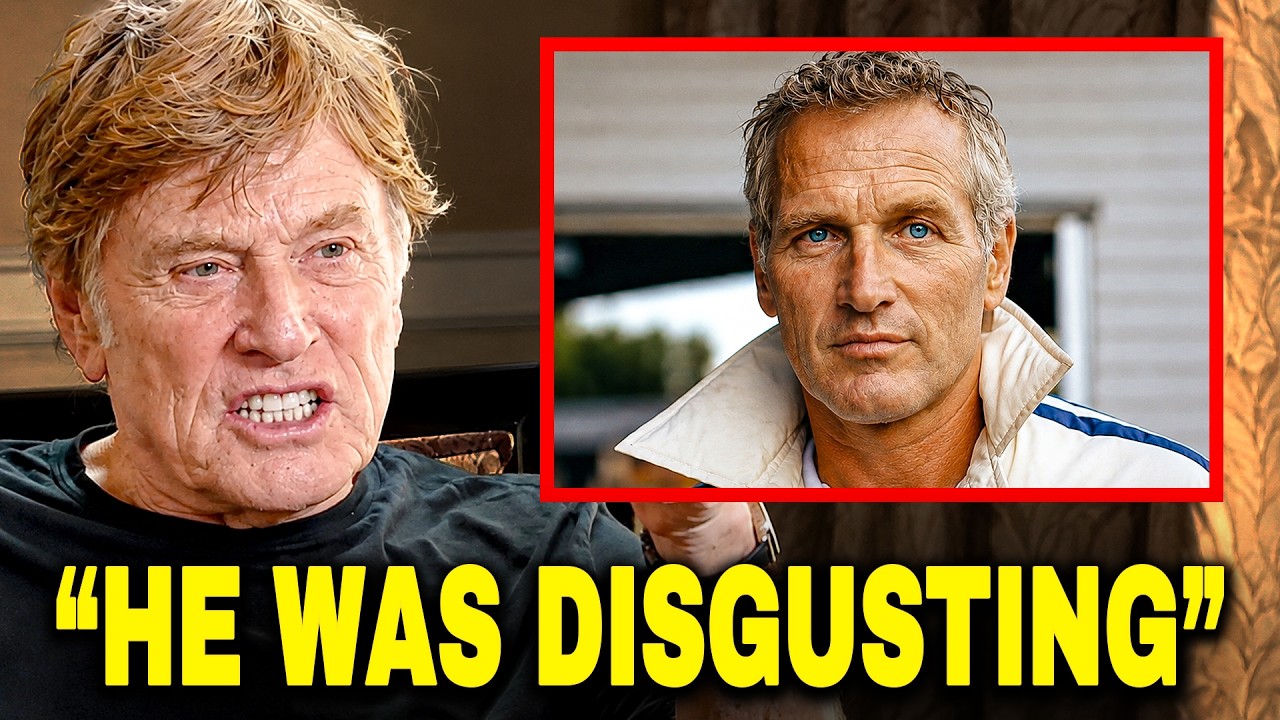
Robert Redford has finally broken his decades-long silence about his relationship with the late Paul Newman, and the truth is far more complicated than the golden-boy brotherhood fans believed. In a candid new interview, the 88-year-old actor revealed that the studio behind their iconic 1969 film “Butch Cassidy and the Sundance Kid” actively tried to keep him out of the role that would define his career.
“The studio did not want me,” Redford said, his voice carrying the weight of five decades of unspoken frustration. “They tried everything to really keep me from being in the film because they felt that I would never write, that I was not of an equal stature to Paul Newman.”
 The admission shatters the polished narrative that has surrounded Hollywood’s most celebrated screen partnership. For over 50 years, Redford and Newman were portrayed as effortless friends whose on-screen chemistry mirrored a perfect off-screen bond. But behind the laughter and legendary performances, Redford now says there were hidden rivalries, fierce power struggles, and heartbreaking regrets that neither man ever discussed publicly.
The revelation comes as a bombshell to an industry that has long romanticized the duo’s work together. Newman, already a global superstar when “Butch Cassidy” was being cast, had to fight the studio to bring Redford on board. According to Redford, Newman insisted on working with a real actor rather than a pretty face, telling executives, “I want to work with an actor.”
That single demand changed the course of cinema history.
But the cracks in their relationship were deeper than fans ever imagined. Redford admitted that the competitive dynamic between them was intense, with both men pushing each other to deliver better performances. “It wasn’t driven by jealousy,” he explained, “but by mutual respect and an unspoken determination never to disappoint the other.”
Yet that very respect masked a painful truth: Redford spent years feeling insecure about his place alongside Newman’s towering legacy.
The studio’s initial rejection left a lasting scar. Redford revealed that he was acutely aware of the power imbalance from the very beginning. Newman was already one of the biggest stars in the world, carrying years of experience and undeniable charisma.
Redford, on the other hand, was the rising talent many believed would become Hollywood’s next leading man. Instead of competing for attention on screen, the two seemed to complement each other perfectly. But off screen, the dynamic was far more complex.
“Success has a way of bringing people together, but it also has a way of exposing insecurities, creating unspoken expectations, and testing even the strongest friendships,” Redford said. While fans celebrated what looked like Hollywood’s ultimate brotherhood, cracks were forming beneath the surface. Cracks that would remain hidden until now.
 The breaking news comes as a shock to millions who grew up watching the duo in classics like “Butch Cassidy and the Sundance Kid” and “The Sting.” Their chemistry was so natural that audiences believed they had been friends for years. But Redford now reveals that the friendship was forged in the crucible of production, not before it.
“We were actually getting to know one another while making the film,” he said. “It was the experience of playing Butch and Sundance that created the foundation of our friendship.”
Despite the tensions, Redford’s account is not one of betrayal or bitterness. He repeatedly praised Newman’s generosity, integrity, and commitment to family. He credited Newman with launching his career and described their bond as one built on trust, loyalty, and relentless teasing.
But the “bad” part of the story, as the title suggests, is the hidden struggle Redford endured to be seen as an equal.
“For over five decades, Robert Redford and Paul Newman defined Hollywood royalty,” the transcript notes. “While the media painted their iconic bond as an effortless golden boy brotherhood, the dynamic behind the cameras was far more complex than fans ever imagined.” Redford’s silence on the matter only deepened the mystery.
Now, with Newman gone since 2008, Redford has finally decided to lay bare the painful truth.
The revelation also sheds light on Redford’s own rocky road to stardom. Long before he became one of Hollywood’s most admired leading men, he was a restless young man searching for a place where he truly belonged. He was expelled from college, traveled through Europe, and only discovered acting after studying painting.
 The studio’s rejection of him for “Butch Cassidy” echoed the insecurities of his youth.
“They felt that I would never write, that I was not of an equal stature to Paul Newman,” Redford repeated, the words hanging in the air. It was a wound that never fully healed, even as he went on to win an Oscar for directing and become a global icon.
The interview also touches on the lighter side of their friendship, including Newman’s notoriously terrible sense of humor. Redford joked that Newman told bad jokes constantly and seemed to enjoy laughing at his own punchlines more than anyone else did. The playful rivalry extended to elaborate practical jokes, including a prank where Newman had a wrecked Porsche crushed into a block of metal and placed in Redford’s home.
Redford’s response? He never acknowledged it, winning the joke without saying a word.
But beneath the humor, the pain remains. Redford admitted that he blamed himself for the loss of his first child, Scott, who died from sudden infant death syndrome. That guilt lingered for decades, and he confessed that he wondered whether he had somehow failed as a father.
The tragedy shaped his approach to family and fame, making him fiercely protective of his privacy.
The breaking news has sent shockwaves through Hollywood and among fans worldwide. Social media is already flooded with reactions, with many expressing surprise that the seemingly perfect partnership had such a difficult beginning. “I always thought they were best friends from the start,” one fan wrote.
 “This changes everything.”
Redford’s decision to speak out now, after Newman’s death, raises questions about why he waited so long. Some speculate that he wanted to protect Newman’s legacy while he was alive. Others believe that Redford needed time to process his own emotions.
Whatever the reason, the truth is finally out.
As the news spreads, film historians are reexamining the duo’s work through a new lens. The tension that Redford described may have actually enhanced their performances, adding a layer of authenticity that audiences instinctively felt. “Their chemistry wasn’t just acting,” one critic noted.
“It was two men navigating a complex relationship in real time.”
The full interview, which spans over an hour, includes Redford’s reflections on his marriage, his children, and his environmental activism. But it is the revelation about Newman that has captured the world’s attention. For decades, the public believed that their friendship was as flawless as the films they made together.
Now, they know the truth: it was a relationship built on admiration, fierce honesty, relentless competition, and a sense of humor that sometimes bordered on unbearable.
Robert Redford has finally broken his silence. And the story is far more complicated than anyone ever imagined.