In a stunning revelation that has sent shockwaves through Hollywood, legendary actress Sally Field, now 78, has finally broken her decades-long silence about the 1977 blockbuster “Smokey and the Bandit,” exposing a tumultuous behind-the-scenes reality that diverges sharply from its on-screen charm.
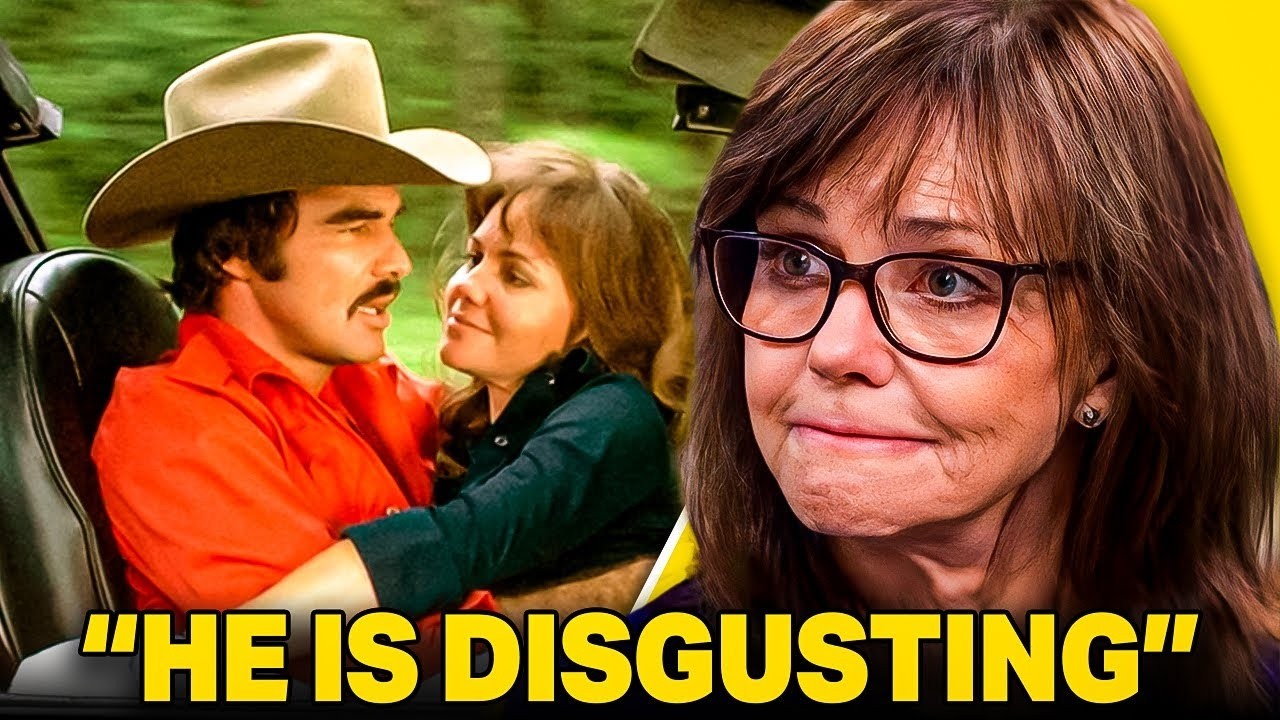
Field, an Academy Award-winning icon with a career spanning over six decades, disclosed that the film’s celebrated kiss with Burt Reynolds was, in her own words, “the worst I have ever experienced.” This admission, made during a candid 2022 interview, has reignited public fascination with one of cinema’s most famous on-screen pairings.
 The actress, who rose to fame as the sunny Gidget and the nun in “The Flying Nun,” faced immense personal and professional challenges during the production. She confessed that upon first reading the script, she deemed it “terrible,” only to be persuaded by Reynolds that improvisation could salvage the project.
Field’s revelations extend beyond artistic disagreements, delving into the emotional complexity of her relationship with Reynolds. She described the romance as “passionate yet troubled,” revealing that Reynolds struggled with control issues and jealousy as her own star began to eclipse his.
These disclosures come as part of a broader narrative about Field’s life, a story of resilience that she meticulously detailed in her 2018 memoir “In Pieces.” Born on November 6, 1946, in Pasadena, California, Field’s childhood was marked by divorce and instability.
Her father, Richard Dryden Field, a strict army officer, and her mother, Margaret Field, an actress connected to Hollywood’s glamour, divorced when Sally was just four years old. This event left a lasting emotional scar that shaped her approach to relationships and career.
In 1952, her mother married stuntman and actor Jock Mahoney, but instead of bringing security, the union introduced painful experiences that Field would only reveal decades later in her memoir.
Despite these domestic difficulties, Field found solace in acting. She spent time on film sets with her mother, developing a passion that would become her lifeline. At age 17, a talent agent noticed her at a party and encouraged an audition at Columbia Studios.
This opportunity catapulted her into the lead role in the 1965 series “Gidget.” Though the show lasted only one season, its reruns turned her into a household name, a pattern repeated with “The Flying Nun,” which ran for three seasons.
Field has admitted she disliked the role, feeling typecast as a sweet, innocent character. This discontent drove her to take drastic measures in the early 1970s, including appearing topless in “Stay Hungry” and refusing any sitcom roles for nearly three years.
She studied at the Actors Studio under Lee Strasberg, a period so difficult she considered abandoning acting entirely. Her determination paid off spectacularly in 1976 with the television miniseries “Sybil,” where she portrayed 13 distinct personalities.
The role earned her an Emmy Award and proved she was far more than a light television actress. This transformation paved the way for her casting in “Smokey and the Bandit,” with Reynolds personally pushing for her despite the studio’s desire for a more glamorous star.
Filming in Georgia during brutal summer heat was grueling, but the movie became a massive surprise hit, earning over $126 million and launching Field firmly into film stardom. Yet, behind the scenes, she noticed Reynolds was relying heavily on medications like Percodan and Valium.
 This dependency deeply concerned Field, who observed his behavior with growing alarm. The on-screen chemistry that captivated audiences masked a relationship fraught with power struggles and emotional turbulence.
Field’s success continued with “Norma Rae” in 1979, a performance that earned her the Academy Award for Best Actress. She won her second Oscar in 1984 for “Places in the Heart,” delivering the famous acceptance line: “You like me right now. You like me.”
Over the years, she took memorable roles in “Steel Magnolias,” “Mrs. Doubtfire,” and “Forrest Gump,” cementing her status as a Hollywood legend. She returned to television with “Brothers and Sisters,” earning another Emmy, and portrayed Mary Todd Lincoln in Steven Spielberg’s “Lincoln.”
Despite these achievements, Field’s revelations about Reynolds have struck a powerful chord. Although Reynolds claimed in a 2015 interview that Field was “the love of his life,” she confirmed they had not spoken for the final 30 years of his life.
The actress has also become known for her activism, supporting LGBTQ+ rights, women’s equality, and social justice causes. Her journey from a troubled childhood to Hollywood royalty is a testament to her enduring spirit.
Field’s early life was shaped by the divorce of her parents when she was just four. She grew up in the shadow of Hollywood through her mother, while her father’s military background imposed strict discipline.
Her stepfather, Jock Mahoney, brought additional trauma, details of which Field revealed in her memoir. She described the environment as unstable, finding her only escape in the fictional worlds she could create through acting.
Attending Portola Middle School and later Birmingham High School in Van Nuys, she discovered a natural talent for performance. A talent agent’s encouragement at a party led to her first big break at Columbia Studios.
“Gidget” may have been short-lived, but its impact was immense, turning Field into a teenage sensation. She followed it with “The Flying Nun,” which she has criticized for limiting her artistic range.
Her refusal to be confined to light roles led her to take bold risks. The topless scene in “Stay Hungry” was a deliberate attempt to shed her wholesome image, a move that shocked many at the time.
 Her studies with Lee Strasberg deepened her craft, allowing her to tackle the demanding role in “Sybil.” This performance was a watershed moment, demonstrating her range and earning critical acclaim.
The role in “Sybil” required her to play 13 different identities, a feat that showcased her extraordinary talent. It won her an Emmy and opened doors to more serious film roles.
Her casting in “Smokey and the Bandit” was a gamble, but Reynolds’ faith in her proved prescient. The film’s success was phenomenal, becoming a cultural touchstone of the late 1970s.
Field’s description of the kiss as “the worst” has become a talking point, highlighting the disconnect between their real dynamic and the chemistry they projected. She joked about how awkward it was, despite their obvious on-screen connection.
Her decision to share this truth now speaks to her commitment to authenticity. Field has always been open about the challenges of her career and personal life, offering a rare glimpse behind the curtain of fame.
The medications Reynolds used, Percodan and Valium, were common in the industry, but Field’s concern underscores the darker side of Hollywood’s golden era. She watched him struggle with dependency, a situation she found deeply troubling.
Although Reynolds called her the love of his life, their estrangement in his final decades is a poignant footnote to a relationship that burned bright but ultimately faded. Field’s silence on this until now has been a subject of speculation.
Her activism today is a natural extension of her life’s work. She has marched for women’s rights, advocated for LGBTQ+ equality, and used her platform to speak truth to power.
Field’s story is not just one of professional triumph but of personal survival. From the emotional scars of her childhood to the turbulence of her relationship with Reynolds, she has emerged as a voice of resilience.
The public reaction to her revelations has been intense, with fans and critics alike revisiting “Smokey and the Bandit” with new eyes. The film’s legacy is now intertwined with Field’s candid testimony.
 As news of her disclosures spreads, industry insiders are weighing in, many praising her courage for speaking out after so many years. The timing, she has said, reflects a desire to set the record straight before her own history is written without her input.
Field’s career continues to evolve, with recent roles in projects like “Hello, My Name Is Doris” and “Spoiler Alert.” She remains an active and respected figure in entertainment, while also focusing on her family and activism.
Her marriage to film producer Alan Greisman, though it ended in divorce, brought her two sons. She also has a son from her first marriage to Steven Craig, and she has spoken about the challenges of balancing motherhood with a demanding career.
The revelations about Reynolds have also prompted a reassessment of his legacy. As one of the biggest stars of his era, his personal struggles have become part of the narrative Field has now enriched.
Field’s memoir “In Pieces” was a critical and commercial success, praised for its unflinching honesty. In it, she detailed her childhood trauma, including alleged 𝓪𝓫𝓾𝓼𝓮 from her stepfather, a topic she addresses with remarkable openness.
The book also explored her relationship with Reynolds in more depth, though the kiss comment adds a new layer to that history. Field’s ability to look back with humor and perspective is a testament to her growth.
Today, at 78, Field is a symbol of longevity in an industry that often discards its stars. Her willingness to share the raw, unvarnished truth about her life and career has endeared her to a new generation of fans.
The impact of her statements on popular culture is likely to be significant. “Smokey and the Bandit” is currently experiencing a resurgence of interest, with streaming platforms seeing increased viewership.
Field’s story is far from over, as she continues to take on projects that challenge her. Her legacy is secure, but today’s revelation is a reminder that even the most beloved Hollywood tales have their shadows.
As the media scrambles to cover the fallout, Field has remained characteristically composed. In a statement released through her publicist, she expressed hope that her candor would encourage honest conversations about relationships and power dynamics in the entertainment industry.
For now, the world watches as one of its most cherished actresses pulls back the curtain on a pivotal moment in film history. The truth about “Smokey and the Bandit” is finally out, and it is every bit as complex as the woman who shared it.