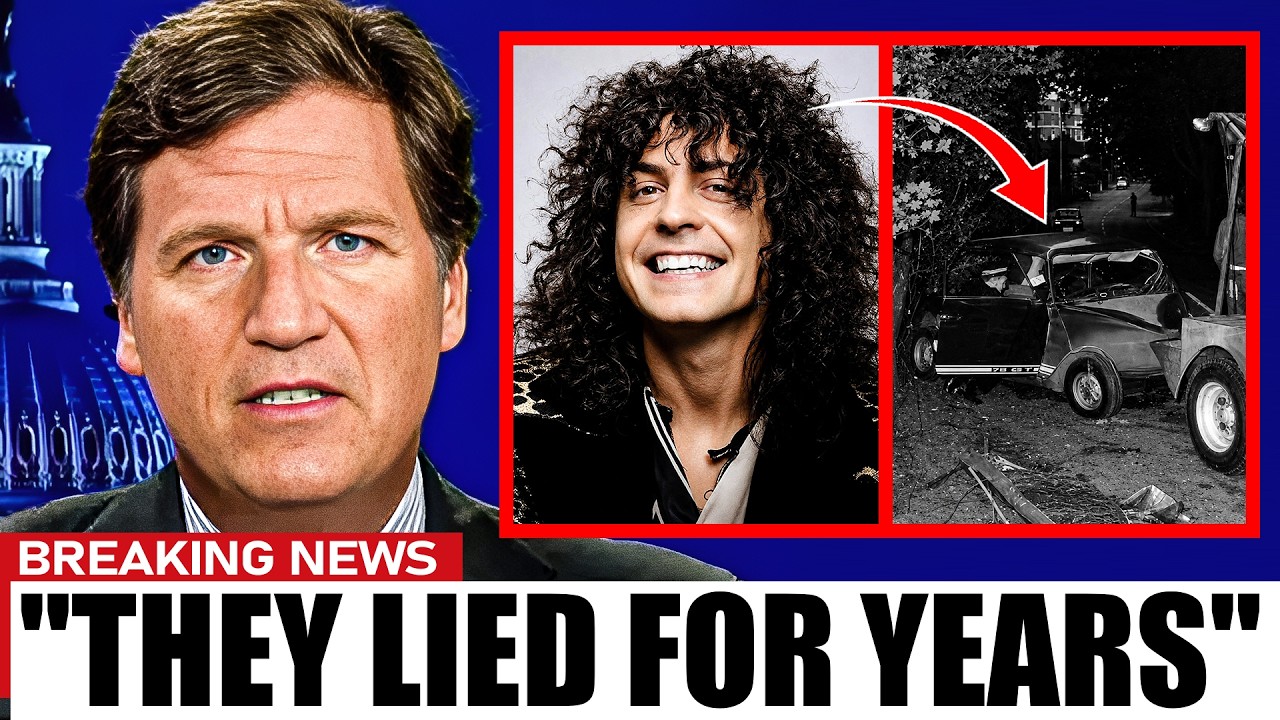
The long-accepted story of Marc Bolan’s death has just been shattered by forensic evidence that remained hidden for nearly half a century. The glam rock pioneer did not die when his purple Mini struck a sycamore tree on a quiet London road in September 1977. Instead, a steel-reinforced fence post—equipped with a large structural eye bolt—sliced through the passenger window and killed him instantly, before the car ever reached the tree that became his shrine.
Newly surfaced forensic mapping and witness accounts confirm that the primary impact was not with the tree, but with a chain-link fence post protruding from the ground near Gypsy Lane in Barnes, southwest London. The eye bolt, designed to anchor tension wires, penetrated the passenger side window and struck Bolan directly, causing a catastrophic injury that ended his life before the Mini spun to a halt against the sycamore. The tree, which fans have covered with flowers for decades, was merely where the wreckage came to rest.
 This revelation changes everything about how the world remembers the final moments of the 29-year-old star. For years, the official narrative blamed the tree, the wet road, and the lack of seatbelts. But the truth is far more disturbing: a piece of roadside infrastructure that should never have been placed where it was turned a survivable accident into a death sentence.
The vehicle, a 1977 Austin Mini, was mechanically neglected. Police investigators at the time noted that two wheel nuts on the front passenger wheel were completely loose, and the tires were significantly under-inflated. While these failures did not cause the crash, they critically compromised the car’s steering the moment it hit a humpback bridge at speed.
A properly maintained vehicle might have stayed on the road entirely.
Neither Bolan nor his passenger, singer Gloria Jones, was wearing a seatbelt. Seatbelt use was not yet mandatory in the United Kingdom in 1977, and many drivers still treated them as optional. Had Bolan been buckled in, the eye bolt would have missed him completely.
He would have been thrown forward instead of sideways. That small, everyday choice made the difference between life and death.
The woman behind the wheel, Gloria Jones, has been unfairly reduced in most accounts to a footnote—the driver who survived while Bolan died. But she was a significant musician in her own right, the writer of the original “Tainted Love,” and the mother of Bolan’s son, Roland. Their relationship was one of the most controversial of his career, as Bolan was still legally married to June Child when he and Jones began their partnership.
On the night of September 15, 1977, Bolan and Jones had celebrated the completion of his television series “Marc” at Morton’s Club in Mayfair. They left well past 4 a. m.
 in light rain. Jones was driving, as Bolan had a lifelong phobia of car crashes and never learned to drive. He reportedly believed with superstitious certainty that he would die in a car accident before his 30th birthday.
He was 29 years old, less than a year from that self-imposed deadline.
The crash left Jones with a shattered jaw, fractured arm and leg, and severe internal injuries. She was rushed to Queen Mary’s Hospital in Roehampton, where doctors kept her heavily sedated and gave strict instructions that no one was to tell her Bolan had died. The news, they believed, could kill her.
She lay in that hospital bed for days, unaware that the man she loved was already gone. She did not attend his funeral on September 20 because she did not know there was a funeral.
When she finally learned the truth from her brother, the devastation was compounded by legal cruelty. Bolan had written a will in 1973, still legally married to June Child, leaving everything to his wife and blood family. He had never updated it.
A decree nisi had been granted in October 1976, but the final decree absolute was scheduled for October 1977—one month after the crash. In the eyes of the law, Marc Bolan died a married man.
 Gloria Jones and her two-year-old son Roland were evicted from the home they shared with Bolan. The T. Rex fortune, built on millions of records, was frozen.
She had no legal standing, no income, and no assets. She packed what she could and returned to Los Angeles with nothing but the clothes she wore and her child in her arms.
What happened next remained a secret for nearly four decades. David Bowie, who attended Bolan’s funeral, saw the injustice and quietly set up a private discretionary trust for Roland Bolan. He funded the boy’s private schooling, living expenses, and upbringing from childhood into early adulthood—demanding absolute silence in return.
Roland Bolan himself confirmed the story years before Bowie’s death, revealing a rare act of generosity from a man who used his wealth to protect a fallen friend’s family without any desire for public recognition.
Gloria Jones eventually rebuilt her life. In the 2000s, she moved to Sierra Leone and established the Marc Bolan School of Music and Film, teaching underprivileged youth. She did not forget Bolan; she honored him.
But the official story of how Bolan died has never sat comfortably with those who examined the evidence. The post-crash forensic mapping now makes clear that the sycamore tree was never the culprit. The real killer was a steel eye bolt on a fence post—a piece of roadside infrastructure that should never have been placed where it was.
 The tree, ironically, likely saved Gloria Jones from an even worse fate by stopping the car from tumbling down a steep embankment into a drainage ditch.
Today, the site on Queen’s Ride is known as Marc Bolan’s Rock Shrine, an international pilgrimage destination where fans leave flowers and notes at the base of the sycamore. In 1997, the T. Rex Action Group stabilized the eroding embankment and placed a dedicated stone memorial.
In 2002, a permanent bronze bust of Bolan was added. None of the thousands who visit each year realize that the tree they come to see was never the cause of his death.
This new understanding of Bolan’s final moments adds a layer of tragedy to an already heartbreaking story. The fear he carried since childhood—that he would die in a car crash before turning 30—came true not because of a tree, but because of a piece of metal that was never supposed to be there. The truth, hidden for nearly 50 years, reveals that Marc Bolan’s death was not a simple accident.
It was a preventable tragedy caused by a combination of mechanical neglect, a dangerous roadside fixture, and a legal system that left the woman he loved with nothing.
The music world lost a pioneer on that rainy September morning. Now, the full story of what really happened demands to be told. The tree is innocent.
The fence post is not. And the woman who has carried the weight of this secret for half a century deserves to be remembered not as a footnote, but as the partner, mother, and survivor she always was.