At 96, Clint Eastwood has outlived nearly every man on the list he’s about to give you. Five names he’s called the best he’s ever stood across from on a dusty set, out of a career spanning more than seventy years and dozens of collaborators. Every single one of them is already gone. This isn’t just Eastwood ranking talent.
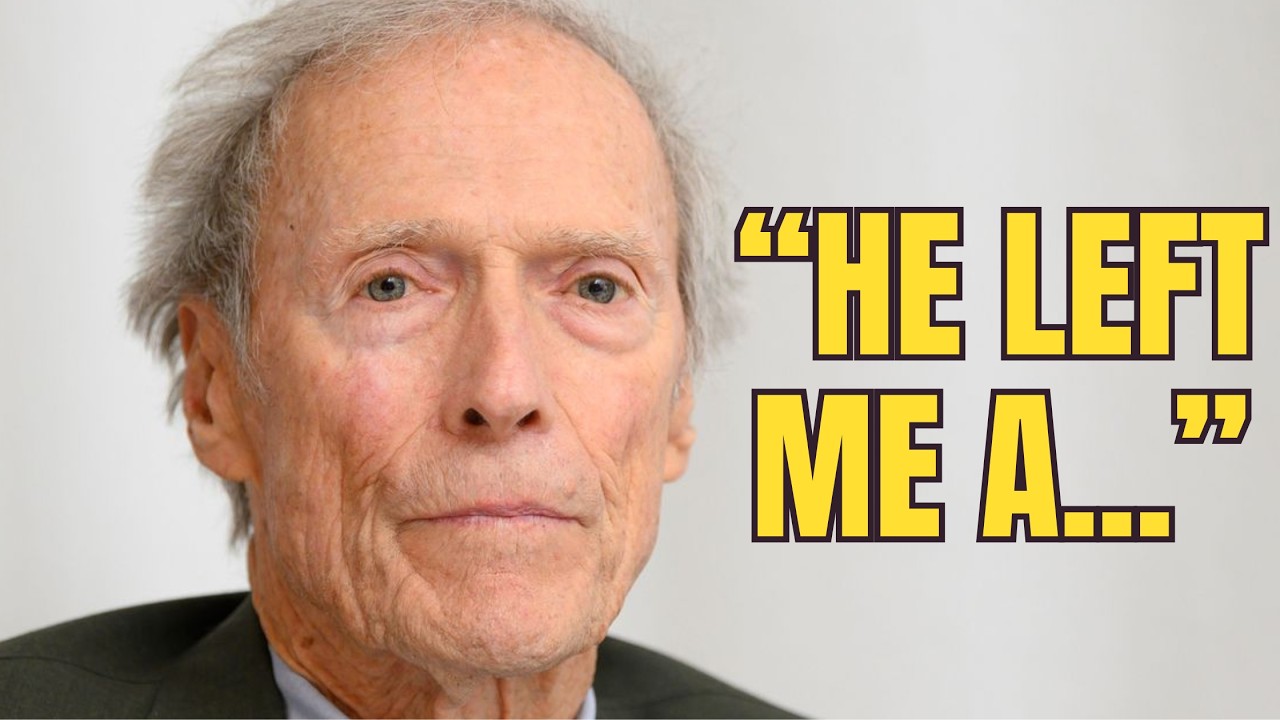
It’s a 96-year-old man quietly settling accounts with the ghosts of his own career. Number five is Gene Hackman, for his work as Little Bill Daggett in 1992’s Unforgiven. Hackman’s own road to that role had been a long one. Born in San Bernardino, California, in 1930, he grew up mostly in Danville, Illinois, in a household his father eventually walked out of, a wound Hackman has said shaped his restless, hard-edged screen presence for the rest of his life.
He lied about his age to join the Marines at sixteen, drifted through odd jobs afterward, including a stint as a warehouse worker and a diesel mechanic, and didn’t seriously commit to acting until his thirties, famously being voted least likely to succeed by his own classmates at the Pasadena Playhouse alongside a young Dustin Hoffman. He proved that vote spectacularly wrong. His breakout came in 1967 with Bonnie and Clyde, which earned him his first Oscar nomination, and by 1971 he’d already won his first Academy Award for playing the relentless narcotics detective Popeye Doyle in The French Connection, cementing himself as one of the defining leading men of the decade and one of the few actors of his generation equally comfortable as hero, villain, or something uncomfortably in between. Getting him into Unforgiven two decades later took real effort.
Eastwood has said in an American Film Institute interview that he’d known Hackman for years, but the two had never worked together, and when he first submitted the script, Hackman turned it down flat, telling Eastwood he was simply tired of violent pictures after a career full of them. Eastwood didn’t let it go. He reframed Unforgiven not as another shoot-em-up but as a story built specifically to dismantle the myth of the Old West gunslinger, a statement against the very violence Hackman said he’d grown weary of glorying. That pitch worked.
Hackman signed on, and the result was a performance so layered and charming, one moment and casually brutal the next, that it earned him his second Academy Award, for Best Supporting Actor. Eastwood has pointed to that performance repeatedly over the years as proof that Hackman could do more with a smile and a pause than most actors could do with a monologue. Hackman went on to quietly retire from acting altogether in the early 2000s, choosing novels and painting over Hollywood for the last two decades of his life, a graceful exit that few of his contemporaries ever managed with the same total lack of fuss. In February of 2025, he was found dead at his home in Santa Fe, New Mexico, alongside his wife Betsy Arakawa, a loss that shook the entire industry and made Eastwood’s own list feel, almost overnight, like a memorial rather than a ranking.
Number four is Richard Harris, for his role as English Bob, also in Unforgiven. Harris arrived in that role already as one of the most turbulent, larger-than-life figures in international cinema. Born in Limerick, Ireland, in 1930, he was one of eight children in a family that ran a flour milling business, and he originally dreamed of playing rugby professionally before a bout of tuberculosis in his twenties derailed that ambition and pushed him toward acting instead. He trained at the London Academy of Music and Dramatic Art and, by the early 1960s, had built a reputation as a serious dramatic actor, earning an Academy Award nomination for This Sporting Life in 1963 and later international fame for playing King Arthur on both stage and screen in Camelot.
He spent much of the sixties and seventies living exactly as hard as his characters often did, developing a well-documented reputation for drinking that ran alongside close friendships and rivalries with fellow hellraisers like Richard Burton and Peter O’Toole. By the time Unforgiven came along in 1992, Harris had already sworn off alcohol and was rebuilding a career that had cooled considerably since his 1960s peak. The story of how Harris landed the part is one Eastwood has told with genuine delight over the years, including in an episode of Inside the Actors Studio. When Eastwood called Harris’s home to offer him the role, the woman who answered the phone relayed the name Clint Eastwood to her husband, who was, at that very moment, apparently watching one of Eastwood’s own westerns on television.
Harris was so certain the call had to be some kind of prank that he made his wife confirm it twice before he’d even come to the phone, a story Eastwood loved retelling decades later because it captured exactly how unlikely their partnership must have looked from the outside. Once he took the part, Harris pushed the character further than what was written, suggesting to Eastwood that English Bob should play as an exaggerated upper-class fraud, someone whose entire performance of aristocratic dignity collapses the moment Hackman’s Little Bill beats him down in a jail cell and strips the myth away in front of the whole town. Eastwood trusted him with that vision completely, and the jailhouse confrontation between the two men remains one of the film’s most quietly devastating scenes. The role helped launch a full late-career renaissance for Harris, who went on to earn another Oscar nomination for The Field the very same year and, most famously to a whole new generation, introduced himself as Albus Dumbledore in the first two Harry Potter films.
Harris died in 2002 after a battle with Hodgkin’s lymphoma, reportedly telling paramedics wheeling him out of a hotel lobby that it was the food that got him in the end, a joke delivered with the same theatrical flair he brought to English Bob a decade earlier, a second act his Unforgiven director lived to see play out in full before losing him too. Number three is Eli Wallach, for playing Tuco in 1966’s The Good, the Bad, and the Ugly. Wallach came from about as far from the Old West as an actor could get, born in Brooklyn in 1915 to Jewish immigrant parents who ran a small candy store in an otherwise mostly Italian neighborhood. He earned a degree from the University of Texas at Austin before training at the Actors Studio and the Neighborhood Playhouse, becoming one of the earliest and most respected practitioners of Method acting on the New York stage.
He won a Tony Award in 1951 for The Rose Tattoo, and by the time Sergio Leone came calling for the third installment of his Dollars trilogy, Wallach had already built a formidable film career playing bandits and rogues, including the vicious Calvera in 1960’s The Magnificent Seven. Wallach’s Tuco very nearly stole the entire film out from under Eastwood’s own iconic Man With No Name, a fact Eastwood has never seemed to resent in the slightest. Filming in Spain with Leone was genuinely dangerous for Wallach. During one sequence he was dragged for a considerable distance by a galloping horse while his hands were bound behind his back, and in another, Leone positioned him so close to a moving train that its iron footboard missed him by mere inches.
Wallach absorbed all of it and turned in a performance so vivid that people still whistle Ennio Morricone’s theme at him decades later, something he said he could feel coming before it even happened. He kept working steadily for the rest of his life, appearing in The Godfather Part III as an aging mobster who meets his end via poisoned cannoli and continuing to take film roles well into his nineties, including parts in Wall Street: Money Never Sleeps and The Ghost Writer, an endurance that made him, by the time of his death, one of the last surviving major stars of Hollywood’s golden studio era. In 2010, at the Governors Awards, it was Eastwood himself who presented Wallach with an honorary Academy Award, the two men sharing a stage forty-four years after they’d first shared a graveyard in the Spanish desert. Wallach used the moment to joke that he’d played more bandits, thieves, killers, warlords, and mafiosi than anyone could shake a stick at, a tidy summary of a six-decade career built almost entirely on morally compromised men played with real warmth underneath.
When Wallach died in 2014 at the age of 98, Eastwood released a statement calling him a wonderful guy and a wonderful actor, adding that they’d shared fond memories from The Good, the Bad and the Ugly and had reunited decades later on Mystic River, where Wallach took a small role in a film Eastwood directed, and that working together again after all those years had been genuinely great. Number two is Robert Duvall, for his role as the ruthless land baron Frank Harlan in 1972’s Joe Kidd. Duvall’s path to that role ran through a childhood shaped by military discipline, born in San Diego in 1931 to a Navy rear admiral father, a background that gave him a natural, understated command whenever he later played officers, judges, or men used to being obeyed. He trained at New York’s Neighborhood Playhouse alongside a young Dustin Hoffman, with whom he shared a cramped apartment early in their careers when neither of them could afford much of anything, and made his screen debut in 1962 playing the reclusive Boo Radley in To Kill a Mockingbird, a nearly silent performance that still left audiences shattered decades later.
By the time he crossed paths with Eastwood a decade later, Duvall had already built a reputation as one of the most reliably excellent character actors working, someone directors trusted to make a supporting role feel essential. Joe Kidd wasn’t considered one of Eastwood’s stronger westerns at the time, a fast, functional John Sturges picture written by Elmore Leonard that Eastwood himself has admitted was rushed toward its own ending almost out of narrative exhaustion. But Duvall’s performance was the film’s steadiest asset, a landowner who wore civility over cruelty so effortlessly that critics singled him out even while dismissing the movie around him. That restrained menace became Duvall’s signature for the next five decades, carrying him through Tom Hagen in The Godfather and its sequel, the napalm-loving Lieutenant Colonel Kilgore in Apocalypse Now, and an Oscar-winning lead performance as a broken-down country singer in Tender Mercies a decade after he and Eastwood shared the screen.
He kept working almost to the very end of his life, racking up seven total Academy Award nominations across a filmography that also included Network, The Natural, and the acclaimed miniseries Lonesome Dove, in which many critics consider his performance as Augustus McCrae the finest work of his entire career, a role he reportedly cherished more than any Oscar he ever received. Duvall died in February of 2026 at the age of 95. Tributes poured in from across the industry, with Adam Sandler calling him one of the greatest actors there ever was, Viola Davis describing herself as being in awe of his towering, humane portrayals, and Alec Baldwin placing him without hesitation alongside Brando, De Niro, and Pacino in the pantheon of the greatest American screen actors of all time. The timing closed out two of the five names on Eastwood’s list within the same brutal February, a coincidence that turned an already elegiac list into something closer to a eulogy delivered in real time.
Number one is Lee Marvin, for playing the boisterous prospector Ben Rumson in 1969’s Paint Your Wagon, the one and only musical Eastwood ever agreed to star in. Marvin’s own path there was as rough as any character he ever played. Born in New York City in 1924 to a family with deep colonial American roots, he was expelled from multiple schools as a teenager before enlisting in the Marine Corps during World War II, where he was wounded during the invasion of Saipan, an injury and a war he rarely discussed but which friends said never fully left him. He stumbled into acting almost by accident afterward, working as a plumber’s assistant when he was asked to fill in for an ailing actor in a local theater production, and from there built a career playing menacing heavies through the 1950s in films like The Big Heat and The Wild One before his breakout as a comedic, scene-stealing drunken gunslinger in 1965’s Cat Ballou earned him the Academy Award for Best Actor, beating out Richard Burton and Laurence Olivier in the process.
It’s an unusual choice to top the list, a film even Eastwood has treated with a bit of self-deprecating distance over the years, given that neither he nor Marvin had any real business singing on screen. Marvin’s performance is the reason the film still has any life left in it decades later. He was reportedly drunk through much of the production, and somehow that only added to Ben Rumson’s ragged, melancholy charm, a man who confesses to his younger partner that he gets low every now and then but figures he’ll be fine as long as his friend sticks around. Marvin’s own recording of the film’s ballad Wanderin’ Star shot to number one on the UK charts, an unlikely hit for a Hollywood tough guy who’d already won his Oscar a few years earlier for playing an entirely different kind of drunk.
Eastwood has credited casting conversations around that era, built partly on Marvin’s own recommendation, with helping steer him toward director Don Siegel, a partnership that would go on to define the next stretch of his career entirely, producing films like Dirty Harry and Escape from Alcatraz. Marvin went on to spend his later years largely out of the spotlight, occasionally returning for smaller roles but never chasing the fame that had once made him one of the biggest names in the business, and in 1987, he died of a heart attack in Tucson, Arizona, at the age of 63, a loss quietly felt by an industry that had always considered him a far more serious craftsman than his tough-guy image ever let on. The film that once got mixed reviews for its gold rush love triangle has aged, in Eastwood’s own telling, into something stranger and more affecting than anyone expected from a western that just happened to break into song. Taken together, these five names tell you more about what Clint Eastwood actually values in an actor than any awards speech ever could.
It was never about who could draw fastest or scowl hardest under a ten-gallon hat. It was about Hackman’s ability to make menace feel almost reasonable, Harris’s willingness to let a false legend crumble in real time, Wallach’s gift for finding humanity inside a scoundrel, Duvall’s talent for making quiet cruelty look like good manners, and Marvin’s knack for turning a drunken, half-sung wreck of a man into someone you’d actually want standing next to you at the end of the world. Every one of them is gone now, three of the five within the last few years alone, and Eastwood, at 96, is one of the last living men who actually watched all of it happen in real time, camera rolling, dust in the air, a genre he helped define and redefine across seven decades slowly emptying out around him one old friend at a time. That might be exactly why this particular list matters more than the dozens of other rankings and interviews Eastwood has given across his long career.
It isn’t really a countdown. It’s closer to a roll call, the kind an old soldier gives at a reunion when he realizes he’s the last one left standing who remembers everyone’s real name, not just the character they played. Eastwood didn’t need to make this list flashy or controversial. He simply told the truth about who impressed him most, in the order they came to mind, and let the weight of losing every single one of them speak for itself.
There’s something almost unbearably poignant about a man who spent sixty years playing gunfighters who never seemed to feel anything, quietly naming the five performances that moved him the most, only to realize, by the time he says the last name out loud, that he’s the only one left who can still tell the story. Maybe that’s the real lesson buried inside a list like this one. Westerns were always about survival, about the last man standing at the end of a long, dusty road when the smoke finally clears. Clint Eastwood has become that man in real life now too, not because he outdrew anyone but simply because time worked the way it always does, the way it works on every gunfighter eventually, real or fictional.
What he’s chosen to do with that position isn’t boast about his own legacy. He spends a little of his remaining time making sure five other names get said out loud, clearly, with real respect attached, before it’s too late for anyone to say them at all.


