For decades, Rodney Dangerfield was one of America’s most beloved comedians.
The red tie.
The nervous expression.
The unforgettable phrase: “I get no respect.”
Audiences knew him as the man who could turn rejection, embarrassment, and failure into some of the funniest comedy ever created.
But behind the jokes was a much deeper story.
A story about a man who spent much of his life feeling invisible.
A performer who struggled for decades before finally becoming a legend.
And a person who found his greatest peace only later in life.
Rodney Dangerfield’s journey was not a typical Hollywood success story.
It was a story of persistence.
Of reinvention.
And of a man who kept going even when the world seemed determined to ignore him.
Rodney Dangerfield was born Jacob Cohen in 1921 in Babylon, New York.
His childhood was difficult.
His father left the family when Rodney was young, and he grew up experiencing emotional distance and instability.
Those early years shaped the feelings that would later become the foundation of his comedy.
The feeling of being overlooked.
The feeling of not being valued.
The feeling of not receiving the recognition he believed he deserved.
As a teenager, he discovered comedy and began writing jokes.
He entered show business under the name Jack Roy, performing wherever he could find opportunities.
But success did not come quickly.
For years, he struggled.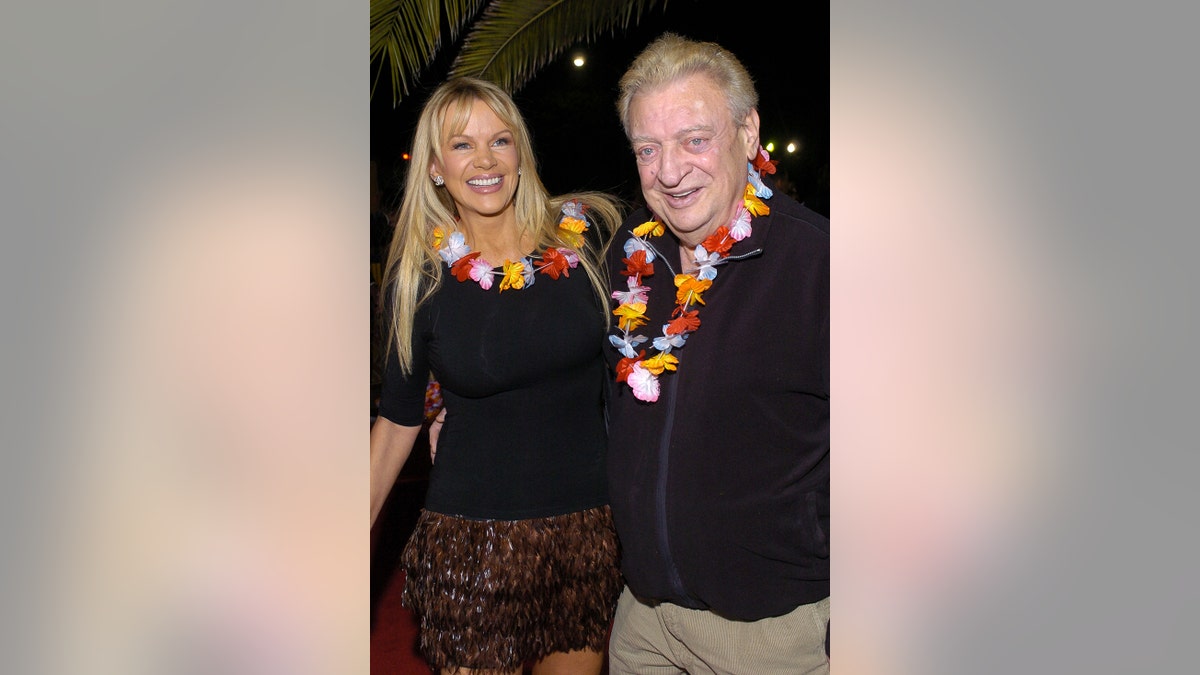
He worked small comedy jobs while trying to support himself and his family.
Unlike many entertainers who become famous early, Dangerfield spent decades wondering if his dream would ever happen.
Eventually, exhausted by rejection, he stepped away from comedy.
He left entertainment behind and became an aluminum siding salesman.
For a while, it seemed like his comedy career was over.
But something inside him never disappeared.
At around 40 years old, he decided to return to comedy.
This time, he reinvented himself.
He became Rodney Dangerfield.
The character was built around everything he had experienced.
The insecurity.
The frustration.
The feeling of being ignored.
But instead of hiding those feelings, he turned them into laughter.
The famous red tie became part of his image.
His rapid delivery and self-deprecating jokes became his signature.
And his legendary phrase, “I get no respect,” transformed his personal struggles into a universal comedy style.
Suddenly, the man who had spent years being overlooked became impossible to ignore.
His career exploded in the 1980s.
He became a regular presence on television and performed at some of the biggest comedy venues in the country.
He also found success in movies.
His role as Al Czervik in Caddyshack became iconic.
His performance in Back to School introduced him to a new generation of fans.
The comedian who once struggled to get attention was now one of the most recognizable entertainers in America.
But fame did not erase his personal battles.
Behind the laughter, Dangerfield struggled with depression and emotional difficulties throughout his life.
The confidence audiences saw on stage was partly a performance.
Off stage, he often carried insecurity and sadness.
His personal relationships were also complicated.
His earlier marriages faced difficulties, and balancing family life with the demands of entertainment was not always easy.
Then, in the later part of his life, he met Joan Child.
Their relationship became one of the most important sources of happiness he ever experienced.
They married in 1993.
For Rodney, Joan represented stability and emotional support.
She was someone who saw the person behind the comedy persona.
Not just the entertainer.
Not just the man making millions laugh.
But the human being who had spent his life searching for acceptance.
During his final years, Joan remained by his side as his health declined.
In 2004, Dangerfield underwent major heart surgery.
The procedure was intended to improve his health, but complications followed.
After suffering a stroke, Rodney Dangerfield passed away on October 5, 2004, at the age of 82.
The entertainment world mourned the loss of a comedy legend.
But for his family, the loss was much more personal.
After his death, disagreements developed regarding his estate and legacy.
His widow Joan became involved in legal and financial disputes with members of Dangerfield’s family.
The conflicts lasted for years.
But throughout that period, Joan also worked to protect his memory and preserve the artistic legacy he had created.
Because Rodney Dangerfield was more than a comedian.
He represented everyone who had ever felt ignored.
Everyone who had experienced rejection.
Everyone who wondered if they would ever get their chance.
His greatest joke was also his greatest truth.
The man who always said he received “no respect” eventually earned the respect of millions.
He proved that success does not always belong to those who arrive first.
Sometimes it belongs to those who refuse to quit.
Rodney Dangerfield’s life was filled with difficult chapters.
But the ending was not defined by sadness.
It was defined by achievement.
A struggling young comedian became a cultural icon.
A man who once felt invisible became unforgettable.


