The United States president has reignited a geopolitical firestorm with his renewed push to acquire Greenland, the world’s largest island, a territory that has been under Danish control for centuries but is now at the center of a high-stakes international confrontation over security, rare earth minerals, and the rapidly changing Arctic landscape. This is not a new obsession for Donald Trump, who first floated the idea of purchasing Greenland during his initial term in office, only to be met with a firm rejection from Denmark. Now, back in the White House in 2025, he has escalated the rhetoric, refusing to rule out the use of military force to seize the island, a threat that has sent shockwaves through diplomatic circles and raised alarms about a potential breach of international law.
The question on everyone’s mind is why Greenland, a vast, ice-covered territory with a population of roughly 57,000 people, has become such a coveted prize.
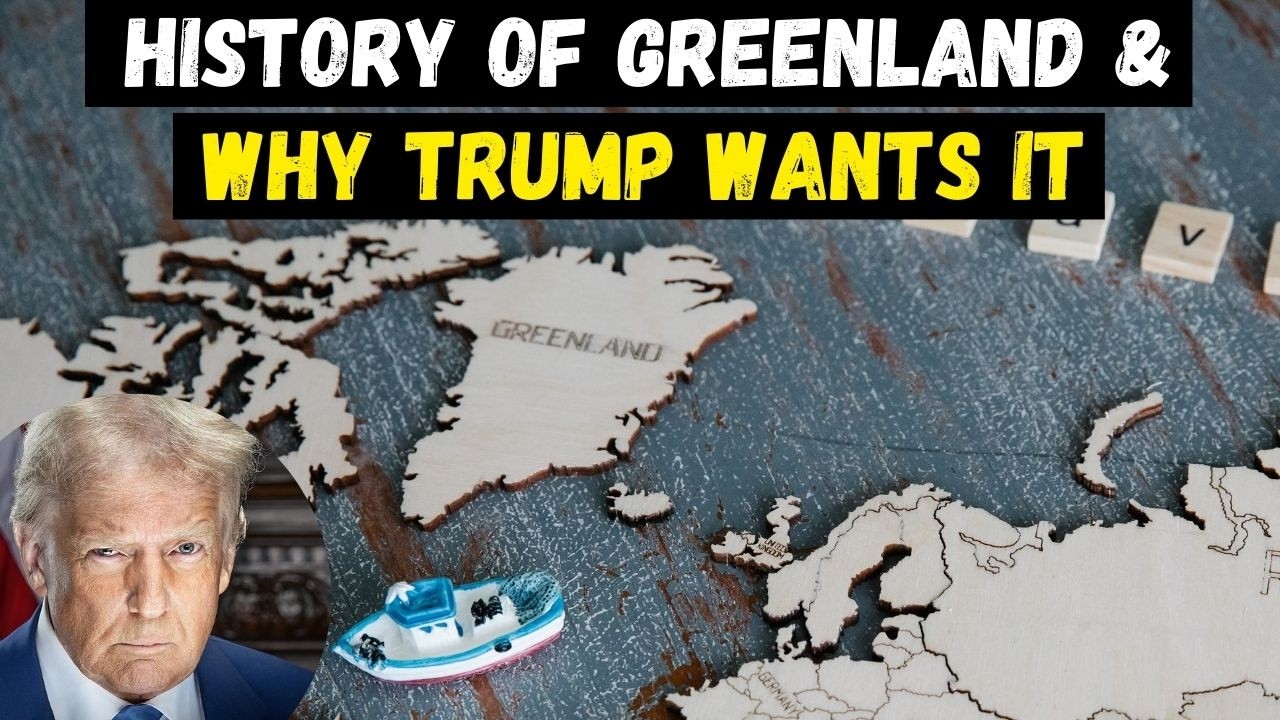 To understand the current crisis, one must look back over a thousand years to the island’s earliest history. Greenland was formed over tens of millions of years through tectonic plate movements, as shown in NASA visualizations, and it is part of the North American continent, despite its political ties to Europe. Its landmass spans 836,330 square miles, or 2.
1 million square kilometers, with 81 percent of that area buried under a massive ice sheet. Humans have inhabited Greenland for at least 4,000 to 5,000 years, with the first arrivals migrating from modern-day Canada across a frozen strait that once connected the two landmasses. The last of these early immigrants came in the 9th century AD, and their descendants are known today as the Inuit, who form the core of the indigenous population.
European contact began in the 10th century, when a Norwegian explorer named Gunnbjörn Ulfsson is believed to have sighted the island. However, the most famous figure from this period is Erik the Red, another Norwegian who was exiled from Iceland for manslaughter around 982 AD. He landed on Greenland and later returned with 14 ships full of settlers, though 11 ships were lost in the perilous journey, a stark reminder of the dangers of medieval seafaring.
It was Erik who gave Greenland its misleading name, a strategic move to attract settlers to a land that was largely covered in ice. According to the Sagas of Icelanders, he said that “people would be encouraged to go there if the land had a good name,” thus creating one of history’s most deceptive place names. Another story, from German chronicler Adam of Bremen, claimed the name came from the green tinge of the inhabitants’ skin from living near seawater, a theory that has been widely dismissed.
Over the following decades, more Scandinavian settlers arrived, including Erik’s son, Leif Erikson, who brought a Christian missionary with him. The first Christian church on the North American continent, Thjodhild’s Church, was built around 1000 AD at Brattahlíð. Leif is also credited as the first European to set foot on mainland North America, landing in modern-day Canada, centuries before Christopher Columbus.
The Norse colonists lived in two main settlements, the East and West Settlements, and by 1261, Greenland’s parliament acknowledged the king of Norway as their leader, allowing him to collect taxes and enforce Christianity. The population grew slowly, reaching an estimated 2,000 to 3,000 individuals by the late 13th century, but by the mid-14th century, the settlements began to decline. The Western Settlement was abandoned, and trade with Norway dwindled.
 By the 15th century, the Norse colonists had vanished completely, leaving behind only ruined buildings. The last written record is of a wedding in 1408, and the last known ship left Greenland in 1410, though archaeological finds suggest European fashions were still followed as late as the 1480s. The fate of the Norse settlers remains one of history’s great mysteries.
Theories include intermarriage with the Inuit, extermination by them, pirate attacks, or a slow decline due to harsh environmental conditions, including climate change spurred by the eruption of the Samalas volcano in Indonesia in 1257 and overgrazing. DNA studies have found no evidence that modern Greenlanders are descended from Norse Vikings, and written records indicate hostile relations between the two groups, making intermarriage unlikely.
Contact between Europe and Greenland was reestablished in 1585 by English explorer John Davis, who found no Norse survivors. In the early 1600s, King Christian IV of Denmark sent expeditions that brought Inuit people back to Copenhagen as prisoners. Europeans were also searching for the Northwest Passage, a sea route through the Arctic Circle that would shorten the distance between Europe and Asia.
However, the immense ice cover made this route essentially unusable for centuries, a fact that is now changing due to climate change. In the early 1720s, Danish-Norwegian missionary Hans Egede recolonized the island on behalf of the joint crown, staying for 15 years. In 1814, the union between Denmark and Norway ended, leaving Greenland under Danish control, a situation that continues today despite a 1931 attempt by Norway to reclaim part of the island.
The Permanent Court of International Justice ruled in Denmark’s favor, and Norway accepted the decision.
 World War II brought new tensions. The Nazis occupied Denmark in 1940, and the United States occupied Greenland with permission from the Danish minister to the US, though he acted without authorization from the Danish government. The Germans were forced out by 1944, and America has maintained a military presence ever since.
In 1946, President Harry Truman offered to buy Greenland for $100 million in gold bars to secure America’s military position, but Denmark refused. This interaction ended Greenland’s centuries-long isolation, and during the Cold War, the US expanded its bases there. In 1953, Greenland was formally adopted into the Kingdom of Denmark as a province rather than a colony, which brought it into the European Economic Community in 1973, despite objections from most of its population.
Home rule was granted in 1979, and Greenland voted to leave the EEC by 1982.
Over the past four decades, Greenland has pushed for full independence, renaming its capital from Godthåb to Nuuk, adopting its own flag in 1985, and removing Danish as an official language in 2009. However, it remains heavily reliant on Denmark for financial support, with a block grant of $750 million in 2019, making up 30 percent of Greenland’s GDP and 60 percent of its public spending. Independence would mean losing this funding, as well as Denmark’s responsibility for security, foreign affairs, and access to the Danish welfare state.
Denmark has not always treated Greenlanders well, with scandals involving forced contraceptive devices fitted on Inuit women between 1966 and 1970 without their consent, and the kidnapping of Greenlandic children for adoption in Denmark in the 1960s and 1970s.
Now, Donald Trump’s renewed interest in Greenland brings these historical tensions to a boiling point. The president’s desire appears driven by a combination of security and economic factors, though his conflicting statements make it difficult to discern his true motives. Economically, Greenland is rich in untapped rare earth elements, including dysprosium, neodymium, europium, and yttrium, which are critical for AI hardware, quantum computing, renewable energy, and advanced defense equipment.
The Tanbreez project alone contains an estimated 20 million tons of rare earth oxides, with nearly 30 percent being heavy rare earth elements. These resources could significantly reduce US reliance on China, which currently controls over 80 percent of global rare earth production.
The Northwest Passage is another key factor. Once virtually unusable due to ice, climate change is opening new Arctic shipping routes, offering massive economic potential for whoever controls them. Russia already controls 53 percent of the Arctic coastline, which is heavily militarized, and China has been investing in Greenland’s mining sector, increasing its stake in the region.
Trump’s desire to counteract these security and economic concerns helps explain his push to take control of Greenland, and even Canada, which he has suggested should become the 51st state. However, America already has military bases on Greenland, making a takeover seem unnecessary. There is also a theory that Trump overestimates Greenland’s size due to the distortion of standard rectangular maps, which make it appear larger than it is.
In reality, Greenland is about the same size as Saudi Arabia and not much larger than Mexico, far smaller than Canada.
The president has even refused to rule out taking Greenland by force, a move that would be a breach of international law and a repeat of the colonization that Greenland only recently escaped. Denmark is adamant that Greenland is not for sale and has strengthened relations with the territory, enhancing its representation on the royal coat of arms and boosting security spending. A recent poll showed that 85 percent of Greenlanders are against being taken over by the US, with only 6 percent in favor and 9 percent undecided.
The situation remains fluid, with world leaders watching closely as the Arctic becomes a new frontier for geopolitical conflict. Where this will end is unknown, but the stakes could not be higher for Greenland, Denmark, and the United States.