The final days of England’s most despised monarch were as foul and undignified as his reign, culminating in a death so wretched that even hell itself was said to be fouled by his presence. King John, the tyrannical ruler who signed Magna Carta under duress and lost the Crown Jewels in a tidal marsh, perished from dysentery on October 18, 1216, after gorging himself on peaches and new cider. His body, ravaged by bloody diarrhea and fever, was later dug up not once but twice, revealing a skeleton picked clean by souvenir hunters who stole his teeth, fingers, and even his crown.
Contemporary chroniclers, including the monk Ralph of Coggeshall, painted a grim picture of John’s final hours. The king had been marching through Norfolk and Suffolk, trying to hold his kingdom together after a French invasion. At King’s Lynn, he suffered an attack of dysentery, an intestinal infection causing bloody diarrhea.
 Ralph attributed the illness to John’s “excessive greed,” noting that his stomach was “always insatiable” and that he had “gorged himself to the point of drunkenness.” The condition worsened after John lost his baggage train, including his chapel relics and many of his household, to the treacherous waters of the Wash. The king, already weakened, fell into a violent fever.
Roger of Wendover, another chronicler, added that John’s gluttony was to blame. He wrote that the king “surfeited himself with peaches and drinking new cider” at Swineshead Abbey, which “greatly increased and aggravated the fever in him.” By the time John reached Newark Castle, he could barely ride.
Matthew Paris, a later historian, described how John’s attendants had to improvise a litter from willow branches and soldiers’ gear, but the king was “tossed about, shaken here and there, and almost broken.” In agony, John cried out, “These cursed, indeed accursed, beds have already shattered and shaken all my bones. They have almost killed me.”
On the night of October 18, John died, having confessed and received the Eucharist from the Abbot of Croxton. He appointed his nine-year-old son Henry as his heir and ordered his barons to swear allegiance. His final wish was to be buried at Worcester Cathedral before the altar of St.
Wulfstan. The chroniclers recorded that John’s body was embalmed, but the process was botched. Ralph of Coggeshall noted that John’s household “plundered all the things he had with him and fled from him in haste, leaving nothing with the body by which the corpse might be properly covered.”
The castellan of Newark provided a shroud, and the body was later dressed in royal robes and carried to Worcester.
John was interred on October 23, 1216, in a stone sarcophagus before the high altar. For centuries, his tomb remained undisturbed, but in 1529, during the reign of Henry VIII, it was opened for the first time. A description by John Beale recorded that the king was found wearing a crown, with a sword, rings, spurs, a staff, and a scepter in the coffin.
The body was left on display for two days before being reinterred. However, this opening proved disastrous. Souvenir hunters stole many of the grave goods, including the crown and rings, and even pulled teeth from the king’s skull.
 The tomb was forgotten until 1797, when confusion over John’s burial location prompted another opening. The Dean of Worcester, Arthur Onslow, granted permission to dig in the choir, where the effigy lay. On July 17, workers lifted the stone effigy and found a broken slab beneath.
After clearing rubble and two elm boards, they uncovered the stone coffin. Valentine Green, a local historian, later published a detailed account based on observations by his friends James Ross and Mr. Sandford, a surgeon.
Green wrote that the body was “adjusted in the stone coffin precisely in the same form as the figure on the tomb.”
The king’s remains were in a 𝓈𝒽𝓸𝒸𝓀𝒾𝓃𝑔 state. Green described the skull as “presented the foramen magnum… turned upwards,” meaning the base of the skull faced the sky. The upper jaw was “displaced from the skull and found near the right elbow,” containing only four teeth.
The lower jaw had no teeth at all. Green noted that “some gray hairs were discernible under the covering of the head.” The bones of the arms and hands were missing, with only the ulna of the left arm found “lying obliquely on the breast.”
The ribs and pelvis were “so much covered with dust and the foldings of the decayed robe as not to be clearly distinguishable.”
The legs were in better condition, with the tibia of the right leg 𝓮𝔁𝓹𝓸𝓼𝓮𝓭 and the bones of the toes “in good preservation.” Green observed that “on two or three of which the nails were still visible.” The body measured five feet six and a half inches.
 A vast quantity of “dry skin of maggots” was found scattered over the corpse, likely from putrefaction that occurred despite embalming. Green concluded that the remains “appeared to have lain as they might naturally have done in their quiescent progress through the various stages of decay and dissolution.”
The clothing was equally revealing. John wore a monk’s cowl, tied under the chin, meant to help him “through the regions of purgatory.” A long robe, possibly crimson damask, covered him from neck to feet, with fragments of embroidery still visible at the right knee.
The sword in a leather scabbard was found down the left side, though much decayed. Green noted that the legs had “ornamented covering” tied at the ankles, with toes visible through decayed parts. The coffin itself was cracked, and the head was turned the wrong way, evidence of tampering.
The 1797 opening confirmed that grave robbers had been at work. The absence of the crown, rings, spurs, staff, and scepter, all described in 1529, was glaring. Green noted that the “large crack in the coffin” and the “displacement of the jawbones” suggested interference.
The missing finger and radius bones were likely taken as souvenirs. This was confirmed by the discovery of two teeth in Worcester City Museum, accompanied by a note stating they were “taken from the head of King John by William Wood, a stationer’s apprentice, in 1797.” A thumb bone, returned to Worcester Cathedral in 1957, also came from the tomb.
Part of John’s shoe was later displayed at the British Museum in 2015.
The body was left on display for only a day because of the “multitude of people who came to view it and who quickly became ungovernable,” Green wrote. Despite the short time, more items were stolen. The remains were then reinterred, but the damage was done.
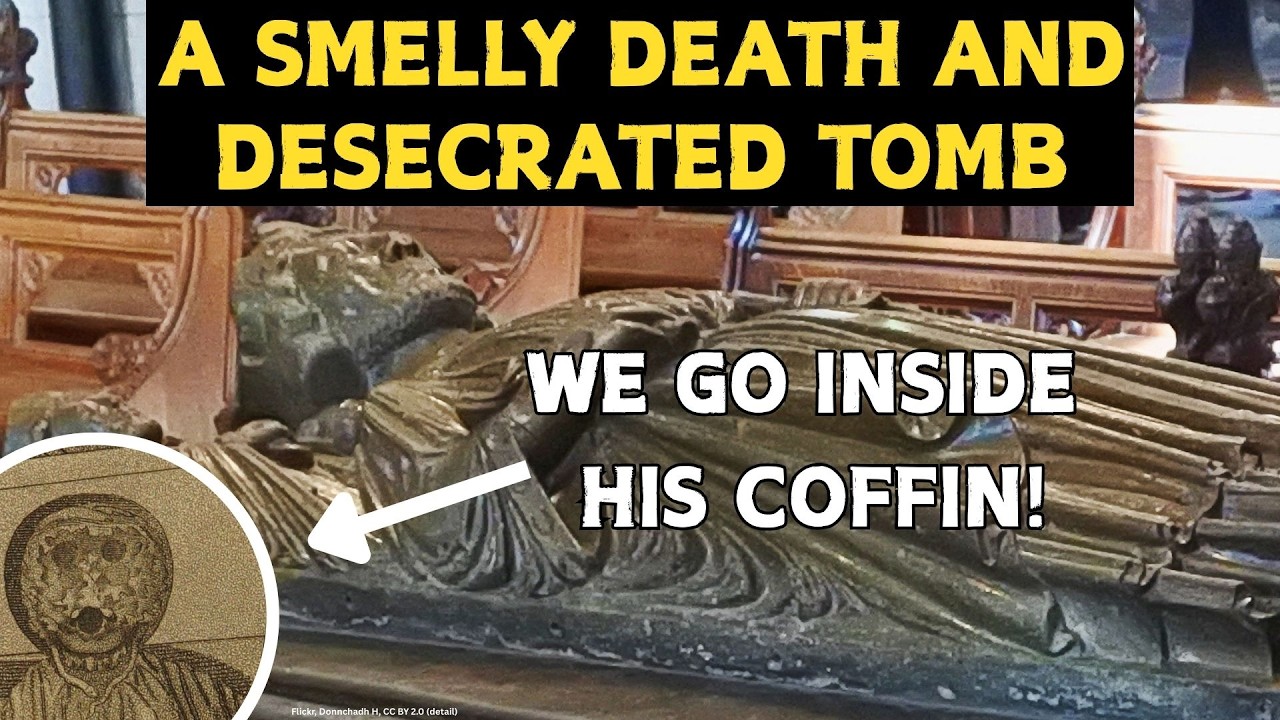
 John’s tomb, a magnificent effigy dating to around 1232, remains at Worcester Cathedral. The effigy, considered the oldest royal effigy in England, shows John in royal robes with a crown, his feet resting on a lion biting a sword. The chest is decorated with red shields bearing three golden Plantagenet leopards.
The nose and lips are broken, but the chin-length hair and beard remain intact.
Historians debate whether the effigy is a true likeness. John Gillingham, writing in the Oxford Dictionary of National Biography, argued that the 16-year gap between John’s death and the effigy’s creation makes it unreliable. However, the cathedral maintains it is an accurate representation.
The tomb originally had precious stones set into the crown and cuffs, but these were stolen long ago. Today, only the indents remain.
King John’s death and desecration stand as a grim testament to his legacy. The monarch who lost the Crown Jewels, signed Magna Carta under duress, and was excommunicated by the Pope died in agony, his body ravaged by dysentery and his grave plundered by souvenir hunters. Matthew Paris, the chronicler, summed up the sentiment of the age when he wrote, “Foul as it is, hell itself is made fouler by the presence of John.”
The king’s remains, scattered across museums and private collections, serve as a macabre reminder of a reign marked by cruelty, chaos, and a death so miserable that even his enemies might have pitied him.