The world lost one of its most revolutionary musical talents on October 6, 2020, but the legacy of Eddie Van Halen remains forever intertwined with the dark personal battles that defined his life behind the spotlight. The guitar virtuoso, who redefined the instrument for a generation, spent decades locked in a brutal cycle of artistic brilliance and self-destructive behavior, a pattern that began in childhood and ultimately contributed to his untimely death at the age of 65 from a stroke.
Van Halen’s journey into the abyss began long before the stadiums filled with screaming fans. Born on January 26, 1955, in Amsterdam, Netherlands, to a Dutch musician father and an Indo mother, the young Eddie faced relentless persecution from an early age. The family relocated to Nijmegen, a small Dutch town, where the mixed-race heritage of Eddie and his older brother Alex made them targets of vicious bullying, with classmates cruelly labeling them “half-breeds” and showing them no respect or mercy.
 The constant torment became so unbearable that Eddie’s parents made the dramatic decision to uproot their entire lives, seeking a fresh start in the land of opportunity. In 1962, the Van Halen family arrived in Pasadena, California, with little more than hope and determination, only to discover that the American Dream came with its own set of brutal challenges. His mother took work as a maid while his father accepted a janitorial position, their lack of English fluency relegating them to menial jobs and forcing them to share a cramped house with two other families just to survive.
The schoolyard cruelty that Eddie and Alex had hoped to escape in the Netherlands followed them across the Atlantic Ocean, manifesting in new and even more humiliating ways. Arriving at their new school with almost no command of the English language, the Van Halen brothers were immediately marked as outsiders by their peers. The bullying escalated beyond mere name-calling, with classmates tearing up Eddie’s homework and even forcing him to eat sand from the playground, a degrading experience that left deep psychological scars.
Music became the only escape from this relentless persecution, and both brothers turned to it with a desperate intensity. From the age of six, Eddie and Alex took piano lessons, but Eddie displayed an extraordinary gift that set him apart from the very beginning. Rather than learning to read traditional musical notation, Eddie would simply watch recitals of classical masters like Mozart and Bach, absorbing the compositions through pure observation and then replicating them flawlessly on his own.
This remarkable ability to learn by watching rather than reading hinted at the genius that would later revolutionize rock music. When Eddie was just ten years old, he entered the Long Beach City College piano competition and walked away with first prize, a moment of triumph that filled his father with immense pride and dreams of a classical career for his son. But young Eddie had different aspirations, finding his inspiration not in the concert halls of Vienna but in the raw energy of bands like the Beatles and the Dave Clark 5.
The musical dynamic between the brothers shifted dramatically when Alex purchased a guitar, prompting Eddie to buy a drum kit in response. One fateful day, Alex sat down at Eddie’s drums and effortlessly played the famous drum solo from the surf classic “Wipe Out,” and in that instant, Eddie realized his brother’s superior talent behind the kit. Without hesitation, Eddie surrendered the drums to Alex and picked up the electric guitar instead, a decision that would alter the course of music history forever.
The brothers formed their first band, The Broken Combs, while Eddie was still in the fourth grade, playing at Pasadena’s Hamilton Elementary School. These humble beginnings solidified Eddie’s determination to become a professional musician, a dream that his mother actively discouraged at every turn. She went so far as to lock his guitar away to prevent him from practicing, but her efforts proved futile against her son’s overwhelming passion and drive.
Despite his growing confidence as a musician, Eddie Van Halen suffered from crippling stage fright that threatened to derail his ambitions before they could take flight. Seeking guidance from his father, who had experienced the same fears during his own musical career, Eddie received advice that would ultimately seal his tragic fate. His father handed him a cigarette and a drink, a seemingly simple solution to calm his nerves that would spiral into a lifelong battle with addiction.
 What began as a performance aid quickly transformed into a crutch that Eddie relied on for every aspect of his life. He soon found himself attending high school classes completely intoxicated, and when a teacher discovered his condition, instead of offering help, the educator recommended different types of alcoholic beverages for him to try. This shocking response from an authority figure only reinforced Eddie’s belief that his substance use was acceptable, embedding the behavior deeper into his psyche.
The year 1972 brought another pivotal moment when Eddie’s father suffered a horrific workplace accident, dropping a trailer on his finger and losing it entirely. This incident ended his father’s musical career and served as a stark reminder of how quickly fate could strip away one’s dreams. Rather than frightening Eddie away from his ambitions, the accident ignited an even fiercer determination to succeed, and he channeled that energy into forming a new band with his brother called Mammoth.
The band was missing one crucial element, a flamboyant lead singer, until they recruited a charismatic frontman named David Lee Roth from another local group. Roth, despite his massive ego, insisted on renaming the band Van Halen, claiming he saw marketing potential in the brothers’ surname. Whatever his motivations, the decision proved inspired, and Van Halen quickly became a sensation in the Los Angeles music scene, drawing attention from industry heavyweights.
The band’s breakthrough moment came when they opened for British rockers UFO at the Starwood in West Hollywood, and in the audience sat Gene Simmons of KISS. Simmons was so impressed by Van Halen’s performance that he immediately approached the band backstage, offering them a contract with his record company. The excitement was palpable until Simmons’ bandmates in KISS objected to the signing, forcing him to tear up the contract and leaving Van Halen devastated and back to square one.
The rejection only fueled Van Halen’s drive, and in 1978, Warner Records offered the band a recording contract. Their self-titled debut album shot to number 19 on the Billboard charts, and suddenly everyone knew the name Van Halen. The first thing the brothers did with their newfound wealth was repay their father’s unwavering support by purchasing him a boat, allowing him to retire in comfort and finally escape the menial jobs that had defined his American experience.
With fame came an entirely new set of temptations and complications, chief among them the attention of women. Valerie Bertinelli, star of the hit television show “One Day at a Time,” saw Van Halen on an album cover and became determined to meet him. She attended one of his concerts in 1980 and boldly went backstage, informing the promoter of her crush on the guitarist, a message that eventually reached Van Halen himself, who had no idea who she was.
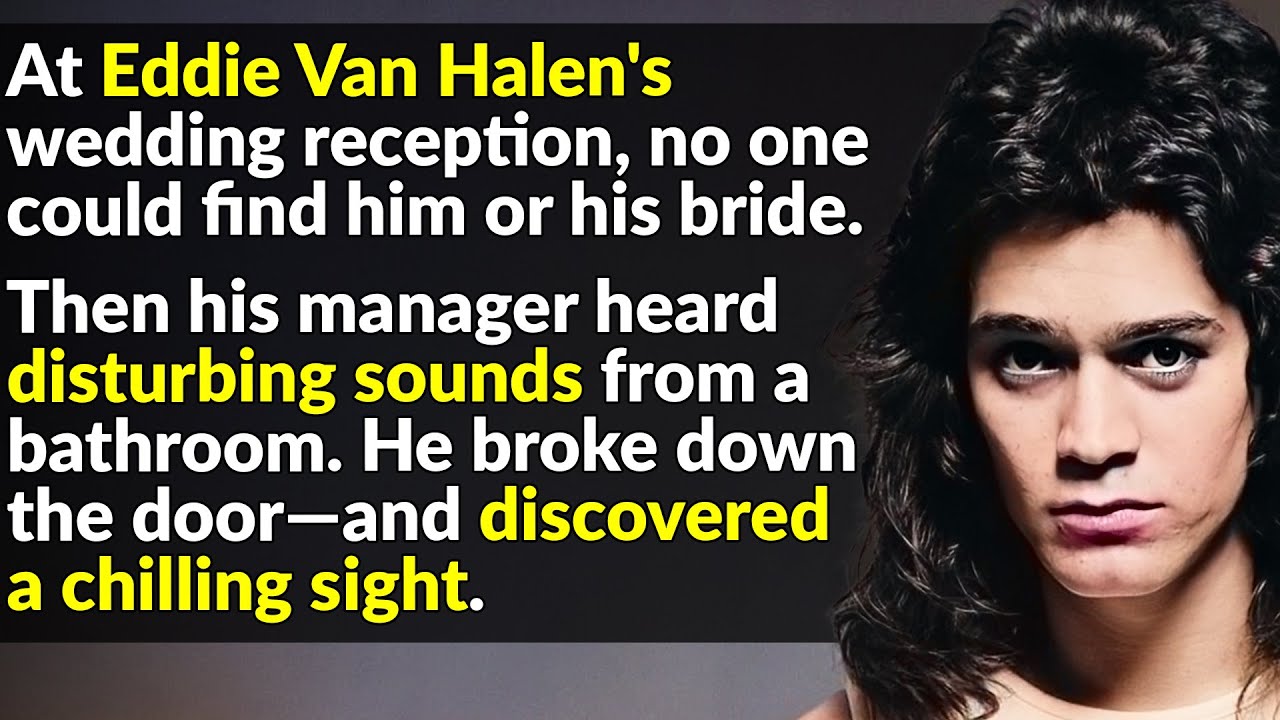
 Their meeting was marked by mutual nervousness, but the chemistry was undeniable, and a whirlwind romance began that would lead to marriage in April 1981. The wedding ceremony itself went smoothly, but the reception revealed the dark reality of their union when the bride and groom disappeared. Band manager Noel Monk eventually found them in a washroom, with Bertinelli in her beautiful white gown holding Van Halen’s hair back as he vomited into the toilet, a harbinger of the struggles to come.
Life on tour with Van Halen was a hedonistic blur of groupies, substances, and reckless behavior that would shock even the most jaded rock fans. Van Halen’s infidelity was an open secret, with the band engaging in what could only be described as a smorgasbord of sexual encounters, including shared groupies and degrading games involving condiments. These antics led to frequent doctor visits for penicillin and other treatments, as well as prescriptions for codeine and Percodan that only fed the growing addiction.
The band’s reckless lifestyle extended to their vehicles, with Van Halen and his bandmates notorious for driving Italian sports cars at speeds reaching 240 kilometers per hour through Los Angeles streets. This dangerous fun was just another manifestation of the invincibility that fame and fortune had granted them, but the consequences were mounting. A paternity suit filed by an unidentified woman threatened to expose Van Halen’s infidelities, though he was ultimately proven not to be the father, a revelation that devastated Bertinelli.
The year 1982 brought Van Halen to an entirely new level of fame when legendary producer Quincy Jones called, seeking his guitar skills for a project with Michael Jackson. Initially believing the call was a prank, Van Halen soon realized the opportunity was real, and he found himself contributing a blistering guitar solo to Jackson’s song “Beat It.” Van Halen made significant changes to the song, which Jackson had written himself, and the King of Pop was not only thrilled but deeply touched by the guitarist’s creative investment.
Van Halen’s work on “Beat It” was a labor of love, so much so that he refused any payment for his contribution, a decision that proved financially disastrous when the single sold over 11 million copies worldwide and topped the Billboard Hot 100 for three weeks. To add insult to injury, the album containing “Beat It” knocked Van Halen’s own record from the number one spot. The collaboration brought Van Halen a new audience and even more fame, but it also intensified the pressure and the partying.
By this point, Van Halen’s substance use had reached alarming levels, with lines of white powder hidden inside his onstage amplifier cabinet for easy access during performances. The band’s concerts grew more outrageous, and Van Halen’s behavior became increasingly erratic, with one incident requiring an aide to remove pen marks from his face and chest before he could take the stage. The line between genius and self-destruction had become dangerously blurred.
 Despite the band’s massive success, the members were somehow not making the money they deserved, thanks to an unfavorable contract with Warner Brothers. Manager Noel Monk stormed into negotiations and secured a much better deal, suddenly making the band members wealthy beyond their wildest dreams. But even with this increased income, Van Halen struggled financially, constantly trashing hotel rooms and limousines while maintaining an insatiable appetite for substances that seemed to consume every dollar they earned.
Tensions within the band reached a boiling point, particularly between Van Halen and lead singer David Lee Roth. During one heated argument, Van Halen threw a glass bowl of guacamole at Roth’s head, and he decided he had enough. His solution was to quit the band and join KISS, approaching his friend Gene Simmons with the proposal.
Simmons, however, knew that Van Halen was a nightmare to work with and turned him down, forcing Van Halen to return to the band he had grown to despise.
The egos within Van Halen were in constant competition, and the partying continued unabated until 1985 when the band finally imploded. The breakup was followed by more tragedy when Van Halen’s father passed away in 1986, his addiction to alcohol playing a significant role in his death. In the aftermath, Van Halen told Rolling Stone magazine that he was done with drinking forever, but his sobriety proved tragically short-lived, and he soon returned to the habits that would eventually destroy him.
Somehow, through all the chaos, Van Halen remained married to Bertinelli, and the couple welcomed a son they named Wolfgang, after Mozart. The marriage, however, was beyond repair, and the couple separated in 2001 before finalizing their divorce in 2005. Van Halen finally acknowledged his addiction and checked into a rehab center, but the timing was cruel, as it coincided with Van Halen’s induction into the Rock and Roll Hall of Fame, a ceremony he spent locked away in treatment.
The end came on October 6, 2020, when Van Halen suffered a stroke and died at the age of 65, surrounded by those who loved him. His legacy as one of the greatest guitarists in rock history is secure, but so too is the tragic story of a man whose incredible gift came with an unbearable curse. His son Wolfgang carries on the family name with his band Mammoth WVH, a tribute to his father’s first band and a reminder that the music lives on, even as the demons that plagued Eddie Van Halen finally fell silent.