The investigation into the death of six-year-old JonBenét Ramsey has produced more unanswered questions than definitive answers in the nearly three decades since her body was discovered in the basement of her family’s Boulder, Colorado home on December 26, 1996. But for the first time in his adult life, the one person who has remained silent the longest, her older brother Burke, has broken his silence. And what he has to say cuts through the noise of internet speculation and tabloid fodder to deliver a stark, simple message that challenges the very foundation of the most persistent theory surrounding this case.
Burke Ramsey, who was nine years old on the night his sister was killed, has spent two full decades refusing to engage with the media circus that has followed his family like a shadow. He has watched from the sidelines as amateur sleuths and professional documentarians built entire careers on circumstantial evidence and unproven conjecture. He has endured the public dissection of his childhood, his family’s private moments, and his own demeanor.
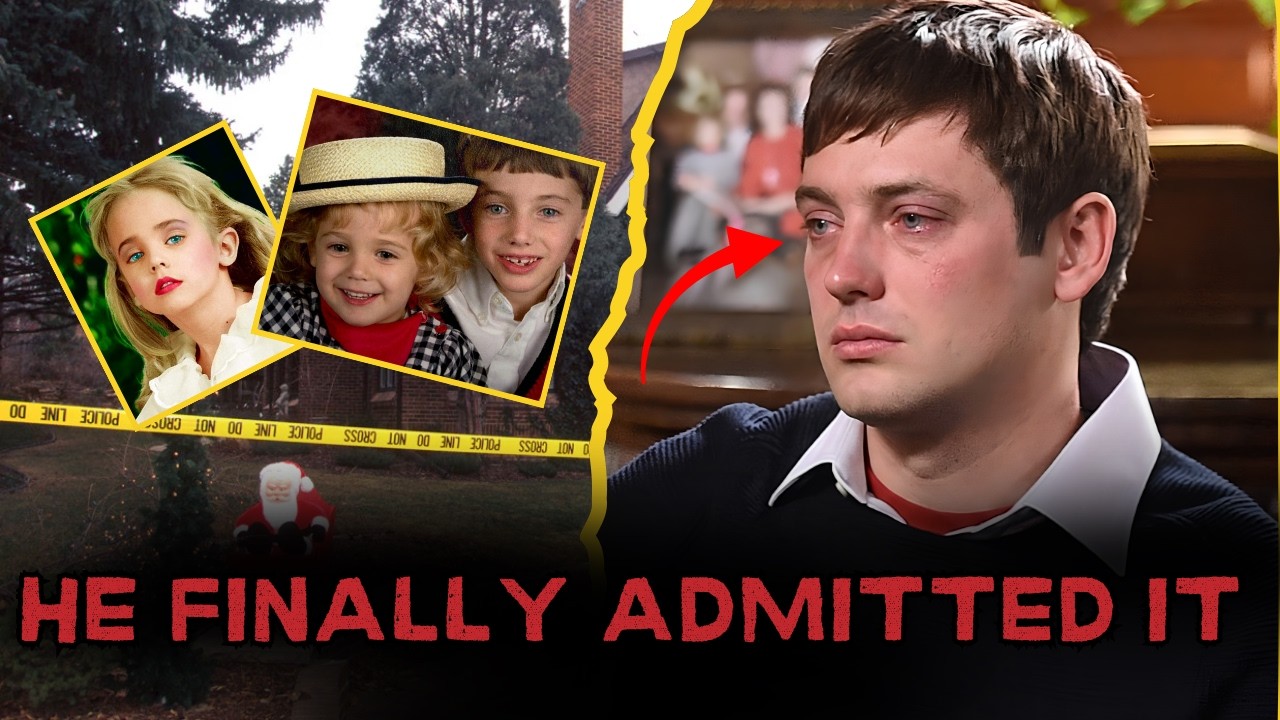 Now, in a series of interviews marking the 20th anniversary of JonBenét’s death, he has stepped forward to state unequivocally that he had no role in her murder and that the narrative that has haunted him since childhood is a fabrication built on a foundation of flawed interpretation and outright falsehood.
The story of Burke Ramsey is not just the story of a man trying to clear his name. It is a case study in how a single, sensational theory can override forensic science, derail an active investigation, and permanently scar the life of an innocent child. To understand the weight of his statement, one must first understand the chaotic, compromised, and deeply flawed investigation that allowed such a theory to take root in the first place.
The timeline of that morning is critical. At 5:52 AM, Patsy Ramsey called 911 in a state of hysteria, reporting that her daughter had been kidnapped. The ransom note, a bizarre and lengthy 2.
5-page document demanding $118,000, was found on the staircase. That specific sum, it would later be revealed, was nearly identical to a bonus John Ramsey had recently received from his employer.
The Boulder Police Department, a small force unaccustomed to high-profile homicides, responded to the scene. However, operating under the assumption that this was an active kidnapping, they made a catastrophic error. They treated the home as a staging ground for a potential ransom call, rather than a crime scene to be secured and processed.
For nearly seven hours, the house was a whirlwind of activity. Family friends, a pastor, and officers moved freely through the residence, contaminating any potential physical evidence. The phone line was kept open, waiting for a call that would never come.
Meanwhile, in a windowless storage room in the basement, just off the boiler room, JonBenét’s body lay undiscovered. It was not until Detective Linda Arndt asked John Ramsey and his friend Fleet White to conduct a final search of the house that her body was finally found, at approximately 1:00 PM.
The scene that greeted investigators was a nightmare of forensic ambiguity. JonBenét had been struck with blunt force trauma to the head and strangled with a garrote constructed from a length of nylon cord and a broken paintbrush handle that belonged to Patsy’s art supplies. Duct tape covered her mouth, and a cord was tied around one wrist.
The autopsy would later reveal partially digested pineapple in her stomach, suggesting she had eaten it one to two hours before her death, contradicting her parents’ account that she had fallen asleep in the car and been carried straight to bed.
The physical evidence painted a picture of a crime that was both brutal and bizarre. The ransom note, written on a notepad from inside the house with a pen from inside the house, was a rambling, almost theatrical document that referenced a “small foreign faction” and was signed with the cryptic initials “SBTC.” It was a note that, to many seasoned investigators, felt staged.
The lack of forced entry, aside from a basement window with an intact spiderweb and no footprints in the snow outside, pointed inward. The pineapple bowl, found on the kitchen table with fingerprints from both Burke and Patsy, but not JonBenét, became a focal point of suspicion.
It was from this murky pool of evidence that the theory implicating Burke Ramsey was born. Proponents of this theory, most notably the producers of a 2016 CBS documentary series titled “The Case of JonBenét Ramsey,” constructed a narrative that suggested Burke, possibly angered over the pineapple snack, struck his sister with a flashlight or a similar object in a fit of rage. The documentary, which aired over six hours across two nights, featured a panel of experts who conducted physical reconstructions to demonstrate that a nine-year-old boy could indeed have delivered the fatal blow.
They argued that the parents, discovering the accident, then staged the elaborate kidnapping scenario to protect their surviving son.
This theory, however, rests on a foundation of sand that crumbles under the weight of the actual forensic record. The most critical piece of evidence is the DNA. In 1997, forensic testing recovered unidentified male genetic material mixed with a small amount of blood from JonBenét’s underwear.
 In 2003, using more advanced “touch DNA” technology that did not exist in 1996, that same profile was found again on a separate item of clothing, her long underwear. This profile has never matched John Ramsey. It has never matched Patsy Ramsey.
It has never matched Burke Ramsey. In fact, Burke was formally and scientifically excluded as the source of that DNA in May of 1999. This exclusion predates the CBS documentary by a staggering 17 years.
The DNA evidence is not a minor detail; it is the cornerstone of the intruder theory. It is the reason that career detective Lou Smith, who worked the case for the DA’s office, resigned in 1998. He believed so strongly in the family’s innocence that he could not continue working a case he felt was being pointed in the wrong direction.
He spent the rest of his life, until his death in 2010, convinced that the real killer was an unidentified outsider. Conversely, lead investigator Steve Thomas, working from the same evidence, reached the opposite conclusion. He resigned for the opposite reason, frustrated that the DA’s office was not pursuing charges against the family, and published a book naming Patsy Ramsey as the responsible party.
Two experienced professionals, the same case file, completely opposite conclusions. This fundamental disagreement is not a footnote in the story; it is the entire story. It is the reason why, 30 years later, the case remains genuinely unresolved.
It is not because nobody looked closely enough, but because the people who looked closest could not agree on what they were looking at.
Burke Ramsey’s own words, finally heard in full, cut through this professional disagreement with a raw, personal clarity. In his interview with Dr. Phil, he described waking up to chaos.
“The first thing I remember is my mom bursting into my room, really frantic, saying, ‘Oh my gosh, oh my gosh,’” he recounted. “Running around my room. Now I know.
Looking for JonBenét.” He described being taken to a friend’s house, shielded from the investigation unfolding in his own home. He spoke of the “chaotic nightmare” of growing up with news trucks parked outside his house and his face plastered on tabloids in the supermarket checkout line.
When asked directly about the accusations that have followed him into adulthood, he did not deflect. “I know people think I did it,” he said. “I know people think my parents did it.”
He stated plainly that he had nothing to do with his sister’s death and that he had no memory of anything unusual happening that night.
His demeanor during that interview, specifically occasional smiles while discussing painful topics, was seized upon by the internet as evidence of guilt. This reaction, however, is a well-documented physiological response to extreme stress and anxiety. Mental health professionals have noted that nervous smiling or laughing under duress is a common coping mechanism, not an indicator of truthfulness or emotional state.
Reading anxiety as a confession is a choice, not a finding. The CBS documentary, which aired just weeks after the Dr. Phil interview, ignored this context.
 It presented its theory with a cinematic authority that overwhelmed the careful disclaimers buried within the broadcast. For millions of viewers, the image of a nine-year-old Burke striking his sister became a permanent fixture in their understanding of the case, despite the fact that the DNA evidence excluding him had been public knowledge for nearly two decades.
The fallout from that broadcast was immediate and severe. Three weeks after it aired, Burke filed a defamation lawsuit against CBS, the documentary’s producers, and several of its featured experts, seeking $750 million in damages. The lawsuit argued that the documentary had presented speculative theories as fact, leading reasonable viewers to conclude that he had likely killed his sister.
The case moved through years of legal proceedings before being settled in 2019 under terms that have never been publicly disclosed. While CBS never issued a formal retraction, legal analysts noted that a network with CBS’s resources rarely settles a case of this magnitude unless it sees genuine exposure at trial. The settlement, in effect, served as a quiet acknowledgment that the documentary had crossed a line.
Since that settlement, Burke has retreated from public life entirely. He has relocated to Michigan, where he works in technology management. He has given no further interviews.
He declined to participate in the 2024 Netflix documentary series “Cold Case: Who Killed JonBenét Ramsey,” a project whose own director explicitly framed the series as a pushback against the “false narrative” that JonBenét was killed by her parents or her brother. His decision to decline even that sympathetic platform speaks volumes. This is not a man avoiding scrutiny out of fear of what new evidence might surface.
The DNA has not changed since 1999, and it has never pointed toward him. It reads instead as a hard personal boundary set by someone who has already had to sue a national television network to push back against unproven speculation broadcast about his own childhood.
The case against Burke Ramsey has never been supported by a single piece of forensic evidence directly tying him to the injuries JonBenét suffered. It runs directly into the DNA exclusion and the practical, rarely addressed question of how a nine-year-old could have single-handedly staged an elaborate false kidnapping scene, written a 2. 5-page ransom note in what forensic document examiners describe as an adult hand, and left zero forensic trace connecting him to the fatal injuries, all without a single adult in that house noticing anything in the hours immediately afterward.
The theory is built entirely on inference constructed after the fact, built backward from a tragedy nobody could make sense of rather than forward from an actual documented childhood. There is no documented pattern of aggression or concerning behavior anywhere in Burke’s life before December 26, 1996. No pediatrician flagged anything.
No teacher sent home a worried note. No family friend interviewed years later has ever described witnessing anything from Burke that reads, even in hindsight, as a warning sign.
The broader context of this case is a study in institutional failure. The Boulder Police Department’s initial mishandling of the crime scene was catastrophic. The decision to allow the family to avoid formal police interviews for nearly four months, on the advice of their attorneys, calcified public suspicion.
The grand jury’s 1999 vote to indict John and Patsy Ramsey on charges of child 𝓪𝓫𝓾𝓼𝓮 resulting in death, which was kept sealed for 14 years, only added to the confusion. Yet, District Attorney Alex Hunter declined to sign the indictment, stating there was no reasonable likelihood of securing a conviction. The 2008 letter from District Attorney Mary Lacy formally clearing the family, including Burke by name, was a landmark moment, but it did not undo the damage already done to the public perception.
The Boulder Police Department, upon resuming control of the investigation in 2009, publicly stated it did not consider the DNA evidence fully conclusive on its own. Both things are true at once. The case against the family as a whole remains, in the department’s own more cautious framing, genuinely unresolved as a matter of institutional certainty.
While Burke’s own individual exclusion by direct DNA testing has never once wavered across every round of independent testing conducted over nearly 30 years.
 The story of JonBenét Ramsey is a tragedy that has been compounded by a secondary tragedy of misinformation. The true crime industry has recycled her pageant photographs and her brother’s childhood photos for three decades, stripping them of context and packaging them as thumbnails to generate views. Researchers who study wrongful public suspicion describe a pattern where once a specific face gets attached to a specific crime in the public imagination, formal exoneration rarely fully dislodges it.
The information that clears someone travels a fraction as far and a fraction as fast as the accusation did in the first place. Burke Ramsey’s entire adult life is in some sense a case study in exactly that gap.
His father, John Ramsey, now 82 years old, has become significantly more publicly active over the past two years, pushing directly for forensic genetic genealogy testing on the unidentified male DNA that has remained unmatched since 1997. He has met personally with Boulder’s current police chief and appealed publicly to federal officials for help. This past summer, that push gained renewed attention after a Colorado Bureau of Investigation forensic analyst pleaded guilty to felony charges connected to mishandling DNA evidence across more than a thousand unrelated cases.
Both the Boulder Police Department and the Boulder County DA’s office confirmed after their own internal review that JonBenét’s case evidence wasn’t affected, since the earliest, most forensically critical testing had been done years earlier by an independent private lab in Virginia. John Ramsey has continued publicly and consistently to press for the kind of technological breakthrough, the same genetic genealogy method that identified the Golden State Killer decades after his crimes, that might finally put a name to that DNA profile.
Burke, by clear contrast to his own father’s increasingly public advocacy, has chosen a fundamentally different, much quieter path. His father lost a daughter and has spent nearly 30 years fighting with growing public urgency for answers about who took her life. Burke lost a younger sister at nine years old and has spent those same 30 years mostly trying to build an ordinary adult life that isn’t permanently defined by a crime the entire forensic record says he had no part in.
Both are legitimate, deeply human responses to something most people can barely imagine enduring once, let alone across three decades of recurring public attention.
So where does that leave things honestly in 2026? JonBenét Ramsey’s murder remains unsolved. The unidentified male DNA recovered from her clothing has never been matched to anyone, not to Burke, not to either parent, not to any name in any criminal database, not as of this recording to anyone genetic genealogy has managed to trace.
No arrest has ever been made. Investigators have never named a single confirmed suspect in nearly 30 years. And Burke Ramsey, formerly scientifically excluded by DNA testing back in 1999, formerly publicly exonerated by name in an official 2008 letter from the Boulder County District Attorney’s own office, continues to live quietly in Michigan, working in technology, declining every opportunity to step back into a spotlight that has cost him more than most people ever have to pay for a crime they didn’t commit.
There is something worth sitting with in the fact that this story doesn’t end the way true crime stories are supposed to end. There is no arrest to report, no trial, no verdict, no single moment where all of this resolves into a name. What there is instead is a 30-year record that is actually far more precise about one specific thing than most people realize.
It has never at any point across any independent round of testing pointed toward the boy who was asleep down the hall that night. That is not a dramatic conclusion. It is just the accurate one.
And after everything Burke Ramsey has had attached to his name since he was nine years old, accuracy is really the least he is owed. The goal of covering this story is not to sensationalize any of it. It is to look clearly at what has actually been proven, name what hasn’t, and keep asking the questions that still, after 30 years, deserve real answers.
If you have any information related to JonBenét Ramsey’s case, the Boulder Police Department has an active tip line specifically for it, and it remains open. Somebody somewhere still knows something.