I was four minutes late to gate 22, breathless and sweating through my blazer, thinking the worst thing that could happen was that my carry-on wouldn’t fit in the overhead bin. I was wrong. The flight to Chicago was full. Every seat in first class had a body in it, including mine.
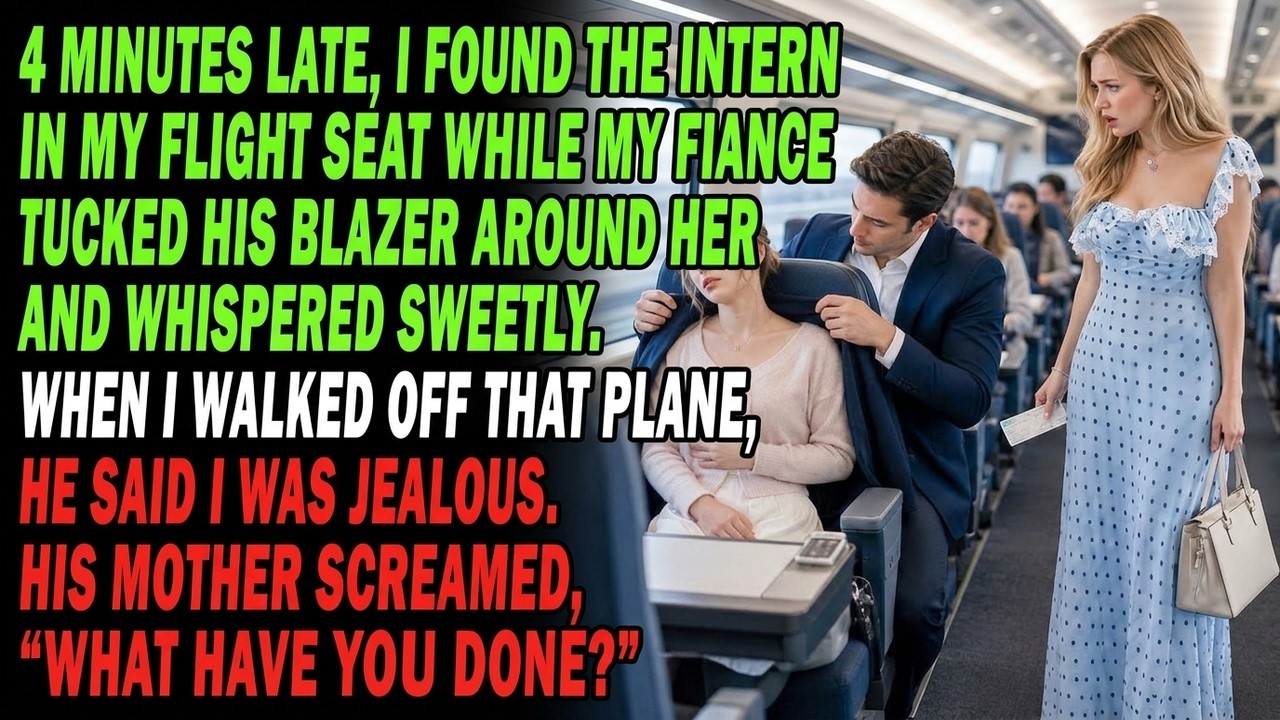
Seat 3A, window, which I had booked three weeks earlier and paid a $180 upgrade fee for because I had a pitch deck to review and I get car sick reading on planes if I can’t see the horizon. Tiffany was sitting in it. She was maybe 23, a marketing intern who joined the agency six weeks before, the kind of hire passed around between senior staff like a well-meaning favor. She was wearing a cream blouse and a soft gray blazer that wasn’t hers.
I recognized it before I even registered that it was Colton’s. He kept that blazer in his office. I had taken it to the dry cleaner twice. Colton was crouched in the aisle beside her, one hand resting on the headrest above her shoulder, the other tucking the blazer corners gently around her lap.
He was murmuring something low. I caught the tail end of it. *She’s easygoing. Don’t stress.
You need the window more than she does. *
Tiffany looked up and saw me before he did. Her face shifted, something between guilt and a practiced helplessness, and she started to rise. “Oh, I’m so sorry.
I wasn’t feeling well. The window helps with nausea. ”
Colton said, finally turning around, “You almost missed it. I’ve been texting you.
”
I stared at him. “There’s a seat two rows back,” he said, lowering his voice like he was doing me a kindness. “Tiffany’s original seat. It’s on the aisle.
You’ll be fine. ”
I looked at the seat in question. Middle of the cabin. Middle seat, actually, between a man with a laptop bag spilling into the adjacent space and a woman already asleep against the window.
That was not Tiffany’s ticketed seat. That was some third arrangement they had worked out without me. “Is 3A my assigned seat? ” I asked.
Colton exhaled through his nose. “Don’t make this a thing on the plane. ”
“Is 3A my assigned seat? ”
Tiffany tugged the blazer tighter and whispered, “I’ll move.
I really will. Please don’t be upset. ” But she didn’t move. Colton put a hand on my arm.
“She organized every single slide deck for this trip. She was up until one in the morning. She gets motion sickness. Can you just be the bigger person here for five minutes?
”
There it was. *Be the bigger person. *
I had been the bigger person for six years. I had been the bigger person when his mother borrowed money and forgot to pay it back.
I had been the bigger person when he took credit in front of clients for concepts I had developed. I had been the bigger person every time something was mine, and he found a reason it should belong to someone else. I looked at the window seat. I looked at Colton.
I looked at Tiffany, who had her fingers curled around the armrests now like she was bracing for landing. Then I turned around, walked back up the jetway, and got off the plane. The gate agent looked startled. “Ma’am, we’re closing in two minutes.
”
“I know,” I said. “I’m deplaning. ”
I stood at the window and watched the jetway retract. My phone buzzed four times in thirty seconds.
Then Colton’s name filled the screen. I declined it. I opened our text thread and typed, *We’re done. *
Then I opened my email and wrote three sentences to my wedding coordinator: *Please pause all active planning on our event.
I’ll follow up within 48 hours. Do not accept further direction from Colton or his family. *
She responded in eleven minutes. *Are you sure?
*
I looked at the engagement ring on my right hand. I’d switched it there months ago after a comment Colton’s mother made about how gaudy solitaires looked at agency client dinners. I pulled it off and dropped it into the front pocket of my bag. *I’m sure,* I typed back.
I booked the next flight to Chicago, which left two hours later. Business class, because I was going to sit in my seat and review my pitch deck in peace, which is exactly what I did. By the time I landed and got to the hotel, Colton had left six voicemails. I listened to the third one while the elevator rose to my floor.
His voice was clipped, that particular tone I had learned meant he was more embarrassed than angry. “You walked off a plane because Tiffany sat in your seat. Do you hear how that sounds? Call me when you’re done being dramatic and we’ll figure out the dinner situation.
”
I saved the voicemail and closed the app. My phone rang again just as I set my bag down. It was Darlene, his mother. I picked up.
She didn’t bother with pleasantries. “Your wedding coordinator sent a pause notice. What happened? ”
Six years ago, Darlene had called me sweetheart.
She’d said I was the daughter she always wanted. I understood now that her warmth had always been a function of my usefulness to her son. “The wedding is paused,” I said. “That’s accurate.
”
“Over a seat on an airplane? Is that what Colton told you? ”
“A pause. He said there was a misunderstanding with the new intern.
”
I almost laughed. “Darlene, I’ll be in touch about the financial details. Good night. ”
She was still talking when I ended the call.
The Chicago pitch was the account I had spent eight months building from scratch. The client was a regional healthcare network, run by Mr. Whitfield, meticulous, old school, the kind of man who noticed when someone mispronounced the name of his organization and did not move past it. I was the lead on the presentation.
Colton was the account supervisor. Tiffany was supposed to be taking notes and managing the printed materials. I found out at breakfast the next morning that Colton had asked Tiffany to open the meeting. He pulled me aside in the hotel corridor before we left, his voice carefully neutral.
“She stayed up working on the intro slides. It would mean a lot to her. ”
“She’s an intern,” I said. “Mr.
Whitfield asked for our senior team. ”
“It’s two minutes of introductions. You’re being territorial. ”
I looked at him for a long moment.
“Fine, she opens. You own the outcome. ”
He frowned. “What does that mean?
”
“Exactly what it sounds like. ”
Tiffany opened the meeting. She mispronounced the client’s name on the first slide, dropped the second syllable entirely, and Mr. Whitfield’s chin lifted by a fraction of an inch that I recognized as the beginning of his patience running out.
She read the wrong quarter’s data on slide four. On slide seven, a comment I had embedded for internal review was still visible on the projected version. A note in red text that said, *This framing feels too blunt. Can we soften before Wednesday?
*
The room went quiet in a specific way that rooms only go quiet when something has gone publicly wrong. Colton looked at me. That look, the same look he gave me every time something needed saving. And he had already spent his goodwill getting it broken.
I waited three full seconds. Then I stood up, connected my laptop, and apologized to Mr. Whitfield for the version discrepancy. I presented the correct materials in nineteen minutes and watched his expression move from irritation to engagement to, by the end, something close to approval.
After the room cleared, he shook my hand and spoke quietly. “Make sure the execution stays consistent with what I saw today. I don’t need to see the learning curve. ”
Colton didn’t speak to me on the cab ride back.
Then: “You let her hang out there on purpose. You put her out there. You could have jumped in sooner. ”
“You told me not to bring personal feelings into work.
”
He pressed his lips together. Tiffany was in the cab ahead of ours. Through the rear window, I could see her hunched over her phone, her shoulders small. “This is still about the seat,” he said.
“It was never about the seat. ”
“Then what? ”
I turned to look at him properly. He had the face of a man who genuinely believed his discomfort was the relevant center of any situation.
“It was about you knowing it was my seat and letting her have it anyway. It was about you not asking whether I was tired when I boarded. It was about you touching her hair like that in public and assuming I would smile about it. It was about six years of you assuming I would absorb whatever you handed me because I always had before.
”
He was quiet. Then: “You’re jealous. That’s what this is. ”
I faced forward and watched the Chicago street scroll past.
That night, Tiffany knocked on my hotel room door. I looked through the peephole. She was alone, holding a paper cup of tea. Her eyes were swollen from what I assumed had been a long afternoon of crying in a room where no one came to comfort her.
I didn’t open the door. “Sloan,” she said. She’d somehow learned my name, though I’d never introduced myself to her directly. “I just want to explain.
”
“There’s nothing to explain. ”
A beat of silence. Then her voice changed, the softness dropping out of it like a coat sliding off a hook. “You should know he talks about you differently than you think.
He says you’re exhausting. He says being with you is like being in a performance review. He feels like himself with me. ”
I turned on my voice recorder and held my phone close to the door.
She kept going. “You’re smart. I get it. But smart isn’t the same as easy.
He’s going to want easy eventually. That’s not my fault. That’s just how it is. ”
I let her finish.
Then I said through the closed door, “Tiffany, if he actually said those things, why are you telling me instead of him? ”
Silence. I saved the file. The internal review after we got back to New York was where the real shape of things became visible.
Our supervising VP, Neil, called the full Chicago team into a conference room and asked for an account of what happened at the client presentation. Colton went first. He said Tiffany had been nervous and that the version confusion was a technical glitch. I opened my laptop and projected the file access log.
Tiffany had modified the presentation at 11:47 p. m. the night before the meeting, softening language, shifting data, embedding a comment that was meant for Colton’s eyes only. Colton had approved the modified version at 12:31 a.
m. Neil’s expression went flat. “Colton, walk me through your decision to have an intern present to a senior client. ”
Colton looked at me.
I looked at my notes. Tiffany, to her credit or her panic, said, “He told me the original was too aggressive. He said the client didn’t like that tone. He said I could make it better.
”
Colton’s jaw tightened. “I told you to review it, not to present an unapproved version. ”
“But you approved it. ”
“I approved the language edits, not the…
you know, the style. ”
The room went still. Neil tapped his pen once on the table and looked at me. I kept my face entirely neutral.
What followed was not dramatic. It was procedural, which is almost worse. Neil suspended Colton from the account. Tiffany’s internship was terminated.
I was confirmed as sole lead on the Chicago account and its second phase expansion, which Mr. Whitfield’s team had already indicated they were interested in pursuing. After the meeting, Colton found me in the hallway. “You could have defended me in there.
”
“When? Anytime? ”
I stopped walking. “Six years ago, you told me I was your partner, that what was mine was ours.
You were right. So, I’m collecting. ”
He looked at me like I had become something unrecognizable. Maybe I had.
Or maybe I had always been this, and he had simply never paid attention. I went to see my attorney the following Thursday. I laid out everything on his conference table. The apartment I had contributed $130,000 of the $180,000 down payment on, documented by wire transfer records.
The renovation costs I had fronted, $45,000. The wedding deposits I had paid, $38,000 across venue, photographer, and catering contracts, all in my name. And the personal loans to Darlene, $22,000 over three years, in increments small enough that each one had seemed like a favor rather than an accumulation. My father had insisted on a cohabitation and contribution agreement before I moved in.
I had been embarrassed to ask Colton to sign it. I signed it anyway. The agreement was clear. My contributions were protected personal assets.
Upon dissolution of the engagement, they were to be returned within forty-five days. “Your father was a careful man,” my attorney said. “He was,” I said. The family dinner came three days later.
Darlene had arranged it at a private room in a restaurant she loved for its lighting. The kind of place designed to make you feel like you owe someone something simply by being there. When I walked in, she was already seated at the head of the table. Colton’s aunt was there.
Two cousins, one dressed in ivory, which struck me as an interesting choice. Darlene smiled with all of her face except her eyes. “You’re here. Good.
This has been a misunderstanding, and we’re going to clear it up like adults. ”
I sat near the door. Colton’s aunt leaned forward. “Honey, these things happen.
Men get a little too attentive with young colleagues sometimes. It doesn’t mean anything. You have six years together. You can’t throw that away.
”
Tiffany’s eyes went immediately wet. “It’s all my fault. I should have known better. ”
“She’s just a sweet girl,” the aunt said.
I looked at her. “A sweet girl doesn’t take someone else’s assigned seat and then cry when asked to give it back. ”
The table went quiet. Darlene set down her fork.
“Sloan, I know you feel hurt, but you need to be realistic. A woman in your position can’t let one moment of jealousy define a six-year relationship. ”
“Is jealousy what you think this is? ”
“What else could it be?
”
I reached into my bag and placed a document on the table, sliding it toward her. “This is the dissolution and settlement agreement. Since everyone is here, let’s talk about it now. ”
Darlene didn’t touch it.
She stared at me. “You’re serious. ”
“I was serious when I got off the plane. ”
What came next was the part of the evening I had prepared for.
Darlene tried the soft approach. Sunk cost. Family honor. Think of the time invested.
Colton’s aunt tried guilt. Colton sat silent for longer than I expected, then finally said, “You’re doing this because you want to punish me. ”
“I’m doing this because I’m finished. ”
“You can’t just be finished.
Six years. ”
I opened my phone and played the recording from outside my hotel room door. Tiffany’s voice filled the private dining room. *He says being with you is like being in a performance review.
He’s going to want easy eventually. *
Tiffany went white. Colton turned to look at her. Darlene sat very still.
“I didn’t record you to embarrass you,” I said to Tiffany. “I recorded you because you said it when you thought no one was listening. That’s usually when people say what they actually mean. ”
Darlene recovered first.
“You’ve been planning this. ”
“I’ve been protecting myself. There’s a difference. ”
I looked at Colton.
“You gave her access to my files without asking. You drape your jacket over her in public. You tell me I’m jealous and tell her I’m too much. You were building a replacement, and you thought I wouldn’t notice because I never made it difficult.
”
I paused. “I’m making it difficult now. ”
He said nothing. I picked up my bag.
“The agreement is there. My attorney will follow up on Monday. If there’s no response in ten days, we proceed with filing. ”
Darlene grabbed my wrist.
“You sit back down. I am not done. ”
“I am,” I said, and I walked out. Colton followed me into the corridor.
He called my name. I stopped but didn’t turn. “Is there anything I can say? ” he asked.
I thought about the plane, the jetway, the way the door had sealed behind me on the tarmac, and I had stood there with my chest aching and nowhere to be except somewhere better. “You had a chance to get off the plane with me,” I said. “You didn’t. ”
I stepped into the elevator.
The settlement took five weeks. Colton liquidated a brokerage account and took a personal loan from a colleague for the remainder of my down payment contribution. He paid in two installments. Each transfer came with a short text that I didn’t open until my attorney confirmed the amount cleared.
Darlene paid back $18,000 of the $22,000. Her attorney argued the remainder constituted a gift. My attorney produced twelve separate text messages in which Darlene had used the words “pay you back. ” We settled on the full amount with a thirty-day extension for the final installment.
The Chicago account went well. Mr. Whitfield was satisfied with the second phase proposal. My lead was confirmed formally in writing, which meant a title change and a budget I had been quietly carrying for eight months without the official designation.
I accepted both without making a speech. A colleague took me to dinner to celebrate, a small Italian place in Midtown. She told me Tiffany had tried to post something online about toxic workplace culture before the agency’s legal team flagged a confidentiality clause in her NDA. I didn’t look up the post.
I didn’t need to. What I remember most from that dinner is that she asked me at some point over dessert whether I was sad. I thought about it honestly. “I’m lighter,” I said.
She tilted her head. “That’s not the same thing. ”
“No,” I agreed, “but it’s better. ”
I saw Colton one more time at the notary.
We sat across from each other at a small table while the documents were stamped and initialed. He had lost some weight. His collar sat slightly wrong, which meant he hadn’t been taking his shirts to the cleaner I had found for him three years ago. I noticed this without feeling anything in particular about it.
“If I had gotten off the plane,” he said quietly while the notary stepped out. “Don’t,” I said. “I’m just… ”
“I know.
”
I looked at him. “That’s the thing about moments. You only get them once. ”
He looked down at the table.
The notary returned. We signed where indicated. The notary stamped the final page and said, in the business-like tone of someone finalizing a car registration, “That’s everything. You’re all set.
”
I picked up my copy. Colton sat still. Outside, I stood on the sidewalk for a moment and breathed in the smell of the city. Coffee carts and concrete in that particular October cold.
That means winter is coming, but isn’t here yet. My phone showed a new email from Mr. Whitfield’s office. Phase two kickoff confirmed for November 4th.
Chicago again. I already had my ticket. Window seat. I’ve thought about that morning at JFK a lot since then, not with bitterness the way I used to, but with a kind of gratitude for my own reflexes.
Because when I saw Colton lean over Tiffany with that jacket, when I heard him say she wouldn’t mind, something in me understood what six years of being reasonable had cost me. And instead of swallowing it one more time, I put down my bag, turned around, and walked back up the jetway into my own life. He thought I was being jealous. His mother thought I was being dramatic.
Tiffany thought she was winning something. None of them understood that I wasn’t losing a seat.