The execution of Margaret Pole, the 67-year-old Countess of Salisbury and the last surviving Plantagenet princess, descended into a scene of such grotesque butchery on the morning of May 28, 1541, that it has haunted the historical record for centuries.
The elderly noblewoman, a first cousin of Queen Elizabeth of York and the mother of the exiled Cardinal Reginald Pole, was led out to a small block of wood in the grounds of the Tower of London. There was no scaffold, no experienced executioner, and no dignity in her final moments.
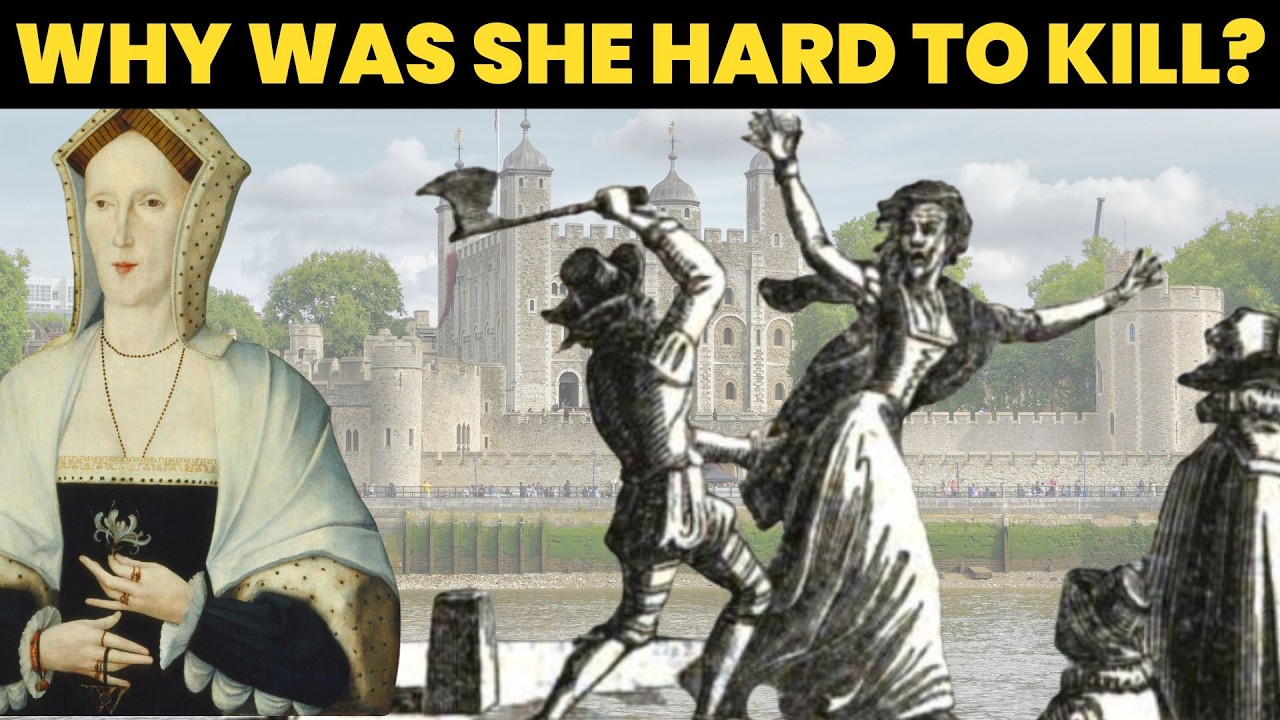 According to the account of Eustace Chapuys, the Imperial Ambassador, a “wretched and blundering youth” was chosen to carry out the King’s sentence because the regular axeman was absent on duties in the north. The result was a horrific mutilation, with the novice executioner literally hacking the Countess’s head and shoulders to pieces in a “most pitiful manner.”
The death of Margaret Pole was not a swift act of judicial murder but a prolonged and agonizing slaughter that shocked even the hardened observers of the Tudor court.
Chapuys, writing to the Queen of Hungary on June 10, 1541, described how the Countess, upon being told her sentence was to be carried out, found the situation “very strange,” claiming she did not know of what crime she was accused. However, perceiving there was no remedy, she walked out of her confinement and toward the space in front of the White Tower.
She commended her soul to her creator and asked those present to pray for the King, Queen, Prince Edward, and the Princess Mary, to whom she sent her blessing. She had been Mary’s godmother and governess, a bond that had been shattered by the King’s break from Rome.
After her final words, she was told to place her neck on the block. She did so without delay, but the executioner, a “garsonel” or young lad, failed catastrophically. The French ambassador, Charles de Marillac, noted that the execution was carried out in such secrecy that by evening, the truth of her death was still doubted, so few were present to witness the horror.
The two ambassadors provide conflicting details on the crowd size, with Chapuys claiming the Lord Mayor of London and about 150 others were present, while de Marillac insisted the killing was done in a corner of the Tower in front of almost no one. Despite these discrepancies, both agree on the central tragedy: the botched, savage nature of the killing.
For centuries, a popular myth has persisted that Margaret Pole refused to lay her head on the block, instead running around the execution area, forcing the axeman to chase her and requiring a staggering eleven strokes of the axe to finally sever her head. This dramatic tale, often repeated in documentaries and online articles, appears to be a fabrication.
The story of the eleven blows cannot be traced to any contemporary source. It does not appear in the letters of Chapuys or de Marillac, nor in the chronicles of Edward Hall, Wriothesley, or the Greyfriars Chronicle. The claim, which is sourced on Wikipedia to a 2011 book by Simon Webb, provides no original documentation.
The detail of the Countess resisting and dodging the block originates from a 1649 book written by Edward Lord Herbert of Cherbury, over a century after the event. Herbert claimed to have heard the story from “a person of great quality,” but provided no verifiable source, leading modern historians like Hazel Pierce, author of the definitive biography of Margaret Pole, to dismiss it as an invention.
The contemporary evidence is clear that Margaret did not resist. She knelt and placed her head on the block as instructed. The horror of her death was not due to her defiance, but to the sheer incompetence of the young executioner who was tasked with the job.
Margaret Pole was a woman of immense royal lineage. Born in August 1473 at Farley Castle, she was the daughter of George, Duke of Clarence, and Isabel Neville. Her father was executed for treason in 1478, and her brother, Edward, Earl of Warwick, was executed by Henry VII in 1499.
She married Sir Richard Pole in 1487 and had five surviving children. After her husband’s death in 1504, she remained a prominent figure at court. Henry VIII made her Countess of Salisbury in her own right in 1512, and she served as governess to his daughter, Princess Mary.
Her downfall began with the King’s divorce from Catherine of Aragon and his marriage to Anne Boleyn. Margaret remained a staunch supporter of the discarded Queen and Princess Mary, offering to serve the latter at her own expense after her household was dissolved in 1533.
Her son, Reginald Pole, fled to mainland Europe and became a devoted Catholic cardinal, openly condemning Henry VIII’s break from Rome. In 1538, her son Geoffrey was found to be in communication with his disgraced brother, leading to the arrest of Margaret and her other son, Henry Pole, Lord Montagu.
Henry Pole was executed in January 1539. Margaret was attainted without trial, accused of plotting with her sons against the King. The evidence against her was flimsy, with Thomas Cromwell, the King’s chief minister, allegedly producing a tunic found in her coffers that symbolized Reginald Pole’s intention to marry Mary and restore papal authority.
 Historians believe this tunic was likely fabricated by Cromwell, as her coffers had been thoroughly searched at her arrest in November 1538, months before the tunic was supposedly discovered. Cromwell himself would be executed in July 1540, but his machinations had already sealed the fate of the Countess.
Margaret remained imprisoned in the Tower for two and a half years. The King was still purchasing new clothes for her as late as March 1541, suggesting there was no immediate plan to 𝓀𝒾𝓁𝓁 her. However, her implication in the supposed intrigues of Sir Thomas Wyatt and Sir John Wallop, coupled with the rising in the north led by Sir John Neville, likely changed the King’s mind.
The execution was carried out hastily, without the usual scaffold, indicating a swift decision to rid the King of a potential rallying point for rebellion. The fact that the regular executioner was unavailable and a novice was used in his place suggests the killing was not planned with the usual care given to high-status prisoners.
When Reginald Pole heard of his mother’s death, his reaction was reported to be one of strange joy. According to his secretary, Ludovico Beccadelli, Reginald declared that the news made him the son of a martyr, glorifying in the fact that God had honored him by making his mother a saint for her constancy in the Catholic faith.
He reportedly said, “Let us rejoice, for we have another advocate in heaven,” before retiring to his private oratory for an hour. This response, while 𝓈𝒽𝓸𝒸𝓀𝒾𝓃𝑔, was consistent with the religious fervor of the time, where dying for the faith was seen as a divine honor.
Margaret Pole was buried near the altar in the Chapel of St. Peter ad Vincula within the Tower of London, just a few feet away from Anne Boleyn and her brother George. She would not rest in peace for long.
In 1876, during the reign of Queen Victoria, the chapel floor required serious maintenance. With royal permission, a mass exhumation of the bodies underneath was undertaken. The bones believed to be those of Margaret were found gathered in two distinct groups, having been disturbed and moved centuries earlier to make way for other burials.
Doyne Courtenay Bell, who oversaw the exhumation, described the remains as belonging to a tall, aged female. A detailed description by Dr. Frederick J.
Mouat noted the presence of a skull fragment, portions of the sternum, ribs, sacrum, pelvis, radius, clavicles, vertebrae, and fibula. Many bones were missing, and some had been eroded by lime.
The skull was in particularly poor condition, a fact that aligns with the horrific nature of her execution, where her head was hacked to pieces. The remains were reburied under the floor, and her name appears on a Victorian marker and a plaque on the wall.
In 1886, 345 years after her death, Margaret Pole was beatified by Pope Leo XIII, recognizing her as a martyr who died for her faith. While her son Reginald claimed she was killed for her constancy in the Catholic faith, historians argue that Henry VIII likely killed her out of spite, unable to reach Reginald, who was the true focus of his ire.
The story of Margaret Pole is one of tragedy, political intrigue, and brutal violence. She was a woman of royal blood who fell victim to the paranoia and tyranny of a king who would stop at nothing to secure his dynasty and his supremacy. Her death, botched and horrific, stands as a grim testament to the dangers of the Tudor court.
The myth of the eleven strokes and the running Countess, while dramatic, does a disservice to the reality of her death. She did not resist. She faced her end with the dignity expected of a noblewoman, only to be betrayed by the incompetence of her executioner.
The true horror of her death lies not in a defiant chase, but in the agonizing, prolonged butchery that occurred when the axe fell. The young executioner, terrified and unskilled, hacked at her neck and shoulders repeatedly, turning a judicial execution into a massacre.
 The accounts of Chapuys and de Marillac, written within days of the event, provide the most reliable picture of what occurred. They describe a woman who accepted her fate, prayed for her family, and was then brutally slaughtered by a bungling amateur.
The legend of Margaret running around the block is a later invention, likely created to add dramatic flair to an already tragic story. The reality is that she was a victim of a system that had decided her fate, and she met it with the courage of her convictions, even as the axe failed to do its job cleanly.
Her remains, disturbed and scattered over the centuries, were finally identified by the Victorians, who noted her advanced age and tall stature. The poor condition of her skull serves as a silent witness to the violence of her final moments.
Margaret Pole’s legacy is complex. She was a devoted mother, a loyal servant to Princess Mary, and a staunch Catholic. She was also a Plantagenet, a bloodline that Henry VIII was determined to extinguish.
Her death was not just a personal tragedy but a symbolic act, marking the end of a royal dynasty.
The Countess of Salisbury was the last of the right line and name of Plantagenet, as noted by the Wriothesley Chronicle. Her execution severed the final thread of a family that had ruled England for over three centuries.
In the centuries since her death, historians have debated the reasons for her execution. Some argue it was purely political, a move to eliminate a potential claimant to the throne. Others believe it was personal, a revenge for the defiance of her son Reginald.
The evidence suggests that Henry VIII was motivated by a combination of fear and spite. He feared that Margaret, with her royal blood and Catholic sympathies, could become a figurehead for rebellion. He was also furious at Reginald Pole, who had escaped his grasp and was actively working against him from Rome.
Unable to punish Reginald, the King turned his wrath on his mother. The execution of Margaret Pole was an act of petty vengeance, carried out with a cruelty that shocked even the contemporaries of a king known for his ruthlessness.
The botched nature of the execution, with the use of an inexperienced axeman and the lack of a proper scaffold, suggests that the killing was rushed and perhaps intended to be as degrading as possible. It was a final insult to a woman who had once been one of the highest-ranking ladies in the land.
The story of Margaret Pole serves as a reminder of the fragility of life in the Tudor era, where even the most noble could be brought low by the whims of a tyrant. Her death, horrific and unjust, has secured her a place in history as one of the most tragic victims of Henry VIII’s reign.
The Blessed Margaret Pole, as she is now known in the Catholic Church, is remembered for her steadfast faith and her courage in the face of death. Her story continues to fascinate and horrify, a dark chapter in the bloody history of the Tower of London.
The Tower, a place of execution and imprisonment, holds the remains of many of Henry VIII’s victims. Margaret Pole lies alongside Anne Boleyn, Catherine Howard, and her own son, Henry Pole, Lord Montagu. Their bones, disturbed and reburied, are a testament to the violence that defined the era.
The exhumation of 1876 provided a rare glimpse into the physical remains of these historical figures. The bones of Margaret Pole, tall and aged, were a poignant reminder of the woman who had once been a governess to a princess and a countess in her own right.
 The description of her remains, with the skull in fragments and the bones eroded by lime, paints a grim picture of decomposition and disturbance. It is a far cry from the grand funeral she would have been afforded in a different time.
Her beatification in 1886 was a recognition of her suffering and her faith, but it does little to erase the horror of her death. She was a victim of a political and religious conflict that tore England apart in the 16th century.
The story of Margaret Pole is a cautionary tale about the dangers of power and the brutality of those who wield it. Henry VIII, a king who broke with the Pope and created his own church, was willing to destroy anyone who stood in his way, regardless of their age, gender, or noble lineage.
Margaret Pole was 67 years old when she was killed, an elderly woman who posed no credible threat to the King. Yet, she was butchered in a manner that was both cruel and incompetent, a final act of spite from a monarch who had lost all sense of mercy.
The myths that have grown up around her death, the eleven strokes and the running Countess, serve to obscure the reality of her suffering. The truth is more terrible: a dignified woman, kneeling at a block, being hacked to pieces by a terrified boy.
The accounts of the ambassadors, written in the immediate aftermath, are the closest we can get to the truth. They describe a woman who faced her death with composure, only to be subjected to a prolonged and agonizing execution.
Her son Reginald, who had caused her downfall, was in Rome when he heard the news. His reaction, to rejoice in her martyrdom, was a product of his religious fervor, but it also reveals a coldness that is difficult to comprehend.
The story of Margaret Pole is one of the most tragic in English history. It is a story of a woman caught up in events beyond her control, destroyed by a king who saw her as a threat. Her death, botched and brutal, is a reminder of the human cost of political ambition.
The Tower of London, with its bloody history, is a fitting resting place for the Countess of Salisbury. Her bones, disturbed and reburied, lie beneath the chapel floor, a silent testament to the violence of the Tudor age.
The Victorian exhumation, while macabre, provided a final chapter to her story. The identification of her remains, tall and aged, confirmed the accounts of her execution and her burial. It was a grim discovery, but one that allowed historians to piece together the final years of her life.
Margaret Pole’s legacy is one of tragedy and faith. She was a woman of royal blood who died a martyr’s death, but her story is also a reminder of the arbitrary nature of justice under Henry VIII. She was condemned without trial, on flimsy evidence, and executed in a manner that was both cruel and incompetent.
The myth of the eleven strokes, while false, has become part of her legend. It is a story that adds 𝒹𝓇𝒶𝓂𝒶 to an already dramatic tale, but it also obscures the reality of her death. She did not run, she did not resist.
She knelt and placed her head on the block, and was then butchered by an amateur.
The truth of her death is more terrible than the myth. It is a story of a woman facing her end with dignity, only to be betrayed by the incompetence of her executioner. It is a story of a king’s cruelty, a family’s destruction, and a dynasty’s end.
The Blessed Margaret Pole, Countess of Salisbury, is remembered today as a martyr and a victim. Her story, horrific and tragic, continues to resonate, a reminder of the dark side of the Tudor age and the brutality of a king who would stop at nothing to maintain his power.