The lake house was his idea. Six years of marriage, and my husband had never once planned a surprise. Not for Christmas, not for my birthday, not for any of our anniversaries. So when he came home in early September waving printed reservation confirmations and talking about a private cabin on Haven Lake in the Catskills, I didn’t question it.
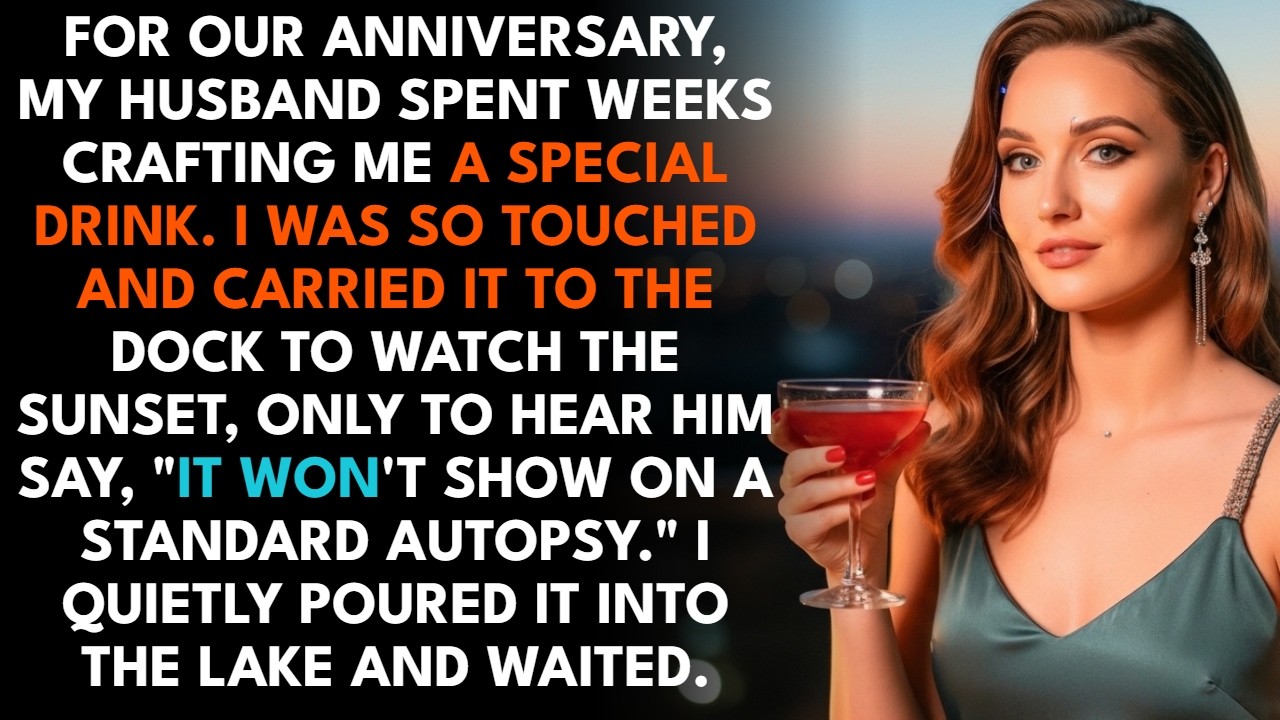
I just smiled and felt something bloom open in my chest. Hope, maybe. Or what I thought was hope. He’d been acting different for weeks.
More attentive, more interested. He asked about my days when he used to be absorbed in his phone. He brought home flowers twice. I told my colleague at work that I thought we were finally coming back around, that maybe the hard stretch of the past two years was ending.
She asked what changed. I didn’t know how to answer that. And I should have paid more attention to why. The drive up took three hours.
He talked the whole way about the fall foliage, about the dock over the lake, about a specialty cocktail he’d been working on for our anniversary—an elderflower and bourbon spritz. He’d ordered the botanicals from a specialty supplier in Vermont. He called it the six-year toast. “You don’t drink cocktails,” I said.
“You drink beer from a can. ”
“People change,” he said, and squeezed my hand on the console. The dock was beautiful. It extended maybe forty feet over the lake, the water so still and dark it looked like hammered pewter.
We arrived late afternoon. While he brought in the bags, I walked to the end of the dock with my camera around my neck and just stood there, breathing in the cold September air. I am a forensic accountant. I have spent eleven years reconstructing financial deceptions, tracing money through shell companies and falsified invoices, following the trail that people lay down when they believe no one is following them.
Over those years, I developed a particular sensitivity to wrongness. A quiet internal signal, like a gauge needle tipping. Something here is not what it’s being presented as. The gauge had been ticking for six weeks.
I’d noticed the first withdrawal in early August—$2,000 to a vendor name I didn’t recognize from our joint account. Then another, then small transfers, irregular, always different amounts, always different vendor names that dissolved when I tried to trace them. I pulled the full transaction records on a Sunday morning and sat with them for four hours, looking for pattern, and I found one. The money was moving to what looked like a newly formed LLC registered at an address in New Jersey I didn’t recognize.
I didn’t say anything. That’s the first rule of a financial investigation. Never let the subject know you’re looking, not until you have everything. I photographed the records and uploaded them to my encrypted work server, and I waited.
That September, on the dock, I was still waiting, still building the picture. I was framing a shot of the far shore, adjusting exposure, absorbed, when his voice drifted out over the water through the open kitchen window. The tone he uses in high-stakes conversations he thinks I can’t hear. “Tonight,” he said.
“I told you tonight. ”
I lowered my camera. “The concentration we discussed is correct. She has no cardiac history, no physician she sees regularly.
They’ll order a standard panel at autopsy. Standard doesn’t catch aconitine unless you’re specifically looking for alkaloids. By the time anyone thinks to order that test, it’ll have metabolized below detectable levels. They’ll see sudden cardiac arrhythmia.
They’ll see a 32-year-old woman with no prior history, and they’ll close the file. ”
A pause. Then, quieter, something I couldn’t make out. “2.
8 million,” he said, “after the primary beneficiary designation I filed in March. She doesn’t know about the policy. I handled the notary myself. It’s clean.
”
The dock swayed, or I did. The camera felt very heavy in my hands. “Yes, tonight, and it’s finished. ”
I don’t remember making a decision.
I raised my camera and pressed the shutter, slowly, so the mechanical click carried across the water, and he would hear it and know I was still out here, still shooting, still the wife who noticed nothing. And with my other hand, I reached into my jacket pocket and pressed record on my phone. He came out five minutes later carrying two highball glasses, something pale gold and sparkling inside each one. He smiled as he walked toward me down the dock in the amber last light.
If someone had photographed that moment, it would have looked like exactly what it was supposed to look like. A husband bringing his wife a drink on their anniversary. “The six-year toast,” he said. “It’s beautiful,” I said.
He handed me my glass. He kept his. We stood at the end of the dock together and he put his arm around me and told me he loved me. He said these had been the best six years of his life.
He said he couldn’t picture growing old with anyone else. I listened to every word. Out of the corner of my eye, I watched him raise his own glass and sip. He drank without hesitation.
“I want a photo of us,” I said. “Hold on. Let me get the tripod. ”
I handed him my glass.
He took both without thinking and watched me walk up the dock toward the camera bag. I crouched and made a show of searching, buying myself twenty seconds of ease. When I looked back, he was facing the water, both glasses in his hands, the last of the light behind him. I set up the tripod.
We took the photograph together, laughing, arms around each other, both holding our drinks up toward the camera. It is a good photograph. I still have it. Then I brought my glass to my lips, turned toward the lake as though looking at something in the distance, and let the liquid pour silently off the edge of the dock into the water below.
Whatever sound it made was swallowed by the wind in the pines. “Perfect,” I said, turning back. “That might be the best thing I’ve ever tasted. ”
He looked at my face with an attention I now understood completely.
He was watching for the first sign. He was calculating when it would begin. “I’m glad,” he said. He glanced at his watch.
7:22 p. m. The next hour was the most exquisitely terrible of my life. We sat in the folding chairs at the end of the dock and talked the way we hadn’t talked in years, about places we’d always meant to visit, about the apartment we’d almost bought, about small, funny things from the early years.
He was warm and present and attentive, and some part of me that was still capable of grief registered the loss of this—not of him, but of the life I’d believed in for six years. 7:35, his leg bounced against the armrest. 7:44, he checked his watch, then looked at me. 7:52, “Are you feeling all right?
” he asked. “I feel wonderful,” I said. “Honestly, I haven’t felt this relaxed in months. ”
He smiled and said that was good to hear, and the smile didn’t reach his eyes.
8:07, his hands had started turning his water glass in slow circles, the way he does when he’s managing anxiety he can’t let show. 8:14, he suggested we go inside. “Getting cold,” he said. “In a few minutes,” I said.
“I want to stay out here a little longer. It’s so beautiful. ”
He stayed beside me. He couldn’t leave without it looking strange.
8:19, nothing was happening to me, and he was beginning to understand that nothing was going to happen. Confusion moved up across his face, subtle, controlled, but there. I had spent eleven years learning to read the moment someone realizes their numbers don’t add up. “I think I’ll call my sister,” I said, standing.
“I promised I’d check in. You stay. Enjoy the view. ”
I went inside.
I sat on the edge of the bed and called Dev—the senior partner at our firm, the person who trained me. He picked up on the second ring. When I played him the recording, the silence on his end lasted long enough that I asked if he was still there. “I’m here,” he said.
“How long have you been sitting on this? ”
“Six weeks of financial records. The recording is from about an hour ago. ”
“Nina.
” He said my name the way people say it when they don’t know what else to say. “You need to get out of there tonight. ”
“I know,” I said. “I’m working on it.
”
“Did you drink any of it? ”
“No. ”
He told me exactly what to do, and I already knew most of it, but it helped to hear it from someone who wasn’t inside the situation. I spent the next twenty minutes in the bathroom photographing every document I’d brought.
The transaction records, the LLC registration printout, the life insurance solicitation mailer I’d retrieved from the recycling bin in January and quietly saved in a folder at work marked with a client code he would never think to look up. I uploaded everything to the firm’s encrypted server. Then I drafted a detailed email to the county sheriff’s tip line, attached the recordings and documents, and pressed send. When I came back outside, I told him I was getting a bad headache.
The pine sap, I thought, setting off my sinuses. And asked if we could drive into town and stay at the inn instead of the cabin. He said of course. He was pleasant and solicitous.
He carried the bags to the car and opened my door. On the drive, he asked twice if I was feeling okay. “A little off,” I said. “Just tired.
”
He nodded and watched the road. The county sheriff’s detective called my cell at 7:45 the following morning while he was still asleep. Her name was Gallagher, and she was quiet and methodical in the way I’ve learned to trust. She asked me to come in before he woke up.
I told him I was getting coffee and drove to the sheriff’s annex on the main road through town. I laid out everything. The recording, the financial records, six weeks of transaction analysis formatted the way I format evidence for court. She listened without interrupting.
When I finished, she looked at the documents for a moment, then at me. “You have a real instinct for this. ”
“It’s my job,” I said. The woman on the phone, the one he’d called Harper, took them four days to identify.
She worked as a compounding pharmacy technician at a private aesthetics clinic in New Jersey licensed to handle specialized pharmaceutical compounds. The state licensing board, acting on an anonymous tip, audited the clinic’s inventory against dispensing logs. They found a discrepancy in the aconitine accounting—small amounts diverted over four months, logged under a discontinued batch number that should have flagged on quarterly review but didn’t because someone had adjusted the timestamp records. She was questioned on a Thursday.
By Friday morning, she had given a full statement. He had met her two years ago, she said. He had been charming and certain. He told her his marriage was over in everything but name.
He said that once things were resolved, they would go somewhere warm and start clean. “Somewhere without winters,” he’d said. She said she had never thought of herself as someone who could do something like this. I believed her.
The way I believe everyone who sits across from me in a financial interview and says they never thought of themselves as someone who could do the thing the records show they did. Almost none of them do. That’s what makes the records necessary. His mother, Elaine, was harder.
She had co-signed the LLC, a fact that emerged from the financial audit once investigators had the entity name and registration date. Her name was on the founding documents alongside his. She said she hadn’t known what the LLC was for. She said he’d told her it was a passive investment vehicle, something related to a client account.
Investigators reviewed her phone records and found a four-minute call placed the morning we left for the Catskills, from her number to his. The call hadn’t been recorded. There was no way to prove what was said. She was not charged.
Insufficient direct evidence of knowledge or intent. I accepted this because I had no choice. But I thought about it afterward, the way she used to look at me at family dinners, weighing and finding short. The way she’d said once to a relative within my earshot that it was a shame about our situation, as though my career were a defect I’d chosen to inflict on her son.
I made peace with not knowing if it was something else. He was arrested at a gas station outside Woodstock on his way back to the city. He did not look surprised when the detective showed her badge. That was the detail that stayed with me longest.
He looked like a man who had been waiting to see how the calculation came out. I visited him once before trial. I didn’t have to. No one suggested I should.
But there was something I needed to say to his face, and I have learned not to leave those things unsaid. He was thinner. The particular confidence that had lived in his posture for as long as I’d known him had gone out of it. He sat across from me in the visitation room in a gray institutional shirt and looked at me with an expression I couldn’t quite name.
Something between resentment and, strangely, relief, as though the pretending were finally finished. “I just want to know one thing,” I said. “Was any of it real? Any of the six years?
”
He was quiet for a moment. “The first two, maybe three. ”
I nodded. I took that information and filed it somewhere it could not do further damage.
“You made one mistake,” I said. “You spent six years married to a forensic accountant, and you forgot that everything leaves a trail. ”
I stood up and collected my jacket. “You should know,” I said quietly before I turned, “that I heard the whole call.
From the beginning. I’ve been recording since before you brought out the drinks. ”
I watched his face change. Disbelief, then calculation, then a cold understanding of exactly how far back it all went.
“I filed everything I had with the investigators three days before your arrest. Every transaction, every document. The recording is unimpeachable. ”
I put on my jacket.
“Goodbye,” I said, and I walked out. The trial lasted nine days. His attorney argued that the recording was manufactured, that the financial evidence was circumstantial, that the case was an elaborate setup by a jealous wife who’d discovered the affair and had both the professional skill and the cold calculation to frame an innocent man. One cross-examination question got the most attention.
“Can you explain why a woman who believed her husband was planning to murder her wouldn’t call the police immediately? Why would she go inside and pretend nothing had happened and make small talk for nearly an hour? ”
“Because,” I said, “I needed the recording to be complete. I needed him to stop talking on that call before I did anything that would make him stop.
And I needed to be certain, absolutely certain, that what I heard was what I thought I heard. I have spent eleven years in forensic work learning not to act on a partial picture. You wait until you have the whole thing. Otherwise it’s just an accusation.
And an accusation without evidence protects no one. ”
The attorney sat down. The jury took eleven hours. Guilty on all counts.
Conspiracy to commit first-degree murder, wire fraud, insurance fraud, and forgery of my signature on the life insurance application. A detail I still find almost stunning in its arrogance. The idea that he could sign my name to a document designed to pay out on my death and I would never notice. Twenty-two years, with eligibility for review at fifteen.
Harper received four years and the permanent revocation of her pharmacy license. I stood outside the courthouse in November air sharp enough to sting, and Dev stood beside me, and neither of us said anything for a while. The city moved around us the way cities do, indifferent, already on to the next thing. “What do you want to do now?
” Dev said eventually. I thought about the dock, the light on the pewter water, the moment before the window was open and I heard anything. Just the camera and the lake and the cold air and something that might have been peace. “Something completely different,” I said.
I moved to Savannah the following spring. I started my own practice—forensic accounting and financial abuse consulting, with a specific focus on economic control in intimate partnerships. It turns out a remarkable number of people are living inside financial structures they didn’t consent to and don’t have the language to name. They know something is wrong.
They feel the wrongness like a pressure in the chest they can’t locate or explain. But they don’t have the evidence, or they don’t know how to build it, or both. I help them find the trail. I help them build the case before they need it.
I got a dog. Her name is Fig, and she has no part in this story except to say that she exists, which is its own kind of evidence that things do get better. I kept the photograph from the dock. Two people at the end of a pier at sunset, laughing, holding their drinks up toward the camera.
I look at it sometimes, not with grief or longing, but as a reminder. I was standing at the edge of something designed to swallow me whole, and I did not fall. I saw it the way I see any ledger. I found the thread, I followed it to the source, and I walked away with the full picture.
My name is Meena Aldrich. I am thirty-three years old, and I am, in every sense that matters, just beginning.