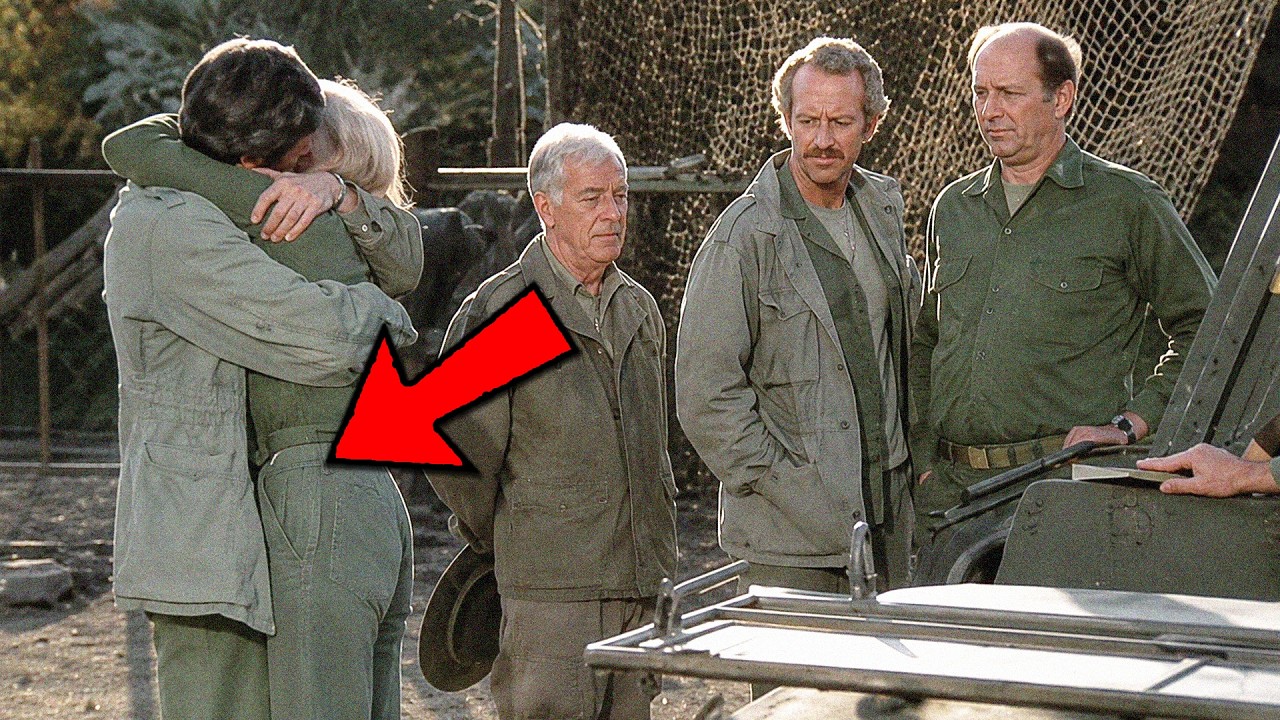
In 1983, the legendary finale of MASH drew a record-breaking 105 million viewers, closing out an 11-season run that had made the show one of the most beloved in television history. Yet hidden within those emotional final moments was an embarrassing detail in plain sight—a visible reminder that the Korean War setting was, in fact, a Southern California film location. The mistake did little to tarnish the episode’s reputation, but it remains a fascinating footnote for eagle-eyed fans to this day. The story of MASH began in 1968, when surgeon H.
Richard Hornberger turned his Korean War experiences into a novel under the pen name Richard Hooker, collaborating with writer W. C. Heinz. The book blended battlefield tragedy with razor-sharp humor, and just two years later, director Robert Altman adapted it into the hit film, creating the fictional 4077th Mobile Army Surgical Hospital by cutting the original real-world hospital number in half.
In 1972, the story moved to television. Several of its biggest stars brought genuine military experience to their roles. Alan Alda, who became inseparable from the role of Hawkeye Pierce, had served six months in the US Army Reserve in Korea. Jamie Farr, who played Corporal Klinger, had been stationed in Japan and toured Korea with Red Skelton’s USO show.
Wayne Rogers had served in the Navy, and Mike Farrell in the Marine Corps. Their familiarity with military life added a layer of realism audiences may not have consciously noticed but certainly felt. The casting process nearly changed the series’ identity entirely. McLean Stevenson initially auditioned for Hawkeye before producers convinced him to take the role of Lieutenant Colonel Henry Blake, a decision widely seen as one of the show’s smartest moves.
Comedian Robert Klein turned down the role of Trapper John McIntyre, and has always insisted he never regretted passing on one of television’s biggest hits. Writer Larry Gelbart, tired of Hollywood, had moved to London before the chance to adapt Altman’s film pulled him back. He wrote the pilot in just two days, earning $25,000 for the script. One character never expected to last became one of the show’s greatest icons: Corporal Klinger was originally written for a single episode and was initially conceived as a gay character.
That idea was abandoned, transforming Klinger into a cross-dressing soldier trying to convince the army he was mentally unfit for service—a concept inspired in part by comedian Lenny Bruce’s claim that he received a Navy discharge after declaring homosexual tendencies. Behind the scenes, MASH’s creators repeatedly clashed with the network over realism. Series creator Larry Gelbart and executive producer Gene Reynolds opposed the use of a canned laugh track, arguing it undermined the show’s emotional balance. CBS insisted audiences expected laughter in a 30-minute comedy, but eventually agreed to a key compromise: no laughter during operating room scenes, allowing those moments to retain their gravity.
As the series progressed, the laugh track became noticeably quieter, and in the UK, the BBC aired the show without it altogether. The network also blocked stories it feared made the military look bad, including one proposed episode about soldiers deliberately exposing themselves to freezing temperatures until they became sick enough to be sent home—a tactic reportedly used by real troops during the Korean War. CBS considered it too unpatriotic and refused to air it. Writers also found creative ways to handle cast complaints.
After growing tired of constant script notes, writer Ken Levine and his colleagues wrote scenes requiring actors to wear heavy winter parkas while filming on the Malibu Ranch set in temperatures between 90 and 100°F. The uncomfortable experience delivered the message clearly, and the stream of nitpicking notes soon stopped. Wayne Rogers decided to leave after the third season, unhappy with his role as Trapper John. Producers threatened him with a breach of contract lawsuit, but discovered he had never actually signed a contract—he refused the standard agreement because he objected to its outdated morals clause.
Without his signature, the studio had no legal way to force him to stay. Rogers always maintained leaving was a decision he never regretted, though he admitted he missed his close friendship with Alan Alda. One of television’s most stunning moments came when McLean Stevenson’s character, Henry Blake, was killed off. Series creators Gelbart and Reynolds wanted to remind viewers that war rarely offered happy endings, so they decided Henry would die after his plane was shot down on the journey home.
To keep the secret, Gelbart distributed the script without its final page, leaving everyone to believe they were filming an ordinary farewell. Minutes before the cast was set to begin the season wrap party, he handed each actor the missing page, revealing Radar O’Reilly’s now-famous announcement that Henry’s aircraft had gone down over the Sea of Japan with no survivors. The cast was stunned. Larry Linville, who played Frank Burns, called the twist “fucking brilliant.
" Gary Burghoff jokingly called Stevenson a son of a because he was convinced the emotional scene would win an Emmy—it never did. The sequence was filmed in just two takes. More than 1,000 angry letters poured in from devastated fans, and CBS was reportedly so unhappy with the backlash that at least one rerun removed the final scene altogether. As the series entered its later years, writers faced a lighter challenge: after introducing so many wounded soldiers, they ran out of believable character names.
During season six, several Marine patients were named after members of the 1977 California Angels infield. A season later, injured soldiers borrowed names from the 1978 Los Angeles Dodgers. Ken Levine even named Radar’s new girlfriend in Goodbye, Radar after one of his former girlfriends, Patty Haven. MASH ultimately lasted far longer than the conflict it depicted.
The Korean War lasted three years, one month, and two days, yet the television series ran for 11 full seasons, becoming one of television’s longest-lasting dramas. The series finale, Goodbye, Farewell, and Amen, aired on February 28th, 1983, becoming one of the biggest television events in American history. An estimated 77% of everyone watching television that night tuned in, translating to roughly 121. 6 million viewers—a figure unmatched by a scripted television finale for decades.
Commercial prices reflected the show’s enormous value: a 30-second ad that cost around $30,000 at the series’ premiere had skyrocketed to $450,000 by the finale. Attempts to continue the story met mixed results. Trapper John, M. D.
, ran from 1979 to 1986, though Wayne Rogers did not reprise his role. AfterMASH reunited Colonel Potter, Father Mulcahy, and Corporal Klinger working at a veterans hospital in Missouri, but struggled against competition from the A-Team and was canceled during its second season. Perhaps strangest of all was Walter, a pilot focused on Radar O’Reilly after he lost his family farm and marriage, becoming a police officer in St. Louis—the story even included Radar attempting suicide.
The pilot aired only once on CBS before quietly disappearing. Even decades later, pieces of MASH found their way back. Gary Burghoff revealed that Radar’s famous teddy bear had been missing for nearly 30 years before resurfacing at auction in 2005. A medical student purchased it for $11,500, then immediately sold it back to Burghoff.
In another twist, during the second-to-last episode, As Time Goes By, the characters buried a time capsule beneath the Fox Ranch. Two months later, construction crews uncovered it, and a worker contacted Alan Alda to ask what to do. Alda told him to keep it, later joking the man seemed far less impressed than any lifelong fan would have been. In the finale’s most devastating storyline, Hawkeye suffers a psychological breakdown and begins treatment with psychiatrist Dr.
Sidney Freedman. At first, he recalls an incident involving a frightened woman who accidentally smothered her noisy chicken while hiding from enemy soldiers. As the memory unfolds, Hawkeye realizes there had never been a chicken—the woman had suffocated her crying baby to keep everyone on the bus from being discovered. The revelation remains one of the most devastating moments ever shown on network television.
Around him, others prepared for their own futures. Charles Winchester attempted to share classical music with Chinese musicians, only to learn most of them were later killed before the ceasefire took effect. Margaret Houlihan accepted a new administrative army role while struggling to leave behind the people who had become her second family. Colonel Potter took one last ride on his horse Sophie, and Klinger fell in love with refugee Soon-Li Han, choosing to remain in Korea and help her search for her missing parents instead of immediately returning home.
The emotional peak came when B. J. Hunnicutt departed by helicopter while Hawkeye watched from below. As the aircraft lifted away, Hawkeye looked down to see a message spelled out in white stones: "Goodbye.
" It was a simple gesture capturing the bond the two friends had built through years of war. But during that helicopter sequence, sharp-eyed viewers later noticed modern paved roads and contemporary vehicles visible beyond the filming location—unmistakable signs of 1980s Southern California surrounding the Fox Ranch. The production team had been so focused on capturing the emotional weight of the goodbye that the glaring continuity mistake slipped through editing completely. Ironically, that mistake has done little to tarnish the episode’s extraordinary reputation.
If anything, it highlights just how emotionally invested viewers were: with every eye fixed on Hawkeye, B. J. , and the heartbreaking end of their journey, almost nobody was paying attention to the scenery. A few misplaced details in the background simply couldn’t compete with emotions that powerful.
Today, more than four decades afterthe finale aired, MASH’s legacy endures. Following Loretta Swit’s passing in 2025, Alan Alda remains the only principal cast member still living who appeared in both the pilot and the finale. performers like William Christopher, who died from non-small cell lung cancer on New Year’s Eve 2016, and Wayne Rogers, who passed in 2015, are no longer here. Larry Linville died from pneumonia in 2000, having left the show after five seasons because he believed Frank Burns had run his course.
Jamie Farr, who wore his real military dog tags throughout the series, enjoyed Broadway success in Guys and Dolls after MASH and remained married to his wife, Joy Ann Richards, whom he wed in 1963. Mike Farrell became an outspoken political activist and author, reuniting with Alan Alda in 2022 to celebrate the show’s 50th anniversary. Gary Burghoff made television history as the only actor to play the same character in both the film and the series, winning an Emmy in 1977, and later reclaimed his famous teddy bear in 2005. Alan Alda, afterwinning six Emmys and six Golden Globes for Hawkeye, continued building an impressive career on The West Wing, ER, and Ray Donovan, revealing his Parkinson’s disease diagnosis in 2015 but refusing to let it define him.
For countless fans, MASH remains inseparable from one of television’s greatest achievements. And while modern roads and vehicles hidden in the finale’s background remain a fascinating production slip, they ultimately serve as a reminder that even the most legendary finales are created by human hands—and that it’s the story, the friendships, and the unforgettable goodbye that audiences remember most.