The warehouse is empty, the lights are down, and the music is about to start. But behind the neon glow and the power chords of one of the 1980s most beloved films lies a story of studio panic, real-life moral panic, and a teenage drummer who unknowingly named his own Hollywood destiny. As audiences prepare to revisit Beaumont, the hidden saga behind the making of Footloose is finally coming to light.
The film, which premiered in 1984, transformed a small Oklahoma town’s actual prohibition on public dancing into a global cinematic anthem of adolescent defiance. What appeared on screen as a seamless explosion of choreography and rebellion was, in reality, a fractured production marked by near-miscasting, a director with a cautionary reputation, and a climax that audiences demanded be completely destroyed and rebuilt.
 The core premise was born not in a Hollywood writer’s room, but in Elmore City, Oklahoma, a community that had enforced a no-dancing rule since 1898. The ordinance, rooted in the belief that dancing led to drinking and carousing, remained unchallenged until a group of high school juniors petitioned the school board in 1980 to hold a prom. That vote, which hinged on a single board member with a daughter in the class, was covered briefly by the Los Angeles Times and caught the eye of songwriter Dean Pitchford.
Pitchford did more than write the script. He became the singular lyrical voice behind the entire soundtrack, composing the words to Footloose, Let’s Hear It for the Boy, and Holding Out for a Hero. Unlike typical productions where songwriters are separate from screenwriters, Pitchford fused the music and dialogue so tightly that the songs feel like extensions of the characters’ internal dialogues.
But the title itself was a deliberate deception. Early drafts carried the working title Cheek to Cheek, a deliberately dull placeholder meant to prevent the studio from getting attached. Only when Pitchford presented four final options on separate pages did the producers, turning to the final sheet, react as he described, lighting up like a Christmas tree.
Bringing this story to life was a logistical nightmare. Paramount’s initial director choice, Herbert Ross, left due to negotiating delays, only to be replaced by Michael Cimino, the infamous director of the disastrous Heaven’s Gate. Cimino’s paranoia was on full display during the brief assignment; he wanted to rewrite the entire screenplay and demanded a $30,000 fee and a delayed start, prompting producers to pull the plug before he could attach himself further.
Ross was brought back, but the casting process remained messy.
Tom Cruise was committed elsewhere, Rob Lowe tested for the role but blew out his knee performing a sliding jump for the producers, and Christopher Atkins was deemed to incapacitated to continue. John Travolta reportedly passed as well. The role of Ren eventually landed in Kevin Bacon’s lap, but only after a screening of his earlier film Diner convinced skeptical executives.
 Bacon, at age 24, prepared for the role by posing as a student at a Provo, Utah high school to get a feel for being an outsider. He later described the day as terrifying, his city-style hair and attire making him a target for taunts, an experience that deeply informed his performance.
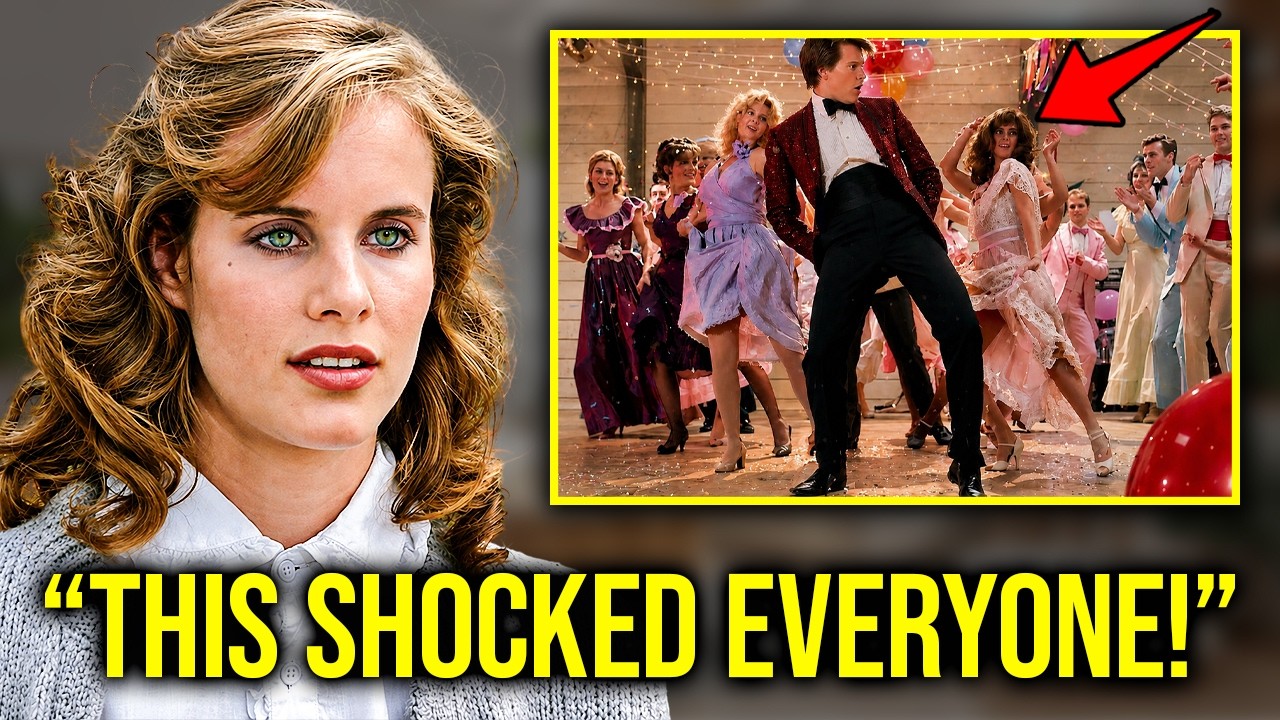
On set, however, the choreography of the film’s most memorable warehouse dance scene was shaped by division. Ren’s outburst, a singular-looking expression of pure athletic frustration, required five different men wearing the same costume to complete the sequence. Bacon performed what he could, but the production called in a dance double, a stunt double, and two gymnastics doubles to handle the flips and flips.
Bacon was furious, comparing the experience to being pulled from a game as the starting pitcher. Furthermore, the film’s climactic dance sequence fans know today, is a reshoot. The original ending, shot in Utah, focused on a stylistic, slow-motion sequence with glitter.
Test audiences panels, making it a failure, and the studio reshot everything nearly a year later in California.
The havoc on set extended to a famous speech. Bacon, who has publicly spoken about his fear of public speaking, broke out in hives days before filming his town council address. Instead of reshooting, director Herbert Ross offered a blunt solution; he handed Bacon half a Valium.
 The scene, a clarion call for the necessity of expression in the film, is now one of the most quoted passages in cinema history.
John Lithgow, playing the Reverend Shaw Moore, also sought authenticity. On location in Utah, he called an Assembly of God minister from the Yellow Pages, claiming he was lonely and wanted to talk about faith, without revealing he was an actor. His performance became a disturbing portrait of authority.
When a boy from a small Louisiana town, where his father was actually a Baptist minister, saw the film years later, he recognized his own father and took him to see it. The man eventually be committed to seeing the film twice, a high school prom. “I became the first of six children allowed to attend a prom,” he told Lithgow, his face wet with tears.
Lithgow later admitted his description of the film as a “teenybopper movie” was wrong.
The music itself is a testament to the fractured production. Kenny Loggins had signed on before breaking two ribs falling off a stage at a show in Utah. The writing window narrowed to a hotel room in Lake Tahoe, where Pitchford, suffering from a severe fever, and Loggins, taped up and unable to move, worked daily for two weeks.
 Pollution, in constant pain, was taking off, but the session produced the iconic track, jumping to number one and remaining there up to ten weeks.
Perhaps the strangest near-collision occurred behind the scenes. Paramount executives, hearing the final soundtrack, didn’t feel the power of synthetic rock music similar to the Flashdance soundtrack. They kept their concerns silent and, as Pitchford states, hid a plan to replace the songs without his knowledge.
His plans were foiled when Columbia Records, hearing the same rough mixes, considered them a generational hit. The soundtrack, a massive crossover of rock, pop, and country, knocked Michael Jackson’s’ Thriller off the top of the Billboard 200 and held the number one position for ten consecutive weeks, selling over 7 million copies in the U. S.
and generating six top-ten singles. A movie soundtrack, set to be scrapped, became the defining sound of that year’s summer.
But Zero has the weirdest fact of them all. Kevin Bacon, years before he became the face of this dance revolution, was a drummer for a Philadelphia soul band called “Chet Brown and Footloose,” later renamed “Jet Brown and Footloose.” The name, a stroke of coincidence or perhaps fate, was still on his resumé when the Footloose script landed on his desk.
Bacon lacks any pretence, joking he would have needed a DJ career under the name “Tremors” to claim fate. The connection doesn’t end there. The Bacon Brothers still perform the song live to this day, a sign of the mark that has lasted over forty years.
The film, the music, and the man, you are intertwined in a saga of Tuskegee and expensive studio panic.