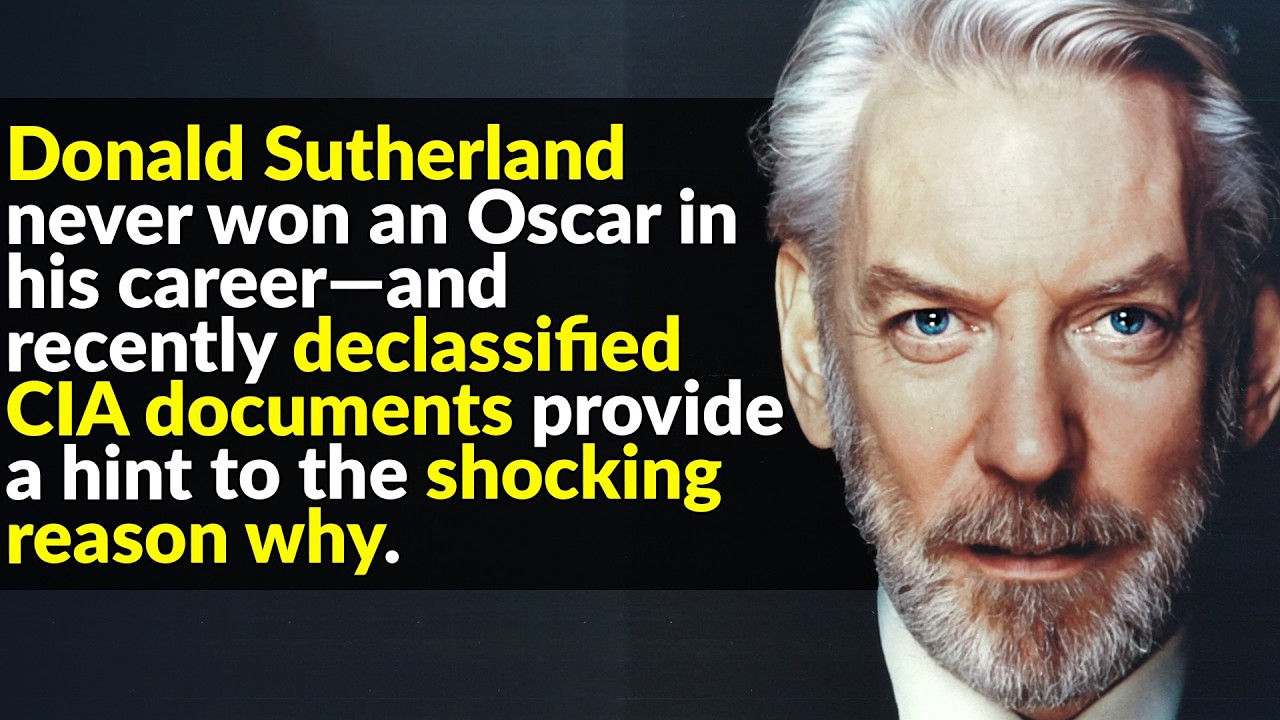
Donald Sutherland, the towering Canadian actor whose half-century career produced indelible performances in such American classics as MASH, JFK, and National Lampoon’s Animal House, has died at the age of 88, leaving behind a legacy that included a stunning paradox: he never won a competitive Oscar, despite being one of the most respected screen actors of his generation. His death, confirmed by his son, actor Kiefer Sutherland, on June 20th, 2024, following a long illness, closes the book on a life that was as dramatic off-screen as it was on it, marked by a near-fatal coma, a CIA surveillance file, and a career that spanned from low-budget horror to dystopian blockbusters.
The news of Sutherland’s passing has reignited a long-simmering question within Hollywood and among cinephiles worldwide: how could a performer of his caliber, who delivered towering work in Ordinary People, Don’t Look Now, and The Dirty Dozen, have been completely shut out of the Academy Awards nominations for acting? The answer, according to recently declassified documents, may be far more sinister than mere oversight, involving the actor’s vocal anti-Vietnam War activism and a secretive federal watchlist that placed him under surveillance during the peak of his career, potentially poisoning his standing with the conservative-leaning voting body of the Academy of Motion Picture Arts and Sciences.
 Born on July 17th, 1935, in St. John, New Brunswick, Sutherland’s early life was anything but glamorous, a rural existence punctuated by severe childhood illnesses including rheumatic fever, hepatitis, and polio, which left him weak and frail, yet forged a resilience that would define his professional trajectory. The family’s eventual return to the city allowed young Donald to explore his burgeoning interests, initially in puppetry during high school, before he set his sights on a more practical career in engineering at the University of Toronto, a path that was abruptly derailed when he discovered the intoxicating pull of the drama department, adding it as a second major and setting the stage for a monumental life choice in 1957 when he abandoned engineering entirely to pursue acting, a decision that propelled him across the Atlantic to London, England, where he enrolled at the prestigious London Academy of Music and Dramatic Art.
Sutherland’s formal education was short-lived, however, as he was soon plucked from the academy by producer Paul Maslansky, who offered him a role in a low-budget Italian horror film titled Castle of the Living Dead, a production that promised multiple roles, a paltry $40 per week, and a place to sleep on the director’s couch, an offer that was, for the struggling young actor, simply too good to refuse, marking his entry into the world of professional filmmaking with a whimper rather than a bang, though it did establish him as a familiar face within the horror genre, leading to subsequent roles in films like Dr. Terror’s House of Horrors, where he honed his craft in the shadows of the industry, far from the glittering lights of Hollywood prestige.
The year 1959 also saw Sutherland marry schoolteacher Lois May Hardwick, a union that would ultimately end in divorce, paving the way for his second marriage to fellow Canadian actor Shirley Douglas, with whom he would have twins, a joyous occasion that arrived with a crushing financial burden, as Sutherland, now responsible for a family of four on an actor’s meager salary, found himself in dire straits, a predicament that was unexpectedly alleviated by a stroke of kindness from an unlikely source: Christopher Plummer, the star of The Sound of Music, who, having barely met Sutherland, recognized his raw talent and generously gifted him $5,000 as an investment in his future, a gesture of faith that would prove instrumental in Sutherland’s subsequent rise, providing him with the financial runway needed to pursue more significant roles in the competitive London film scene.
Armed with this newfound capital and a reel of his television work, including an episode of The Saint opposite Roger Moore, Sutherland set his sights on a coveted role in Lee Marvin’s World War II epic, The Dirty Dozen, a film shooting in the UK with a massive ensemble cast, initially failing to secure a part until another actor’s departure opened a door, finally granting him the opportunity to step onto a set alongside Hollywood heavyweights like Lee Marvin and Charles Bronson, earning $600 per week, where he quickly learned the brutal art of standing out among a dozen other charismatic actors, a challenge he met with natural charisma and a crucial dose of luck when a pivotal scene intended for co-star Clint Walker was declined by Walker, giving Sutherland a chance to shine, a performance that would catch the eye of a director named Robert Altman.
Altman, seeking actors for his irreverent Korean War film MASH, saw something in that Dirty Dozen scene, a quality of improvisational brilliance and dark comedic timing that he believed perfect for his unconventional project, and he cast Sutherland in the lead role of Hawkeye Pierce, a decision that would immediately plunge Sutherland into a maelstrom of creative chaos, as Altman’s freewheeling, improvisational directing style clashed violently with Sutherland’s more structured training, leading Sutherland and his co-star Elliott Gould to believe the director was ruining the film, prompting them to go over Altman’s head to the studio demanding his replacement, a request that was flatly denied, and a decision that would have profound, long-lasting repercussions for Sutherland’s career, as MASH went on to become a massive critical and commercial hit, earning five Academy Award nominations including one for Best Director for Altman, while Gould, recognizing his error, apologized to the director and was subsequently rewarded with roles in Altman’s future films, whereas Sutherland, stubbornly refusing to admit his mistake, found himself permanently exiled from Altman’s creative circle, a professional schism that would cost him dearly in the years to come
 Despite this setback, Sutherland’s career continued its upward trajectory, landing him a role in the star-studded World War II heist film Kelly’s Heroes, shot on location in Yugoslavia, a production that would become a crucible of personal turmoil, as he received word from his co-star Clint Eastwood that his wife, Shirley Douglas, had been arrested by FBI agents in Los Angeles for attempting to purchase explosives, allegedly in connection with her involvement in the Civil Rights movement and her associations with the Black Panthers, a situation made even more absurd by the revelation that she had attempted to pay for the explosives with a personal check, a detail that sent Eastwood into fits of laughter but plunged Sutherland into a nightmare of legal and personal anxiety, a nightmare that was compounded when he fell gravely ill on set, contracting spinal meningitis that quickly deteriorated into a coma, during which his heart stopped for a full five seconds before he was resuscitated, a near-death experience that left him physically drained but spiritually resolute, though it ultimately spelled the end of his marriage to Douglas, who divorced him that same year, a dissolution that, while painful, would soon lead him to the most passionate and consequential relationship of his life
That relationship was with actress Jane Fonda, a fellow activist and Hollywood royalty whom he met while co-starring in the 1971 thriller Klute, a film that earned Fonda an Academy Award nomination and cemented Sutherland’s status as a leading man, but it was their off-screen chemistry, a volatile mix of political passion and animal attraction, that truly ignited, leading to a torrid affair that extended beyond the bedroom into the realm of political activism, as the pair collaborated on FTA, a controversial documentary chronicling their anti-Vietnam War performance tour for American GIs, a film that was fiercely critical of U.S. military policy and sparked significant backlash, a backlash that would have lasting consequences for Sutherland’s career, though at the time, the couple seemed invincible, following up Klute with the forgettable comedy Steelyard Blues, which flopped critically and commercially, effectively ending their professional partnership and their romantic liaison, as Fonda moved on to activist Tom Hayden, while Sutherland, undeterred, quickly married Canadian actress Francine Racette, a union that would prove enduring, though it was immediately tested by one of the most controversial and scandalous film productions of his career
That production was Nicholas Roeg’s 1973 horror masterpiece, Don’t Look Now, in which Sutherland starred opposite Julie Christie, a film that would become infamous not just for its unsettling atmosphere and its tragic, ambiguous ending, but for a graphic love scene that was filmed on the very first day of shooting, before Sutherland and Christie had even properly met, a decision by Roeg intended to break the ice but which instead created a firestorm of controversy, as rumors began to swirl that the actors were not merely simulating sex, rumors fueled by producer Peter Bart’s claim that he witnessed two people actually making love on set, a claim that Sutherland vehemently denied, insisting Bart was not even present during the filming, but the damage was done, as the rumor gained such traction that Christie’s boyfriend, actor Warren Beatty, punched Roeg in the face over it, while censors forced the removal of nine frames from the scene to avoid an X rating, and Irish audiences had the entire scene cut, cementing the film’s notoriety and ensuring that Sutherland’s name would be forever linked with one of cinema’s most talked-about sequences, a sequence that, despite the scandal, showcased his remarkable bravery as an actor, willing to go to emotional and physical extremes for his craft
Sutherland’s willingness to take risks, both artistic and financial, was further demonstrated when he made a promise to a young production assistant named John Landis, whom he had met on the set of Kelly’s Heroes, that he would appear in Landis’s future films, a promise he likely thought would never be called in, but Landis, now a director, held him to it, first with the sketch comedy anthology The Kentucky Fried Movie, a critical flop that Sutherland endured as a matter of honor, and then with Landis’s next project, National Lampoon’s Animal House, a film that seemed, on paper, to be another silly, lowbrow comedy, but which would become a cultural phenomenon, grossing over $141 million against a modest budget, a success that would haunt Sutherland financially for the rest of his life, as Landis, in a gesture of friendship, offered him a choice of compensation: a flat fee of $775,000 or a percentage of the box office gross, and Sutherland, seeking the security of guaranteed money over speculative profit, chose the check, a decision that would cost him an estimated additional $4 million when the film became a massive hit, a classic Hollywood what-if tale that Sutherland, to his credit, never publicly lamented, instead describing his experience on the film as a really good time, though the missed windfall surely stung, particularly as he watched the film’s cultural footprint grow exponentially over the decades
 From the sophomoric humor of Animal House, Sutherland pivoted sharply to one of the most emotionally devastating films of the 1980s, Robert Redford’s directorial debut, Ordinary People, a searing family drama in which he played Calvin Jarrett, a father grappling with the accidental death of his eldest son and the subsequent suicidal attempt of his surviving son, played by Timothy Hutton, a role that required Sutherland to convey profound grief, suppressed rage, and a desperate, ineffectual love for his emotionally distant wife, played by Mary Tyler Moore in a stunning against-type performance, a film that was showered with critical acclaim and six Academy Award nominations, including Best Picture, Best Director for Redford, Best Supporting Actor for Hutton, who won, and Best Actress for Moore, yet Sutherland, despite delivering what many considered the emotional heart of the film, was conspicuously absent from the list of nominees for Best Actor, a snub that was all the more puzzling given the film’s overwhelming success on awards night, where it took home five Oscars, including Best Picture, leaving Sutherland to console himself with a Golden Globe nomination, which he also lost, a pattern of Academy neglect that was becoming impossible to dismiss as mere coincidence, particularly given Redford’s own admission that he had initially turned down the role of Calvin because he found the character uninteresting, a damning indictment that perhaps revealed more about the Academy’s perception of Sutherland’s range than about the actor’s actual capabilities
The snub for Ordinary People was not an isolated incident but rather a recurring theme throughout Sutherland’s career, as he delivered acclaimed performances in films like the 1981 British World War II thriller Eye of the Needle, in which he played a German spy posing as a British officer, a tour-de-force of accent work that required him to navigate a triple-layered performance as a Canadian playing a German pretending to be English, a technical feat that was largely ignored by awards bodies, and the 1991 Oliver Stone conspiracy epic JFK, in which he played a shadowy government operative known only as X, a role that provided the film’s central thesis about the assassination of President Kennedy, a performance that was universally praised by critics as one of the film’s highlights, yet when award season arrived, it was co-star Tommy Lee Jones who received a Best Supporting Actor nomination for his role in the same film, leaving Sutherland once again on the outside looking in, a slight that seemed to confirm a growing suspicion that there was something more than mere oversight at play, something that had nothing to do with the quality of his performances and everything to do with his politics, his personal life, or perhaps some darker force working against him behind the scenes
That darker force was finally brought to light in 2017, when recently declassified documents from the Central Intelligence Agency revealed that Sutherland’s name had been placed on a National Security Agency watchlist, a list of individuals deemed potentially subversive due to their political activities, specifically his vocal and high-profile opposition to the Vietnam War, a stance he had amplified through his collaboration with Jane Fonda on the anti-war documentary FTA, which had been screened for troops and had drawn the ire of the Nixon administration, which viewed such activism as a threat to military morale, and the documents showed that Sutherland was on this watchlist from 1971 to 1973, precisely during the period when he was at the height of his critical acclaim, having just delivered acclaimed performances in Klute and Don’t Look Now, and was being positioned as a potential Oscar contender, leading many to speculate that this surveillance, though it did not result in any formal charges or blacklisting, may have created a climate of suspicion around Sutherland within the conservative, establishmentarian ranks of the Academy, whose members, many of whom were themselves veterans or held hawkish views, may have been reluctant to honor an actor they perceived as a political radical, a traitor to his adopted country, or a dangerous influence, a theory that, while impossible to prove definitively, offers a compelling explanation for why a performer of Sutherland’s undeniable talent and consistent output was repeatedly overlooked for the industry’s highest honor, despite receiving numerous other accolades, including a star on the Hollywood Walk of Fame, a Golden Globe, an Emmy, and a postage stamp in his native Canada
Sutherland, for his part, never publicly complained about his Oscar snub, nor did he ever confirm or deny the surveillance theory, instead continuing to work steadily, taking on a diverse array of roles that showcased his versatility, from the campy teen horror comedy Buffy the Vampire Slayer in 1992, a film that would inspire a beloved television series, though his experience on set was marred by conflict with the film’s writer, Joss Whedon, whom Sutherland alienated by rewriting his scenes, a decision that would cost him future collaborations with Whedon, to the disturbing 2005 Lifetime miniseries Human Trafficking, which earned him an Emmy nomination for his portrayal of a villainous trafficker, a role that was as dark as anything he had played in his early horror days, to the blockbuster Hunger Games franchise in the 2010s, in which he played the tyrannical President Snow, a role he actively campaigned for, sending a lengthy email to director Gary Ross explaining the films’ political importance, a passion project that introduced him to a new generation of fans, proving that even in his late seventies, he remained a vital, in-demand performer capable of commanding the screen in both intimate dramas and massive studio spectacles
 Sutherland’s personal life was as rich and complex as his professional one, marked by a deep commitment to his family, particularly his son Kiefer, who followed in his footsteps to become a successful actor in his own right, starring in the hit television series 24, a career path that Donald supported, though he admitted that Kiefer took a long time to realize how famous his father actually was, in part because most of Donald’s early films were R-rated and thus off-limits to his young son, who had not seen most of his father’s filmography until he was an adult, a fact that made their eventual on-screen collaboration in the 2015 western Forsaken, in which they played father and son, all the more poignant, a film that served as a fitting coda to a remarkable career, allowing the elder Sutherland to pass the torch to his son in a deeply personal project, a moment of artistic and familial closure that seemed to bring him peace, as he began, in 2023, to reflect on his life’s work, telling interviewers that it was finally time to start going over his life and the work he’d done, a process of retrospection that was tragically cut short by his death a year later, following a long illness, at his home in Miami, leaving behind a legacy that, while it may lack the ultimate validation of a competitive Oscar, is richer and more enduring than many actors who have won multiple statues, a legacy built on bravery, versatility, and an unwavering commitment to his craft, regardless of the awards or lack thereof
The reaction to Sutherland’s death has been swift and heartfelt, with tributes pouring in from across the entertainment industry, from his Hunger Games co-star Jennifer Lawrence, who called him one of the most intelligent, intuitive, and truly generous actors she had ever worked with, to Kiefer Sutherland, who in a statement, said that he personally thought of his father as one of the most important actors in the history of film, adding that he was a wonderful father and a remarkable man, a sentiment echoed by countless fans and colleagues who took to social media to share their favorite memories of his performances, from the cynical Hawkeye Pierce in MASH to the sinister President Snow in The Hunger Games, a testament to the sheer breadth and depth of his filmography, which spanned over six decades and included more than 200 film and television credits, a body of work that, while it may not have earned him the Academy’s ultimate prize, has indelibly etched his name into the annals of cinematic history, ensuring that he will be remembered not as the greatest actor who never won an Oscar, but simply as one of the greatest actors, period, a man whose talent, courage, and conviction transcended the limitations of any single award, and whose legacy will continue to inspire actors and audiences alike for generations to come
As the world mourns the loss of this titan of cinema, the question of his missing Oscar will undoubtedly continue to be debated, particularly in light of the CIA surveillance revelations, which add a layer of political intrigue to what was already a puzzling oversight, but perhaps the most fitting tribute to Sutherland lies not in dwelling on what he didn’t achieve, but in celebrating what he did, which was to consistently, fearlessly, and brilliantly illuminate the human condition in all its complexity, from the darkest depths of horror to the highest heights of comedy, from the intimate pain of grief to the grand sweep of historical epic, a body of work that stands as a monument to his extraordinary talent, a talent that needed no golden statuette to validate it, for his performances themselves were the ultimate award, a gift to audiences that will endure as long as films are watched and appreciated, ensuring that Donald Sutherland, the proud Canadian who conquered Hollywood on his own terms, will never be forgotten, his name forever etched alongside the greatest screen actors of all time, not as a footnote of what might have been, but as a towering figure of what was, a career of remarkable achievement that, in the end, was its own reward, and a legacy that will outshine any trophy the Academy could have bestowed