For more than a century, the story of Titanic has seemed straightforward.
An iceberg struck the ship.
Water flooded the forward compartments.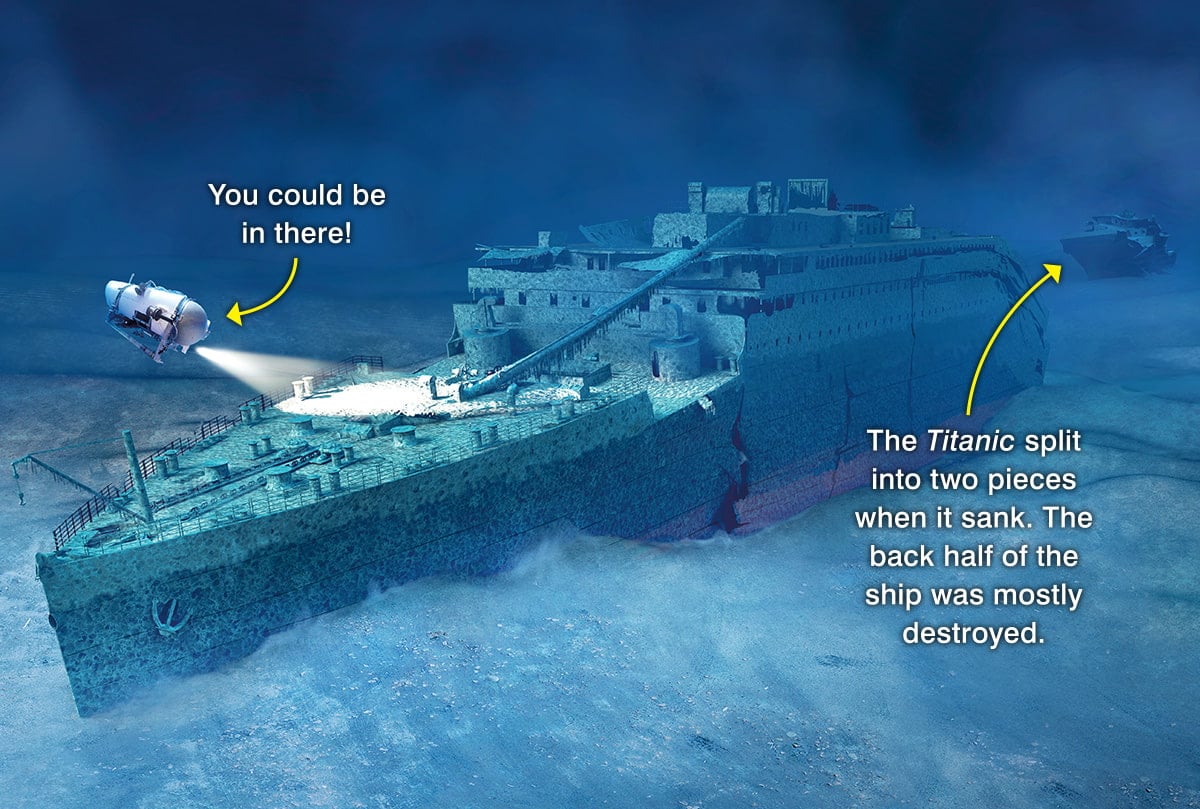
The bow sank first.
The stern rose into the air.
Then the entire vessel disappeared beneath the Atlantic Ocean.
That version became accepted history.
It appeared in books, documentaries, classrooms, and official reports.
But there was one part of the ship that never fit neatly into the story.
The stern.
While Titanic’s bow sits on the ocean floor in eerie silence—remarkably intact despite more than a century underwater—the stern looks completely different.
Twisted steel.
Collapsed decks.
Torn bulkheads.
An almost unrecognizable mass of destruction.
For decades, few people asked why.
And the answer may be far more disturbing than most realize.
The Official Story
In the months following the disaster of April 15, 1912, both the United States Senate and the British Wreck Commission launched extensive investigations into the sinking.
More than one hundred witnesses testified.
Survivors, officers, engineers, passengers, shipbuilders, and maritime experts all contributed evidence.
After reviewing thousands of pages of testimony, investigators reached a conclusion.
Titanic sank after flooding breached multiple watertight compartments.
As the bow filled with water, the ship gradually descended.
The stern rose higher and higher until the vessel finally disappeared beneath the surface.
Most importantly, the official reports suggested the ship remained structurally intact during its final descent.
That conclusion became accepted fact.
For over seventy years, almost nobody challenged it.
The case appeared closed.
The Survivors Told a Different Story
Yet buried deep within the inquiry transcripts was something unsettling.
Many survivors described seeing something completely different.
Several witnesses claimed Titanic broke apart before disappearing.
Seventeen-year-old survivor Jack Thayer later described watching the ship rise dramatically before splitting into two sections.
Others reported hearing a terrifying roar of tearing metal.
Some compared the sound to thunder.
Others described explosions.
Many recalled a sudden catastrophic event moments before the lights vanished forever.
The accounts came from different people in different lifeboats at different distances.
Yet many described the same thing.
The ship did not sink peacefully.
It tore itself apart.
Investigators largely dismissed these reports.
Officials argued the witnesses were traumatized, exhausted, and observing events in darkness.
Experts believed Titanic was simply too strongly built to break in half.
As a result, survivor testimony was pushed aside.
The official version remained unchanged.
The Discovery That Changed Everything
Then came September 1, 1985.
After seventy-three years hidden beneath nearly 13,000 feet of Atlantic Ocean, Titanic was finally found.
Oceanographer Robert Ballard and his team expected to discover a largely intact ship.
Instead, they found something astonishing.
The bow and stern were separated by nearly half a mile.
The ship had broken apart.
The survivors had been right all along.
But the discovery raised an even bigger question.
Why was the stern so badly destroyed while the bow remained relatively recognizable?
At first, scientists assumed the answer was simple.
The stern had suffered greater damage while sinking.
Case closed.
Except the evidence suggested something far worse.
The Violent Death of the Stern
When the ship split apart, the bow immediately began its descent toward the ocean floor.
Its streamlined shape allowed it to fall relatively smoothly.
The stern experienced a completely different fate.
As the bow disappeared beneath the surface, the stern temporarily settled back into the water.
For a brief moment, it may have floated.
Then everything changed.
Without the massive forward section attached, the stern lost stability.
It began filling with water from countless openings and structural fractures.
As it sank, it reportedly rotated, twisted, and accelerated downward.
Unlike the bow, which sliced through the water, the stern acted like a gigantic steel parachute.
Water resistance battered it from every direction.
Decks collapsed.
Walls buckled.
Entire sections imploded under increasing pressure.
By the time it reached the seabed, the stern was already dying.
Then came the impact.
Experts estimate the stern struck the ocean floor at tremendous speed.
The collision unleashed forces strong enough to crush entire decks into one another.
Steel folded like paper.
Rooms disappeared.
Structures collapsed inward.
The stern became a tangled grave of twisted metal.
What researchers see today is not simply a shipwreck.
It is the frozen aftermath of one of the most violent structural failures in maritime history.
The New Digital Scans
Recent high-resolution 3D scans of Titanic have revealed details impossible to see during earlier expeditions.
Researchers created a complete digital twin of the wreck using millions of images captured across the debris field.
The results were extraordinary.
The scans showed evidence supporting long-held accounts that engineers continued working in the ship’s power systems until the very end.
The lights remained on far longer than anyone thought possible.
Even as water poured through the vessel, crew members below deck fought to keep electricity flowing.
Many of those men never escaped.
Their actions gave passengers precious extra minutes to reach lifeboats.
But the scans also revealed just how catastrophic the stern’s destruction truly was.
Entire sections appear shredded.
Decks are compressed together.
Massive structural components have vanished or been displaced.
The stern tells a story the bow cannot.
It records the ship’s final moments in brutal detail.
Why People Rarely Talk About It
The bow is iconic.
It looks like the Titanic people remember.
Its grand shape remains recognizable.
Photographs of the bow evoke nostalgia, tragedy, and history.
The stern is different.
The stern is chaos.
It represents the moment when all hope disappeared.
The moment the ship ceased being a vessel and became a catastrophe.
Looking at the stern means confronting the true violence of Titanic’s final minutes.
Not the romanticized version.
Not the movie version.
The reality.
Thousands of tons of steel tearing apart under unimaginable forces while hundreds of people were still aboard.
That is why the stern receives far less attention.
Because it reveals something many people would rather not see.
The bow tells the story of Titanic.
The stern tells the story of how Titanic died.
And more than a century later, that shattered half of the ship remains one of the most haunting places on Earth.


