Sally Field has spent nearly five decades correcting the record about her relationship with Burt Reynolds, and a series of interviews in 2026 made that correction sharper than ever. While the world remembers Field and Reynolds laughing inside a speeding Trans Am in Smokey and the Bandit, Field remembers something far more complicated: a love affair that began with genuine collaboration and slowly became a struggle for control. The relationship began with a telephone call Field never expected to receive. By the mid-1970s, Reynolds was Hollywood’s most popular leading man, the embodiment of swaggering masculinity with the grin, the mustache, and the athletic confidence that made rebellion look effortless.
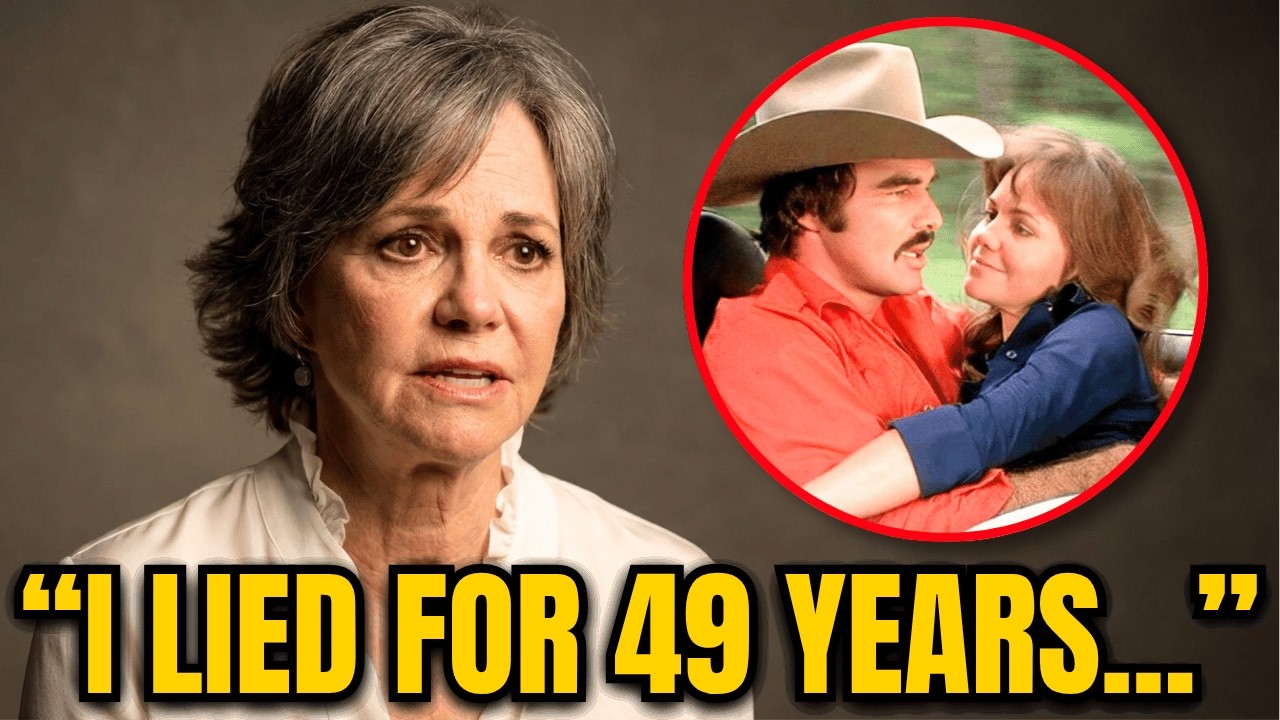
Field occupied a very different position. Audiences knew her from Gidget, which premiered in 1965, and The Flying Nun, which ran from 1967 to 1970. Both shows made her recognizable, but they also trapped her inside a wholesome, harmless image Hollywood refused to forget. Field had begun pushing back against that image.
In the 1976 television drama Sybil, she portrayed a traumatized woman presented as having multiple personalities, and the performance earned her the 1977 Emmy for outstanding lead actress in a limited series. Yet when Reynolds contacted her about Smokey and the Bandit, he had not seen Sybil. Field recalled this detail during a June 2026 episode of TCM and HBO Max’s Talking Pictures podcast. She had assumed her dramatic breakthrough must have changed how Reynolds viewed her.
Instead, he told her that he remembered liking her in Gidget. Executives reportedly questioned whether Field was glamorous or sexually appealing enough to play Reynolds’ romantic interest. Reynolds pushed back, later summarizing his argument by declaring that talent itself was attractive. At a moment when Field was still fighting the damage done by The Flying Nun, one of Hollywood’s most powerful leading men demanded that she appear opposite him.
She agreed to meet him, but the prospect terrified her. Field said she had entered television at 18 and missed the ordinary experiences through which many young people learn to date. When Reynolds’ bodyguard arrived to collect her, she felt completely outside her own life. That vulnerability makes the beginning difficult to reduce to a simple villain-and-victim story.
Reynolds recognized her talent when many executives did not. He opened a major cinematic door and made her feel chosen by the most desired man in Hollywood. But being chosen is not the same as being treated as an equal. Once the cameras were mounted on the Trans Am, their scripted performances and private attraction began merging almost immediately.
Once filming began, the chemistry did not need to be manufactured. According to Field, almost nothing about it felt planned. Field played Carrie, a runaway bride whom Bandit nicknames Frog after she climbs into his car. Field recalled Reynolds warning her that the screenplay was terrible.
His solution was simple: they would repair it by improvising. Cameras were attached to the car, Field would call for them to roll, and the two actors would create their exchanges while driving. The improvisation translated into a natural rhythm. Reynolds projected effortless confidence while Field interrupted that confidence with rapid questions, sharp reactions, and flashes of absurdity.
Carrie was attracted to Bandit, but she was never completely intimidated by him. Reynolds later wrote that audiences could see two actors falling in love onscreen because that was exactly what was happening. Field was around 30, newly divorced and raising two sons. Reynolds was approximately 40, surrounded by the machinery of stardom.
Inside the car, improvisation temporarily created a more balanced space: each actor needed the other to keep the scene alive. When Smokey and the Bandit opened on May 27, 1977, few expected it to become a cultural phenomenon. The film ultimately earned approximately $126. 7 million at the domestic box office, making it one of the biggest releases of the year.
Field gained something equally valuable: proof that she could hold her own in a massive theatrical hit. She was no longer only the Flying Nun, and she was not merely a dramatic actress hidden inside a television event. She could be funny, sensual, spontaneous, and commercially successful. But the conditions that created the first film’s magic were unstable.
Improvisation had given Field room to challenge Reynolds as a performer. Their personal relationship increasingly placed Reynolds at the center. Field would later describe them as a perfect combination of unresolved weaknesses. His confidence offered safety and excitement, while her desire to be chosen made it easier to surrender parts of herself.
Hollywood records four movies starring Sally Field and Burt Reynolds: Smokey and the Bandit in 1977, The End and Hooper in 1978, and Smokey and the Bandit 2 in 1980. Nearly five decades later, Field said she remembers only one of them as a real collaboration. In a May 2026 interview, she said she felt as if she had made only one movie with Reynolds, the original Smokey and the Bandit. In the three later productions, she said she felt like just a girl.
She was present because she had become trapped in the larger situation surrounding Reynolds. The later films belonged more firmly to Reynolds’ professional world. He directed and starred in The End, a dark comedy about a man confronting a terminal diagnosis. In Hooper, he played an aging stunt performer in a production directed by Hal Needham, celebrating the stunt community from which Reynolds and Needham had emerged.
Field had roles in both pictures, but neither depended on her perspective. The films revolved around Reynolds’ character, his anxieties, his friendships, and his public image. Smokey and the Bandit 2 continued that pattern: Frog returned, but the sequel could not reproduce the accidental freedom of the original. By then, the screen pairing had become a commercial property, while the relationship behind it had accumulated years of conflict.
Their personal relationship lasted on and off for approximately five years. Field did not describe every moment with Reynolds as cruel. She remembered qualities that were warm, vulnerable, and deeply lovable. But the affectionate version of him existed beside behavior she found frightening and controlling.
Field did not fully explain that pattern publicly until the publication of her 2018 memoir In Pieces. Her description of the relationship was deliberately complicated. She remembered real affection and care, but also confusion and emotional pain. Reynolds was not one fixed personality in her memory.
He could be funny and tender, then remote, jealous, or controlling. Field wrote that his enormous stardom had become a tool through which he controlled the people surrounding him. Once she entered his world, she felt that force directed toward her. She also connected Reynolds to a far older wound.
Field has said that her stepfather, actor and stuntman Jock Mahoney, sexually and emotionally abused her during childhood. Yet Mahoney was not frightening every hour of every day. She also remembered him as magnetic, playful, and capable of making the family feel enchanted. That contradiction shaped her understanding of love: a person could feel wonderful and dangerous at the same time.
Affection did not erase fear, and fear did not automatically destroy attachment. Looking back, Field believed her relationship with Reynolds repeated that emotional structure. She was trying to make an old pattern end differently by winning the love of another charismatic, powerful man whose approval could suddenly become disapproval. Field’s memoir also described her concern about Reynolds’ condition during the making of Smokey and the Bandit.
She wrote that he used Percodan, Valium, and barbiturates, and sometimes received injections whose purpose was unclear to her. Worried about his stress and physical symptoms, she arranged a discreet examination at the Miami Heart Institute. The tests reportedly found no heart problem. Field urged him to consider psychological help for anxiety, but she said he dismissed the suggestion.
She was not merely falling in love with Reynolds; she was monitoring him, worrying about him, and attempting to protect him while gradually surrendering authority over herself. Field wrote that when she tried to assert herself, Reynolds responded by tightening his control, at times in a physical sense. The decisive moment arrived as a stack of pages. The greatest threat to Reynolds’ control was not another man or a public scandal.
It was a screenplay about an ordinary woman who learns to stand up in a deafening textile mill. When Field brought home the script for Norma Rae, Reynolds did not simply question whether the movie would succeed. According to Field, he threw it back at her. Directed by Martin Ritt and written by Irving Ravetch and Harriet Frank Jr.
, the film followed a textile worker who becomes involved in efforts to unionize a southern mill. Norma was working class, outspoken, sexually experienced, and imperfect. She was also increasingly unwilling to accept conditions that powerful people expected her to tolerate. According to Field’s 2026 account, Reynolds did not want her to accept the role.
She said he objected to Norma’s sexual history and used a degrading label for the character. During the argument, Field recalled, Reynolds threw the screenplay at her. The physical gesture mattered, but the conflict underneath it mattered more. Field believed Reynolds wanted to control the direction of her career.
She was being offered a demanding dramatic lead that existed entirely outside his professional orbit. Norma was not the girlfriend in a Burt Reynolds vehicle; she was the center of her own story. Reynolds allegedly suggested that Field’s growing ambition was getting the better of her. Field’s reply was only six words: “This is the better of me.
” That sentence marked a break from the frightened woman who had felt like a clown before their first date. She met with director Martin Ritt and accepted the role. Field later described that decision as the beginning of finding her legs. The film’s most famous image shows Norma climbing onto a table inside the mill and raising a cardboard sign bearing one word: union.
One by one, the workers stop their machines. The overwhelming mechanical roar gives way to silence because one person has finally made herself impossible to ignore. Field has said that performing Norma changed her. Learning how the character stood inside her own body helped Field recognize strength that she had struggled to use in private.
The role Reynolds opposed did more than advance Field’s career; it gave her a language for resisting the relationships surrounding her. In 1979, Norma Rae was selected to compete at the Cannes Film Festival. That invitation should have been a celebration. Instead, it created another confrontation.
Reynolds had failed to stop Field from making the film, but he still questioned whether the world would value it. Field later recalled that he did not want her to attend and asked whether she honestly thought she would win anything. The doubt struck at an old vulnerability. Hollywood had spent years telling Field that she was too lightweight for serious acting.
Now, one of the people closest to her was questioning whether her most important film deserved the journey to Cannes. She went anyway, attending with members of the filmmaking team, including director Martin Ritt. She later remembered the screening as an overwhelming experience; when the audience responded to the film, she cried. Field won the 1979 Best Actress Award for Norma Rae.
The trip Reynolds discouraged became one of the defining events of Field’s professional life. Field’s memoir describes the period after filming Norma Rae as one in which previously suppressed parts of her personality began emerging. She could not immediately break Reynolds’ emotional hold, but she was becoming less willing to remain still whenever he disapproved. Cannes had confirmed something the Actors Studio, Sybil, and Martin Ritt had already taught her: the depth she felt inside herself was real, even when people closest to her refused to recognize it.
The 52nd Academy Awards took place at the Dorothy Chandler Pavilion on April 14, 1980. Field was nominated for Best Actress alongside Jill Clayburgh, Jane Fonda, Marsha Mason, and Bette Midler. Norma Rae had also been nominated for Best Picture, Adapted Screenplay, and Original Song. By then, the possibility that Field might win was no fantasy.
She had already received the Best Actress Award at Cannes and a Golden Globe for the performance. According to Field’s account in Dave Karger’s 2024 book, 50 Oscar Nights, Reynolds was unhappy with the attention surrounding her. She remembered him as being unkind during that period and said he would not attend the ceremony with her. The rejection could easily have turned one of the most important nights of her career into an extension of their private conflict.
Instead, comedian and filmmaker David Steinberg and his then-wife, Judy Martioni, offered to accompany her. They did not treat Field’s nomination as an embarrassment or a threat; they turned it into a celebration. Field remembered them collecting her in a limousine with champagne waiting inside. Rather than questioning whether she deserved the moment, they allowed her to enjoy it.
When Dustin Hoffman opened the envelope, Field’s name was inside. She walked onto the stage and accepted the Academy Award for Best Actress. The role Reynolds had reportedly tried to discourage had made her an Oscar winner. The relationship did not end cleanly at the podium.
Field and Reynolds remained connected on and off, and she still appeared in Smokey and the Bandit II, released later in 1980. Their permanent separation came after a longer period of emotional distance. The Oscar represented evidence of a process already underway. Field had accepted the script, gone to Cannes, and walked into the ceremony without Reynolds.
Each decision weakened the belief that she needed his approval. For years, Reynolds told a sorrowful version of the story. In his 2015 memoir, But Enough About Me, and interviews promoting it, he described Field as the love of his life. He said he missed her terribly and blamed himself for destroying the relationship.
The aging Hollywood heartthrob looked back on the woman who got away and admitted that he had failed to hold on to the perfect person. It transformed their history into a familiar story about regret arriving too late. That version also preserved something flattering about Reynolds: he became the flawed man wise enough to recognize his greatest mistake, while Field became the lost love whose value confirmed the depth of his feelings. There were elements of truth that made the story persuasive.
Reynolds had defended Field’s casting in Smokey and the Bandit. He repeatedly praised her talent. Their first movie captured unmistakable affection, and Field has never denied that she loved parts of him deeply. But sincerity does not give one person ownership of a shared past.
When Field addressed Reynolds’ romantic narrative in 2022, she rejected the role he had assigned her. She said he had not been someone she could safely remain around. In her view, he had reconstructed the relationship after the fact, making her more important in his memory because she was something he could no longer possess. The two had been estranged for decades by the time Reynolds began publicly calling her his greatest love.
His statements reached millions of fans while Field’s more difficult account remained largely private until In Pieces appeared in 2018. Reynolds died only days before the memoir was published, meaning he could not respond directly to its detailed portrayal. Field acknowledged that reality and expressed relief mixed with sadness. She did not want to punish him after death; she wanted to tell the truth about her own life.
Field’s 2026 interviews add another layer. She still does not describe Reynolds as entirely monstrous. She remembers a man who could be wonderful, vulnerable, and lovable while also possessing qualities she experienced as frightening. That complexity is not a contradiction.
People often remain attached precisely because the person causing pain is not cruel every moment. The warmth makes the frightening behavior harder to name, and the history of affection makes leaving feel like betrayal. Field even speaks about their beginning with humor. She remembers the bewildering first date, the bodyguard at the door, and her own nervous clowning.
Her lighter revelation that Reynolds was her worst on-screen kisser, because, she said, “Too much drooling was involved,” became a viral joke in 2022. Yet the more important correction concerned the larger fantasy. Audiences believed they had watched a love story begin during Smokey and the Bandit. Reynolds later encouraged the belief that the story never truly ended for him.
Field’s account suggests something different. The first film may capture genuine love, but the three films that followed reveal how easily professional partnership can narrow when one star holds greater power. The relationship’s most revealing moment was not their first kiss or final breakup. It was Reynolds throwing away a script because Field wanted something outside the life they had built around him.
The strongest new insight is not that Reynolds secretly hated Field, or that every loving moment was false. It is that he could recognize her talent before the industry did and still resist the independence that talent created. Support that lasts only while someone remains within your control is not complete support. In the first movie, Reynolds gave Field an opportunity and she proved she belonged.
In the second, she accepted an opportunity he did not want her to take and discovered she no longer needed him to tell her she belonged.


