Kyle MacLachlan signed his final public tribute with the phrase “Forever your Kale. ” It was a small, private distortion of his own name that David Lynch had used for him across four decades, and it captured something essential about a bond that survived catastrophic films, cultural phenomena, quarter-century hiatuses, and the demands of some of the most uncompromising art ever made for mainstream audiences. Lynch died on January 16th, 2025, at the age of 78. He had been diagnosed with emphysema the previous year, a condition linked to his lifelong heavy smoking, and had quietly acknowledged that he would likely never direct again.
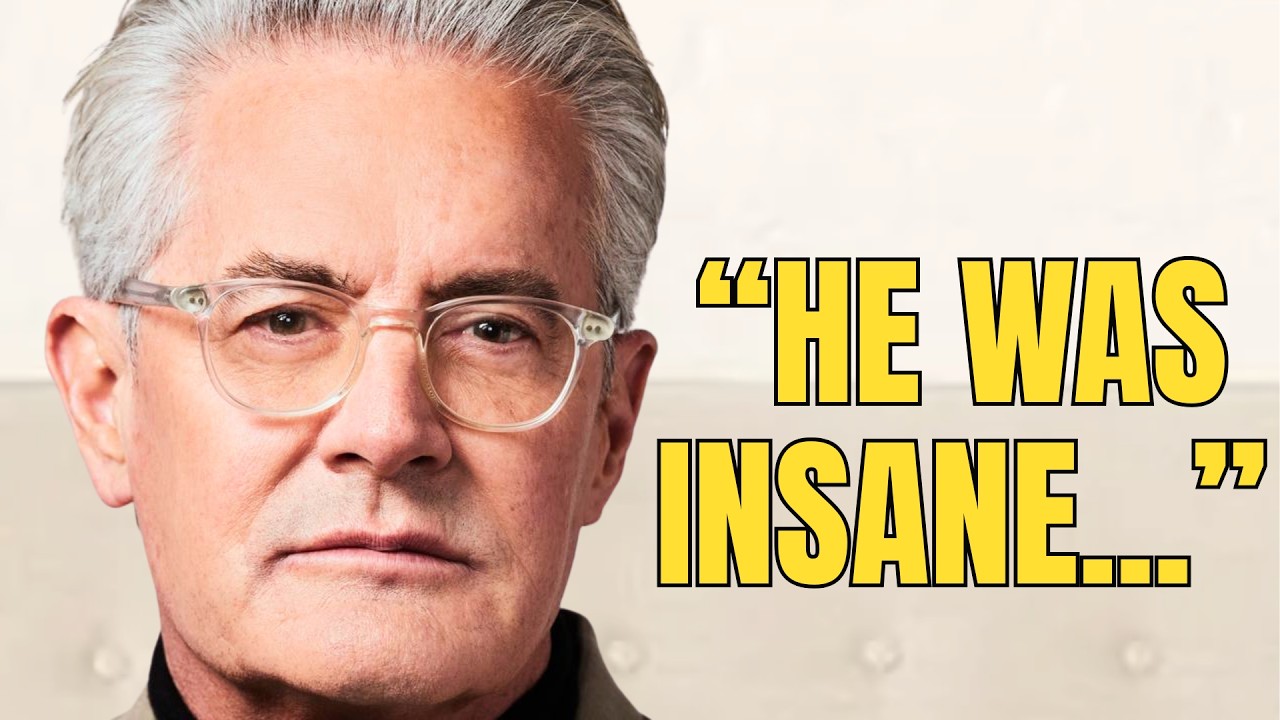
MacLachlan’s tribute to the director who discovered him opened with a memory from 1983, when he was a 24-year-old stage actor from Yakima, Washington, with no film experience whatsoever, and had been cast, almost impossibly, as the lead in Lynch’s adaptation of Frank Herbert’s Dune. The production was immense, seven months of filming in Mexico City with a sprawling cast. But MacLachlan nearly lost the role during his screen test. Asked to deliver a monologue directly into the camera lens, an uncomfortable assignment for any actor, he stopped, started again, and then lost his focus completely.
He told Lynch he didn’t think he could do itth. Lynch walked over, looked at him steadily, and said, “Kyle, I know you can do this. You’ve got this. Just relax.
Breathe. Take your time. ”
He finished the scene and got the part, but Dune opened in December 1984 to devastating reviews and a public reception ranging from bewilderment to outright rejection. Lynch later described the experience as a profound loss of creative control.
MacLachlan, bound by contract to potential sequels that never came, turned down Platoon and Top Gun, dropped his agent, and moved to Los Angeles to wait, uncertain whether Lynch would ever call again. Lynch did call, and the second collaboration, Blue Velvet in 1986, proved to be the true beginning. Where Dune had been a studio-filtered vision, Blue Velvet was Lynch entirely uncut: a picture-perfect American small town hiding something rotten beneath. MacLachlan played Jeffrey Beaumont, a college student who finds a severed human ear in a field and cannot resist following its implications.
Biographer Chris Rodley later described MacLachlan as an on-screen incarnation of Lynch’s own persona, the curious boy from the American heartland who keeps lifting rocks to see what lives beneath them. The film earned Lynch a Best Director Oscar nomination and forged a creative shorthand between the two men that required few words. MacLachlan has described how a single phrase like “There’s a wind blowing” signaled mystery, or “Elvis” told him exactly what the director wanted. “He doesn’t use actor jargon.
And I appreciated that,” MacLachlan recalled. That instinctive communication was tested at a scale neither could have anticipated with Twin Peaks, the series Lynch created with writer Mark Frost. Frost supplied the architecture of serialized television from his years on Hill Street Blues; Lynch supplied the unnerving atmosphere, the ability to make viewers feel a story before they could name what they were feeling. The fictional lumber town in Washington state appeared idyllic on the surface, but beneath it contained everything Lynch had always suspected was hiding there.
Lynch assigned MacLachlan the role of FBI Agent Dale Cooper without a formal audition. “You are Dale Cooper,” he said, with certainty. MacLachlan built the character partly by borrowing from Lynch himself, including his enthusiasm for trees, coffee, and pie. “He’s so childlike in his wonder of these things,” MacLachlan said, “and I wanted a little bit of that in Cooper.
”
The pilot was shot in roughly 23 days outside Seattle in the bitter cold of early 1989, with no one, including MacLachlan, believing it would go anywhere. Accidents on set had a habit of becoming central and the most famous example involved the final scene. During a take with actress Grace Zabriskie, cinematographer Euron Garcia noticed a crew member’s face accidentally reflected behind her in a mirror. On any conventional production, the shot would have been reshot and discarded.
Lynch asked whose face it was. Told that it belonged to set dresser Frank Silva, he went quiet, then decided to build an entire character out of the accident. Silva became BOB, the demonic presence at the center of the show’s mythology, a figure who entered the story through a mirror against the production’s apparent will. When the Twin Peaks pilot aired on ABC on April 8th, 1990, opposite Cheers, commentators expected a quiet death.
Instead, 29% of the American viewing public watched itth, and the show became an overnight phenomenon, a shared national experience organized around the question: Who killed Laura Palmer? MacLachlan, as Dale Cooper, became one of the defining faces of early ’90s pop culture, a man who talked to a tape recorder and treated coffee with religious reverence. The success brought complications. Network notes multiplied, other directors were brought in, and MacLachlan has recalled the friction that created.
“You’d weigh everyone against David,” he said. “It was always, okay, it’s not David, but we’ll make it work. ” Pressure to resolve the central mystery mounted from network executives and an impatient audience, and when the answer came partway through the second season, earlier than Lynch and Frost had intended, the show lost a particular kind of suspense that could not be rebuilt. ABC canceled Twin Peaks in 1991, leaving Cooper possessed, staring into a mirror and asking, “How’s Annie?
” in a voice that didn’t belong to him. The cliffhanger would remain unresolved for 25 years, honoring Laura Palmer’s promise: “I’ll see you again in 25 years. ”
There had been one crack in the foundation. When the film prequel Twin Peaks: Fire Walk With Me was assembled in 1992, MacLachlan, wary of being permanently defined by the role, took a reduced part.
He has since acknowledged tensions arising during the latter part of season 2, when Lynch and Frost stepped back from daily production and he felt, in his own word, abandoned. They worked through it, and the friendship held. When Lynch and MacLachlan finally returned with Twin Peaks: The Return on Showtime in 2017, the 18-part series defied every expectation accumulated over a quarter century. MacLachlan was asked to play three distinct versions of his character: the cold, predatory doppelganger Mr.
C; the childlike, amnesiac Dougie Jones, stripped down to pure instinct; and finally, after an 18-episode wait, the real Dale Cooper. MacLachlan has called it the most demanding acting assignment of his career. He has described the experience with gratitude, recalling mornings when he would wake at 4:00, make coffee, and sit alone in the kitchen, carried by one thought:“I get to go to work today with David. ” He has since called that period the most blessed of his professional life.
“He always had confidence in me,” MacLachlan said, “even when I was uncertain. ” That confidence, extended first to a 24-year-old who couldn’t get through his own screen test, was never withdrawn across four decades. Lynch spent his final months at home in Los Angeles, painting, recording music, and delivering his famous daily weather reports to a devoted social media following. MacLachlan wrote his tribute directly, without performance, in the way Cooper might have recorded a message to Diane.
He wrote about the moment in 1983 when a man he barely knew told him, “You’ve got this. ” He wrote about a friendship built through a severed ear, a dead girl wrapped in plastic, a damn fine cup of coffee, and a mirror that accidentally captured something never meant to be there. Lynch’s family said there is now “a big hole in the world. ” MacLachlan wrote that his own world is“that much emptier.
” Somewhere between those statements is the shape of a loss that comes when someone saw you clearly before you saw yourself, called you by a name only he used, and put you in front of a camera when you didn’t know what you were doing, telling you with complete certainty that you were going to be great. As it turned out, he was right.


