In 1977, NASA launched two spacecraft on what was expected to be a relatively brief mission to explore the outer planets. Nearly five decades later, Voyager 1 and Voyager 2 are still traveling through the darkness beyond the known boundaries of our solar system, sending faint signals back to Earth from distances almost impossible to comprehend. What began as an ambitious planetary survey evolved into one of the greatest exploration stories in human history.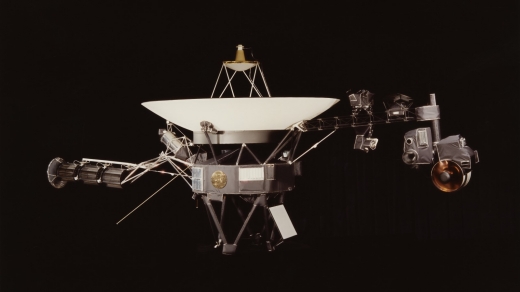
The mission itself was made possible by a rare cosmic alignment. Once every 176 years, Jupiter, Saturn, Uranus, and Neptune line up in a configuration that allows a spacecraft to visit all four worlds using gravity assists. NASA recognized the opportunity and seized it. Voyager 2 launched first on August 20, 1977, followed by Voyager 1 on September 5. Together, they embarked on a journey that would completely transform humanity’s understanding of the solar system.
Before Voyager, the giant planets were little more than distant points of light seen through telescopes. Scientists had theories, models, and expectations, but they lacked detailed observations. That changed dramatically when Voyager reached Jupiter in 1979.
The giant planet revealed itself as a world of constant turbulence. Vast atmospheric bands wrapped around the globe while colossal storms churned through the clouds. The Great Red Spot, already famous from telescopic observations, emerged as a gigantic rotating weather system unlike anything on Earth. Yet Jupiter itself was not the mission’s greatest surprise.
That honor belonged to Io.
Scientists expected Jupiter’s moon Io to resemble Earth’s Moon—a cold, ancient, and inactive world. Instead, Voyager discovered active volcanoes erupting across its surface. Massive plumes of material blasted hundreds of kilometers into space. It was the first direct evidence of active volcanism beyond Earth and forced researchers to rethink how planetary bodies evolve.
Europa delivered another shock. Its icy crust was crisscrossed with mysterious fractures and ridges, hinting at the possibility of a vast ocean hidden beneath the frozen surface. Decades later, that possibility remains one of the most exciting prospects in planetary science.
After Jupiter came Saturn, a planet long admired for its beauty. Voyager revealed that Saturn’s rings were far more complex than anyone imagined. What appeared from Earth to be broad, smooth structures turned out to consist of thousands of individual ringlets separated by intricate gaps and divisions. New rings were discovered, along with small “shepherd moons” whose gravity helped maintain the delicate structure of the ring system.
Saturn’s largest moon, Titan, quickly became one of the most intriguing objects in the solar system. Hidden beneath a thick atmosphere rich in nitrogen, Titan appeared more Earth-like than any moon previously studied. Scientists immediately realized it deserved far more attention than a simple flyby could provide.
While Voyager 1 departed the planetary plane after Saturn, Voyager 2 continued alone toward destinations no spacecraft had ever visited.
In 1986, it arrived at Uranus.
The planet initially appeared calm and featureless, but appearances proved deceptive. Uranus rotates on its side, unlike any other major planet, and Voyager discovered a magnetic field wildly tilted from the planet’s rotational axis. The strange geometry challenged existing theories about planetary magnetism and revealed a system far more complex than expected.
Voyager also encountered Miranda, one of Uranus’s moons. Its bizarre landscape looked as though it had been shattered into pieces and stitched back together. Towering cliffs, enormous canyons, and mismatched terrain made it one of the strangest worlds ever observed.
Three years later, Voyager 2 reached Neptune, becoming the first and only spacecraft to visit the distant blue giant.
Scientists expected a cold, quiet world at the edge of the solar system. Instead, Neptune revealed itself as a planet of violent weather. Enormous storms swirled through its atmosphere, including the famous Great Dark Spot. Winds raced at speeds exceeding 2,000 kilometers per hour, making them the fastest recorded in the solar system.
Neptune’s largest moon, Triton, provided one final surprise. Despite its extreme distance from the Sun, Voyager observed evidence of active geology. Dark plumes rose from the surface like geysers, proving that even one of the coldest worlds in the solar system remained unexpectedly alive.
By the end of its Grand Tour, Voyager 2 had fundamentally changed astronomy. The outer planets were no longer distant spheres orbiting the Sun. They were dynamic worlds with storms, volcanoes, hidden oceans, active geology, and complex histories.
Perhaps Voyager’s greatest achievement was changing how humanity viewed moons. Before the mission, moons were often considered secondary objects, mere companions to larger planets. Voyager revealed them as worlds in their own right. Io, Europa, Titan, Miranda, and Triton each became destinations worthy of future exploration.
Then came one of the most famous moments in scientific history.
Far from the planets, Voyager turned its camera back toward home. The resulting image showed Earth as a tiny speck suspended in a beam of sunlight—a fragile point of light in an immense cosmic darkness. Astronomer Carl Sagan later called it the “Pale Blue Dot.”
The image carried a powerful message. Every human being who had ever lived, every civilization, every triumph and tragedy, existed on that tiny pixel. After revealing the grandeur of the outer solar system, Voyager reminded humanity of the fragility of its own world.
Yet the story did not end there.
Both spacecraft continued outward beyond the planets, venturing into a region never before explored. As they approached the edge of the Sun’s influence, the solar wind weakened and the surrounding environment changed. Voyager 1 crossed into interstellar space in 2012, followed by Voyager 2 in 2018. For the first time, human-made objects entered the space between the stars.
Even today, Voyager 2 continues transmitting data from more than 20 billion kilometers away. Its instruments are studying conditions beyond the heliosphere, providing scientists with information that cannot be obtained any other way. Every signal it sends arrives as a faint whisper from the frontier of human exploration.
Perhaps the most emotional aspect of the mission is what the spacecraft carry with them. Attached to each Voyager is a Golden Record containing sounds, music, greetings, and images from Earth. The records were created not because anyone expected them to be found, but because sending them represented something uniquely human.
The Voyagers are no longer merely spacecraft. They have become time capsules, ambassadors, and symbols of curiosity itself. Nearly fifty years after launch, they continue their silent voyage into the unknown, carrying with them a snapshot of humanity from a small blue world that dared to reach for the stars.