For decades, humanity has relied on space-based observatories such as Hubble, Chandra, and the James Webb Space Telescope to reveal the universe with unprecedented clarity. Yet one of the most remarkable astronomical breakthroughs of recent years has come not from orbit, but from a mountaintop in northern Chile.
The Vera C. Rubin Observatory has officially unveiled its first images, and the results have stunned astronomers around the world. Even before beginning its full scientific mission, the observatory has demonstrated a capability unlike anything previously achieved by a ground-based telescope. Its images are not only breathtaking in scale and detail, but they also offer a glimpse into a universe far more crowded, dynamic, and active than many researchers anticipated.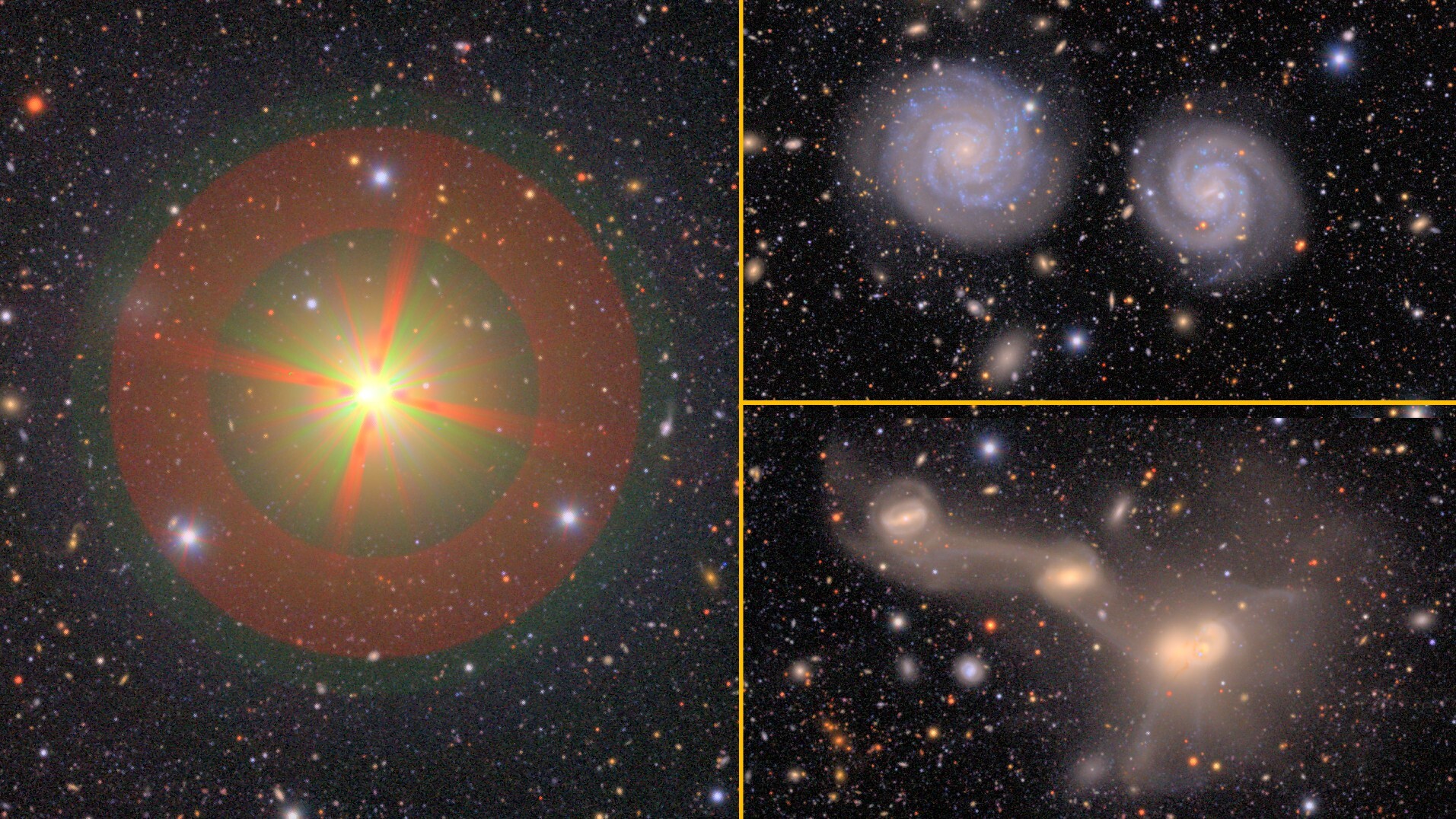
Located atop Cerro Pachón in Chile’s Atacama region—one of the driest and darkest places on Earth—the Rubin Observatory was designed with a singular purpose: to survey the entire visible sky repeatedly over the course of a decade. Unlike traditional observatories that focus on individual targets, Rubin is built to observe everything at once.
At the heart of the facility is the Simonyi Survey Telescope, equipped with an 8.4-meter primary mirror and the largest digital camera ever constructed for astronomy. The camera weighs nearly three tons and captures an astonishing 3.2 billion pixels in a single exposure. Each image covers an area of sky equivalent to roughly 45 full moons, allowing Rubin to record vast regions of the cosmos in extraordinary detail.
When the observatory released its first images in June 2025, expectations were already high. What followed exceeded even the most optimistic predictions.
One of the first public images was a massive mosaic of the Virgo Cluster, the nearest large galaxy cluster to the Milky Way. Constructed from more than a thousand exposures, the image revealed millions of stars and galaxies stretching across space. Spiral galaxies, interacting systems, faint galactic filaments, and distant red-shifted galaxies filled the frame, offering a stunning portrait of cosmic evolution.
What makes the achievement even more remarkable is that this image represents only a tiny fraction of what Rubin is expected to discover during its ten-year survey. Astronomers estimate the observatory will ultimately catalog roughly 20 billion galaxies, creating one of the most comprehensive maps of the universe ever assembled.
Another early image focused on the Lagoon Nebula, a vast stellar nursery located approximately 5,200 light-years from Earth. While space telescopes have previously captured detailed close-up views of the nebula, Rubin provided something entirely different: context.
Its enormous field of view revealed the Lagoon Nebula as part of a much larger celestial landscape filled with star clusters, neighboring nebulae, and ancient stellar populations. For the first time, astronomers could study these structures together within a single image, highlighting the interconnected nature of cosmic environments.
Beyond producing spectacular images, Rubin is already demonstrating its scientific power.
During just ten hours of early observations, the observatory identified more than 2,000 previously unknown asteroids, including several near-Earth objects. This discovery rate far exceeds what most observatories can achieve over much longer periods and highlights Rubin’s potential as one of humanity’s most important planetary defense tools.
Over the coming decade, the observatory will monitor billions of stars and galaxies while searching for evidence of dark matter and dark energy. It will detect exploding stars, gamma-ray bursts, variable stars, and countless other transient events in real time. Every few nights, it will create an updated snapshot of the visible sky, effectively building a time-lapse movie of the universe itself.
Perhaps most surprising is the fact that Rubin achieves all of this from Earth’s surface.
Ground-based observatories typically struggle with atmospheric distortion, which blurs images and limits precision. However, the combination of Rubin’s advanced optical design, massive camera, and exceptional location allows it to overcome many of these limitations. The result is image quality that rivals—and in some cases complements—that of major space-based observatories.
The observatory’s ambitions extend beyond astronomy alone. It is expected to generate roughly 20 terabytes of data every night and accumulate hundreds of petabytes over its operational lifetime. To handle this immense volume, engineers have built a sophisticated data-processing infrastructure capable of identifying moving objects, detecting transient events, and updating astronomical catalogs almost instantly.
In many ways, the Vera Rubin Observatory represents a new era in scientific exploration. It is not merely a telescope taking pictures of the sky. It is a machine designed to monitor the changing universe continuously, transforming the night sky into a living, evolving database.
Its first images are more than a technological achievement. They are a preview of a decade-long revolution in astronomy—one that may reshape our understanding of the cosmos and reveal phenomena we have not yet imagined.