The oldest known human-made bridge was misidentified for nearly a century. French archaeologists excavated the site at Girsu in ancient Sumer, modern-day southern Iraq, in 1929 and catalogued the structure as a temple or a dam. It took a re-examination by the British Museum’s Girsu project, led by archaeologist Sebastian Rey, to confirm what it actually was: a bridge over an ancient canal dating to the 3rd millennium BC, more than 4,000 years old. The story of that bridge reaches far beyond a single archaeological correction.
It traces how humanity moved from crossing a stream on a fallen log to building structures taller than the Eiffel Tower. Bridges were not an afterthought of civilization—they were part of its foundation. The Sumerians, the same people who invented writing and the wheel, were building engineered crossings over waterways more than four millennia ago. Humans were not the first species to solve this problem.
Army ants, specifically Eciton hamatum, build living bridges out of their own bodies. When a raiding column encounters a gap, workers lock legs and mandibles together, forming a structure the rest of the colony walks across. They operate without a foreman or blueprint, adjusting the bridge based on traffic flow and dismantling it when the shortcut no longer justifies the labor cost. Ants solved the bridging problem millions of years before humans appeared.
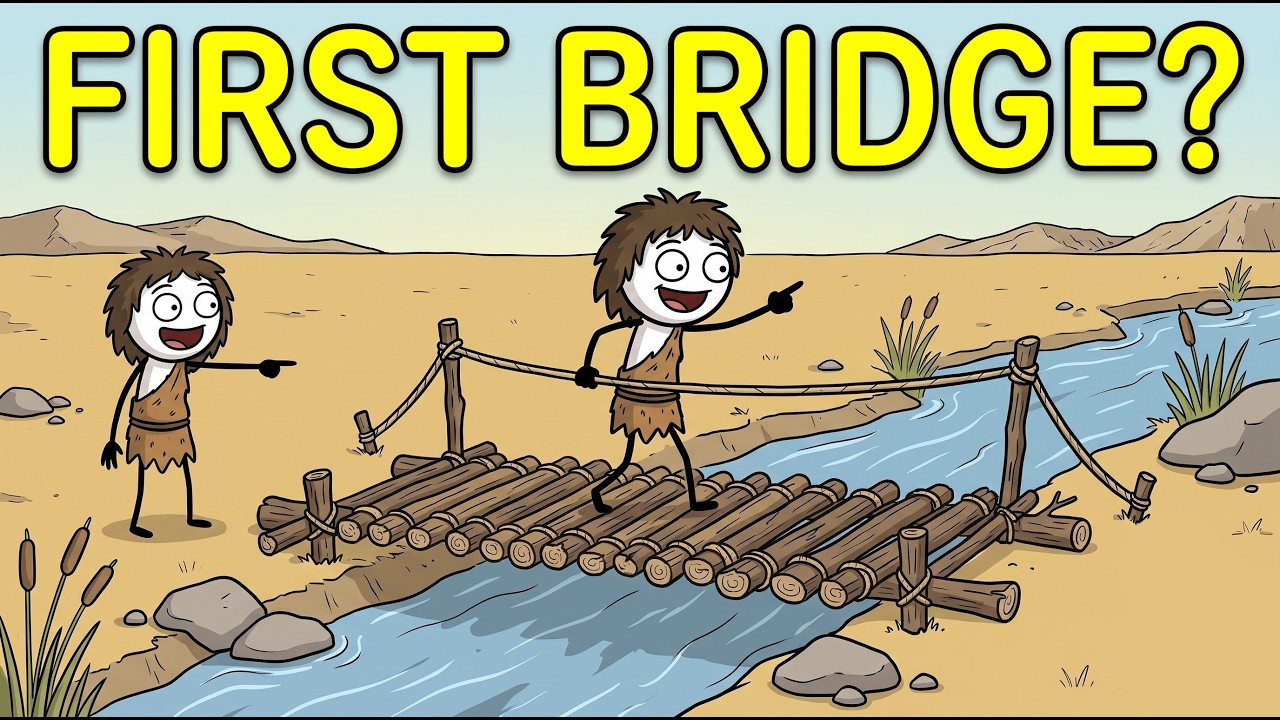
The first human bridge was almost certainly a log—not deliberately placed but found. A tree blown over in a storm, landing across a stream, and some ancestor stepping onto it because the alternative was getting wet or worse. There is no physical evidence of this moment because wood rots; a stone hand ax can survive in sediment for a hundred thousand years, but a fallen log cannot survive a century in open air. Yet the behavior is so intuitive that chimpanzees still use fallen trees to cross streams today.
The bridge is older than engineering, and it may be older than spoken language. The physics of that fallen log explains why bridges took thousands of years to improve. A log lying across a gap is what engineers call a beam bridge. Weight pushes down on the middle; the top surface compresses while the bottom surface stretches.
Compression on top, tension on the bottom. The span of a beam bridge is limited by how much tension the material can handle before it snaps. Wood handles some tension, but stone handles almost none. For thousands of years, this imposed a hard ceiling: you could only cross a gap as wide as your material could stretch without breaking.
A single tree trunk or a few flat stones laid across piers was the limit—until somebody figured out the arch. The oldest bridge still in use today is the Arkadiko Bridge in the Peloponnese region of Greece. Built during the Mycenaean period, roughly 1300 to 1190 BC, it is over 3,200 years old. It is a corbel arch bridge constructed with Cyclopean masonry—massive unworked limestone boulders stacked without mortar.
It measures about 22 meters long, 5. 6 meters wide at the base, and 4 meters high. It was part of a military highway connecting the cities of Tiryns and Epidauros, with stone guide curbs designed specifically for horse-drawn chariots. People still walk across it today.
Built without mortar, steel, or any binding agent, it has not fallen down. That is engineering so sound it outlasted the civilization that created it. The Arkadiko Bridge uses a corbel arch, not a true arch, and the difference matters enormously. A beam bridge fights gravity by resisting it; the material bends, and if the bend exceeds its tolerance, it breaks.
An arch bridge does something fundamentally different: it redirects gravity. The curved shape takes the downward force of a load and channels it outward and downward along the curve, through every stone, into supports at each end called abutments. The entire structure is in compression—no tension anywhere. Stone, which is terrible under tension but magnificent under compression, suddenly becomes the perfect building material.
The arch did not just improve bridges; it removed the ceiling, making spans possible that beam construction could never achieve with any material available to the ancient world. Before the arch changed everything in the West, one of the most spectacular bridge stories of the ancient world involved no arch at all. In 480 BC, the Persian king Xerxes needed to move an army from Asia into Europe. The obstacle was the Hellespont, the narrow strait separating Anatolia from Thrace.
According to the Greek historian Herodotus, Xerxes ordered a bridge built from over 600 ships—triremes and pentaconters—lashed together side by side and anchored against the current. Massive cables made of flax and papyrus were stretched across the boats, with wooden logs, brushwood, and packed earth laid on top to create a road surface stable enough for hundreds of thousands of soldiers, horses, and supply wagons. It was a pontoon bridge: temporary, functional, and enormous. Herodotus claims that when the first attempt was destroyed by a storm, Xerxes ordered the sea whipped 300 times as punishment, then had a new bridge built immediately.
Whether the whipping part is true or not, the engineering is documented: a floating road across a sea strait built in the 5th century BC. The Romans did not invent the arch, but they industrialized it. They figured out how to build arched bridges anywhere, at any scale, in any conditions, including in the middle of a river. To construct a bridge pier in moving water, they built cofferdams—temporary watertight enclosures made by driving two concentric rows of wooden piles into the riverbed and packing the space between with clay.
They pumped the water out using Archimedean screws, exposed dry ground, and built stone foundations directly on bedrock. Once piers stood, they constructed temporary wooden frameworks called centering, shaped to the desired curve, and laid wedge-shaped stones called voussoirs along the arc. When the final stone, the keystone, was placed at the center, the entire arch locked into a self-supporting structure. They also had a secret ingredient: Roman concrete, opus caementicium.
By mixing volcanic ash called pozzolana with lime and water, they created hydraulic concrete that set underwater. Recent research has shown that lime clasts in this concrete give it self-healing properties; small cracks that form over centuries seal themselves through chemical reactions with water. Roman bridges have lasted 2,000 years, while modern concrete often cracks in decades. The Romans accidentally built a material that repairs itself.
The results are still standing. The Pont du Gard in southern France, constructed around 40 to 60 AD, rises 48. 8 meters with three tiers of arches carrying water across a valley with a gradient so precise it drops only 25 centimeters per kilometer—roughly the width of a hand over a distance longer than ten football fields. The Alcántara Bridge in Spain, built between 104 and 106 AD by engineer Gaius Julius Lacer over the Tagus River, rises roughly 57 meters above the water and still stands.
Trajan’s Bridge across the Danube, designed in 105 AD by Greek engineer Apollodorus of Damascus, stretched roughly 1,135 meters with 20 masonry pillars supporting wooden arches. It was the longest arch bridge in the world and held that record for a thousand years—ten centuries that nobody surpassed. A detail about the oldest Roman bridge in Rome connects to something later in this story. The Pons Sublicius was the earliest known bridge in Rome, built entirely of wood so it could be dismantled quickly during wartime.
No iron, no stone, just timber joints, because the Romans understood that sometimes a bridge needs to disappear as fast as it appeared. While Rome was mastering stone arches in the west, something remarkable was happening in China. Between 595 and 605 AD, during the Sui Dynasty, master craftsman Li Chun built the Anji Bridge, also called the Zhaozhou Bridge, in Hebei Province. Its main span is 37 meters, and it introduced a feature that would not appear in European bridge design for another 800 years: open spandrels.
Li Chun cut smaller arches into the solid wall above the main arch, reducing the bridge’s weight and allowing floodwaters to pass through instead of slamming against a solid barrier. The bridge is built from 28 parallel limestone arch rings joined with iron dovetails that let the structure flex during earthquakes instead of cracking apart. It is still standing 1,400 years later, after surviving multiple earthquakes and at least ten major floods. On the opposite end of the engineering spectrum, the Inca solved the bridge problem with grass.
The Q’eswachaka Bridge, spanning the Apurímac River in Cusco, Peru, is the last surviving operational Inca rope bridge. It is 28 meters long, suspended 30 meters above the river, built entirely from hand-braided ichu grass, and it has been maintained continuously for over 600 years. Every June, four Quechua communities—Win’q e, Chaupibanda, Choccayhua, and Ccollana Quehue—gather for a communal labor tradition called minka and rebuild the entire bridge from scratch. New grass ropes are braided by hand, the old bridge is cut loose and dropped into the river, and the new one is strung and anchored in its place.
Three days, start to finish. UNESCO recognized the tradition in 2013. Six hundred years of unbroken bridge-building using a material that rots, stretches, and wears out within a year, kept alive by a community that simply rebuilds it every time. In Meghalaya, in northeastern India, the Khasi and Jaintia peoples build bridges out of living trees.
They guide the aerial roots of rubber fig trees across rivers and ravines, training them over years, sometimes decades, to grow into load-bearing structures. These bridges are alive; they grow stronger over time instead of weaker, and they are self-repairing and self-reinforcing. Nobody knows how old the practice is, but some of these living root bridges have been growing for centuries. There is also a connection between bridges and religion that most people have never heard.
In ancient Rome, the highest-ranking priest was called the Pontifex Maximus. The word Pontifex comes from the Latin pons, meaning bridge, and facere, meaning to make—bridge maker. The original pontifices were the priests responsible for the sacred Pons Sublicius, the oldest bridge in Rome. Over centuries, the title drifted from literal bridge maintenance to spiritual authority, the idea of building a bridge between the human world and the divine.
Roman emperors absorbed the title starting with Augustus, and when the Western Roman Empire collapsed, the Bishop of Rome inherited it. The Pope’s official title to this day is Pontifex Maximus. Every time someone says the word pontiff, they are saying bridge maker in Latin. During the medieval period, bridges became something they had never been before: neighborhoods.
Old London Bridge, commissioned by King Henry II and built by architect Peter of Colechurch between 1176 and 1209, was 926 feet long with 19 pointed arches. On top of it, people built houses. At its peak, the bridge held roughly 140 timber-framed buildings and housed a population of 500 to 800 people suspended over the Thames. It was a street, a market, an entire community on a bridge.
The Ponte Vecchio in Florence, rebuilt in 1345 after a flood, still has shops hanging off its edges today. People lived and worked on bridges because bridges were the most valuable real estate in a medieval city—everyone had to cross them. Everything changed when humans discovered new materials. In 1779, Abraham Darby III built the first major cast iron bridge at Coalbrookdale in Shropshire, England.
A single semi-circular arch, 100 feet across, spanning the River Severn. The design came from architect Thomas Farnolls Pritchard. Iron could handle both compression and tension in ways stone never could, and it could be cast into forms that stone could never hold. The catalyst was steel.
In 1856, Henry Bessemer patented a process for mass-producing steel by blowing air through molten pig iron to burn off impurities. Before Bessemer, steel was rare and expensive. After Bessemer, it was cheap, abundant, and structurally superior to anything that came before it. It made possible a bridge type that stone and iron could never have achieved at scale: the suspension bridge.
The Brooklyn Bridge, completed in 1883, was the first suspension bridge to use steel wire cables. John Roebling designed it; his son Washington Roebling supervised construction. When Washington was permanently disabled by caisson disease—the decompression sickness workers developed from laboring inside the pressurized underwater chambers used to excavate the tower foundations—his wife Emily Warren Roebling stepped in as field manager. She oversaw the project for over a decade, serving as the primary liaison between her bedridden husband and the engineering team, personally learning the mathematics of cable construction and stress analysis to do it.
The main span is 1,595 feet, and the towers rise 272 feet above the East River. Bridges also taught humanity lessons through catastrophic failure, and those lessons saved more lives than the failures took. On December 28, 1879, the central 13 spans of the Tay Bridge in Scotland collapsed during a violent storm while a passenger train was crossing. Seventy-five people died.
The bridge, designed by Thomas Bouch, had used poor-quality cast iron, lacked adequate wind bracing, and suffered from chronic maintenance neglect. The investigation that followed imposed new standards requiring engineers to calculate for wind pressures of 56 pounds per square foot. The Tay Bridge disaster is the reason every modern bridge on Earth takes wind seriously. On November 7, 1940, the Tacoma Narrows Bridge in Washington State tore itself apart.
It had a main span of 2,800 feet but a deck depth of only 8 feet, making it extraordinarily flexible. Nicknamed Galloping Gertie because it visibly swayed in even moderate wind, the bridge began twisting uncontrollably that morning and ripped to pieces on camera. The cause was later identified as aeroelastic flutter—a self-exciting instability where aerodynamic forces feed energy into a structure’s oscillations faster than the structure can absorb it. The failure report, authored by O.
H. Ammann, Theodore von Kármán, and G. B. Woodruff, transformed bridge aerodynamics as a discipline.
Every major suspension bridge built since Tacoma Narrows includes wind tunnel testing in its design process. Today, bridges exist at scales that would be unthinkable to anyone who lived before the 20th century. The Golden Gate Bridge, completed in 1937, stretches 4,200 feet with towers standing 746 feet above the water. The Akashi Kaikyō Bridge in Japan, completed in 1998, has a central span of 1,991 meters.
The Millau Viaduct in southern France, designed by engineer Michel Virlogeux and architect Norman Foster and opened in 2004, reaches a structural height of 343 meters—taller than the Eiffel Tower. Bridge building was never a single invention from a single source. The log bridge was independently discovered by every human culture that lived near water. The arch was developed independently in multiple civilizations.
Rope bridges appeared independently in the Andes, the Himalayas, and Southeast Asia. The gap is universal, the need to cross it is universal, and the bridge is a convergent technology—wherever humans and water coexist, bridges follow. The United States alone has roughly 617,000 bridges; China has over a million.
Every single one of them exists because someone looked at a gap, refused to accept it, and built something to carry them across.