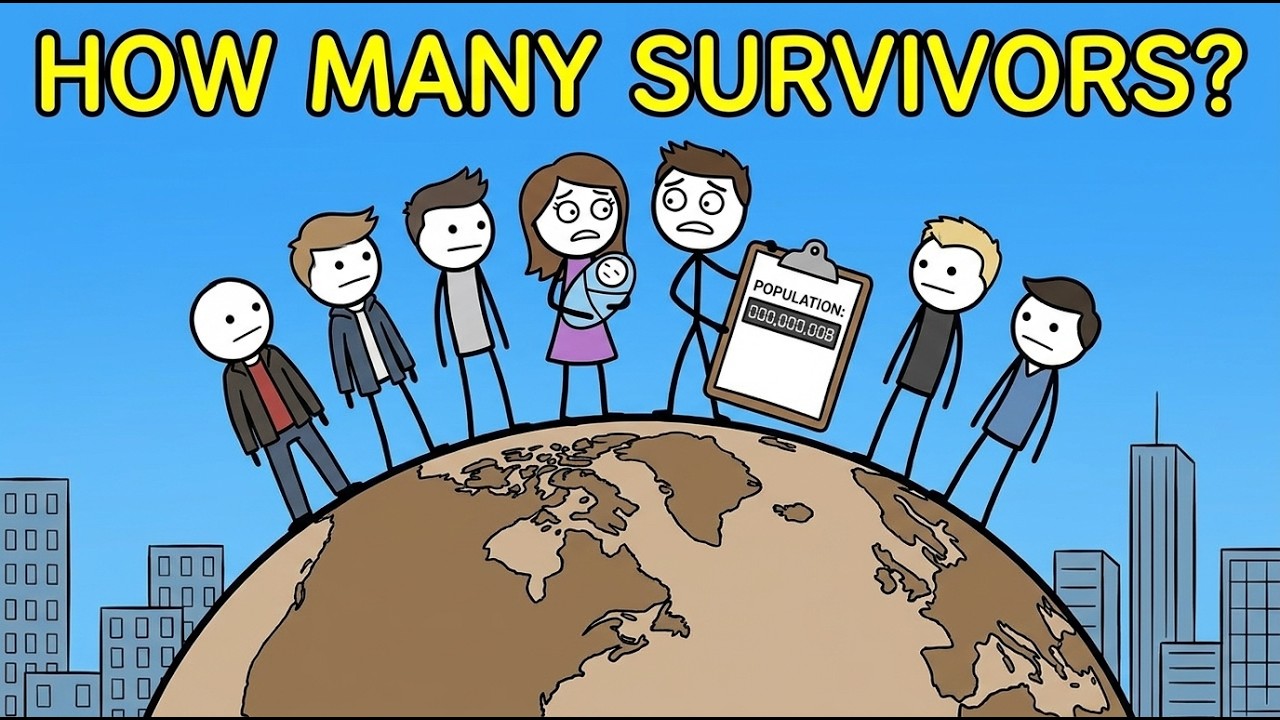
Repopulating Earth after a near-total extinction event sounds like a scenario built around a single couple, but the mathematics of genetics and survival tell a far more complicated story. While two fertile survivors could theoretically produce children, they would also create a genetic bottleneck that threatens the species with extinction within just a few generations. The core problem is not the ability to have children, but the genetic inheritance passed to them. Every person carries harmful recessive genetic variants that usually remain dormant because they are paired with a working copy of the gene.
Two unrelated people are unlikely to carry the same rare harmful variant, but close relatives are far more likely to share it. Siblings share an average of half their variable genetic material, meaning any children they produce face sharply increased risks of recessive disorders, infant mortality, and reduced fertility, a phenomenon known as inbreeding depression. With only two founders, every harmful variant they share becomes a permanent feature of the entire future population. If either parent is infertile, dies young, or produces only children of one sex, the experiment ends immediately.
This is why population geneticists do not rely on simple headcounts when assessing survival odds. The “effective population size” is the number of people who actually contribute genes to the next generation, and it can be dramatically lower than the number of survivors. A group of ten or even one hundred people offers more genetic diversity, but the same structural problems reappear after a few generations as everyone becomes related through multiple lines. Conservation biologists have long used the 50/500 rule as a rough guideline, suggesting an effective population of 50 could limit dangerous inbreeding in the short term, while 500 would preserve enough variation for long-term adaptation.
Later research revised these targets upward to roughly 100 and 1,000 respectively, and these figures refer to effective population size, not simply the number of survivors with a pulse. Real-world history demonstrates that small founder populations can survive, but not without a lasting cost. On Pingelap Atoll in Micronesia, a devastating typhoon in the 18th century reportedly reduced the population to around 20 survivors. One of those survivors is believed to have carried a rare recessive variant associated with achromatopsia, a condition causing color blindness and severe light sensitivity.
In a large population, that variant would have remained rare. Instead, it multiplied to the point that achromatopsia now affects roughly one person in ten on the atoll, a genetic signature visible centuries later. Population growth copies the surviving genetic library into the future. It does not restore the variants that were lost.
Mutation slowly creates new genetic material, but not quickly enough to compensate for a severe bottleneck, and random genetic drift can remove even useful alleles simply because their carriers happen to have fewer children. Beyond genetics, demographic randomness poses a constant threat. A generation could produce far more boys than girls. Several women could experience infertility.
One accident could remove the only midwife and several reproductive-age adults. Conservation biologists call this the extinction vortex: as a population shrinks, inbreeding and lost diversity reduce health and adaptability, which lowers population growth, which makes the population even smaller. Technology could change the equation. If survivors discovered a functioning fertility clinic with frozen embryos and sperm from thousands of unrelated donors, the genetic population could become far larger than the number of living caretakers.
But a cryobank requires liquid nitrogen, power, trained personnel, and sterile procedures to remain viable. Stored genetic material also does not gestate itself, and the number of available pregnancies remains limited by the number of healthy women capable of carrying them. The practical minimum population is therefore pushed higher by the demands of civilization itself. Modern society is not stored inside any single human mind.
It is distributed across millions of specialists and enormous supply chains. A surgeon depends on anesthetists, blood products, electricity, and laboratories. A farmer depends on fuel, replacement parts, and irrigation systems. Survivors can scavenge the ruins of technology for a time, but components break, drugs expire, and fuel degrades.
The community must eventually simplify to what its available labor and knowledge can maintain. Thousands of survivors provide the redundancy required for survival: more than one doctor, more than one mechanic, people who understand childbirth, water systems, construction, and sanitation. A larger community can also absorb conflict. A group of twenty can be shattered by one violent disagreement, while a group of two thousand allows people to move, choose different partners, and change leadership without splitting the entire reproductive network.
Geography also matters. A thousand survivors concentrated in one fertile temperate region may fare better than a million distributed as isolated individuals across continents. The nature of the catastrophe matters as well. If farms and ecosystems remain intact, survivors inherit a planet-sized supply depot.
If the population crash was caused by nuclear war or an engineered disease, the same event may continue killing survivors after the collapse begins. The ideal founder group would not simply be a collection of unrelated healthy adults. It would need a balanced age structure, with children and adolescents to bridge generations and older survivors to provide knowledge and experience. Reproductive effort would need to be distributed voluntarily, with consent and cooperation intact, because a plan that treats survivors as genetic containers would destroy the social trust required for long-term recovery.
Mathematical models suggest that starting with 1,000 people and a 2% annual growth rate could repopulate Earth to billions in roughly 800 years, but reality would interfere immediately. Infant mortality, food limits, epidemics, and environmental change would all slow the process. The most dangerous period is the beginning, when every death removes not just a person, but a set of genes, skills, and irreplaceable knowledge. Under ideal conditions, a few dozen humans might establish a growing population, but the word “might” carries enormous weight.
Below roughly 50 effective breeders, inbreeding rises quickly and demographic accidents become terrifyingly powerful. Around 100 effective breeders offers a better short-term genetic buffer. Around 500 carefully chosen founders makes long-term biological survival plausible. An effective population near 1,000 is a more defensible genetic target, which would require a census population of several thousand.
If the goal is not merely to avoid extinction but to preserve a durable, skilled, socially flexible society, a starting community in the tens of thousands would be far safer still. The absolute biological minimum might be shockingly small. The responsible minimum is not. The final survivors would not spend their first years staring dramatically over empty cities.
They would spend them keeping water clean, preventing infection, tracking family lines, delivering babies, training apprentices, and trying not to let a minor accident remove ten percent of the world’s electricians. Their greatest technology would be planning across generations, preserving books for children not yet born, matching genetic lines to protect grandchildren they will never meet, and training several people for every essential role. Two people can make a child. Twenty can make a bottleneck.
A hundred can make a dangerously fragile community. Rebuilding humanity means creating a population capable of creating the next population and the next without becoming weaker or dependent on one irreplaceable person. The difference between 500 and 5,000 survivors is not merely ten times as many people.
It is more genetic variants, more potential partners, and more chances for one mistake to remain just a mistake.