A wildfire tears through a dry African grassland. Animals scatter, and some are caught by the flames. Hours later, when the ground has cooled, something returns. Not to flee, but to eat.
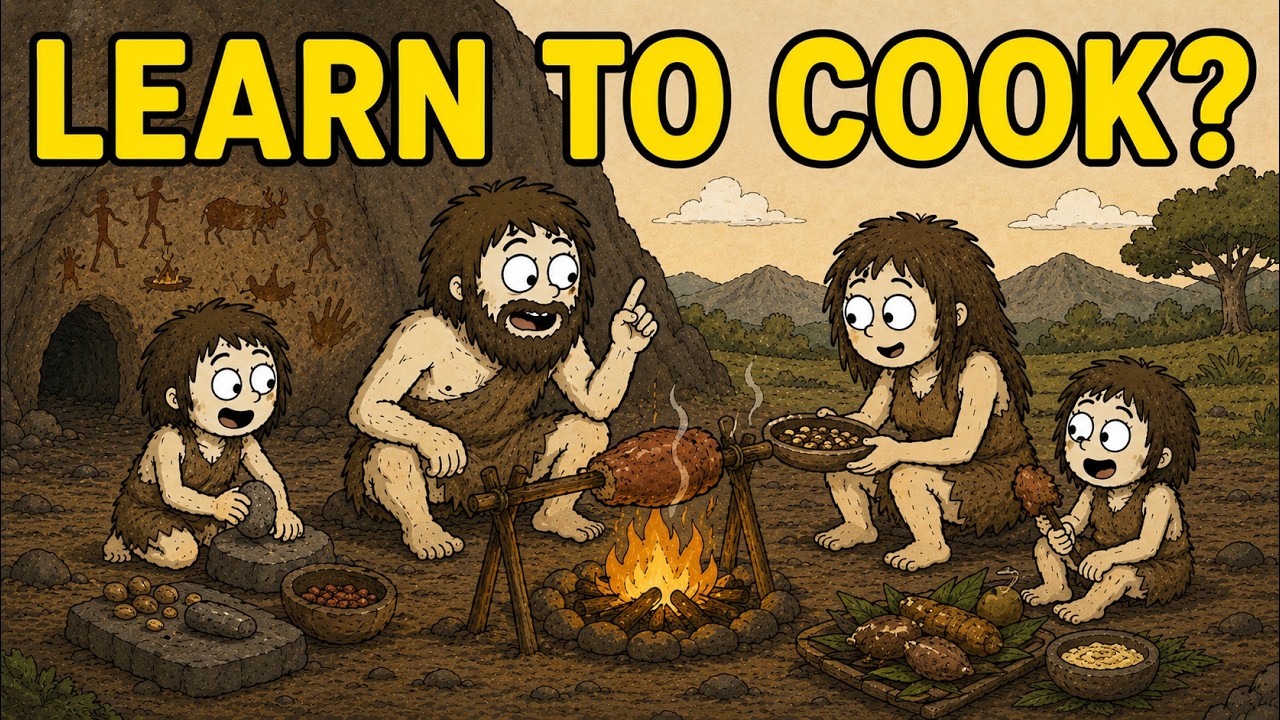
In the ashes, early human ancestors found burned meat, softer and easier to chew than anything raw they had eaten before. That unremarkable moment became one of the most consequential accidents in the history of life on Earth. Before cooking, early human ancestors ate almost entirely raw food. Raw meat, hard nuts, fibrous roots, and tubers took real effort to break apart.
Plants contained natural toxins, and scavenged meat carried parasites and bacteria. Every meal was work to find and work to eat. Modern primates illustrate what that life looked like. Wild chimpanzees spend close to six hours every single day just chewing.
Their jaw muscles are massive, their back teeth are large and built for grinding, and their digestive systems are enormous to process tough raw material. Today, a modern human can finish a full meal in around 15 minutes. That gap between six hours of chewing and 15 minutes of eating is explained by one thing: someone started cooking food first. Skulls carry records of how an animal ate.
When researchers compare the skulls of Australopithecines, who lived more than 2 million years ago, with Homo erectus, who appeared roughly 1. 8 to 1. 9 million years ago, the difference is striking. Homo erectus had a bigger brain, a smaller gut, a lighter jaw, and significantly smaller teeth.
The heavy facial structure built for hard chewing had started to disappear. Harvard biological anthropologist Richard Wrangham spent years asking what caused that transformation. His conclusion, published in his book Catching Fire: How Cooking Made Us Human, is that the most logical explanation is cooked food. Softer food requires less chewing machinery.
Food that releases more calories during digestion allows the gut to shrink. Calories that no longer fuel a massive digestive system can go to something more expensive: the brain. Around 1. 8 million years ago, Homo erectus arose with larger brains and bodies and smaller guts, jaws, and teeth.
The biggest drop in tooth size in human evolution happened with this species. There was no other point where teeth shrank as dramatically or as quickly. The ribs changed too. Earlier relatives had flared rib cages built to hold large bellies full of a slow, grinding digestive system.
Homo erectus had a flatter torso. The gut had shrunk. That only works if the food coming in requires less digestion, if something outside the body is doing some of the work first. The human brain is extraordinarily expensive to run.
It accounts for roughly 2% of body mass, but in an adult at rest, it consumes between 20 and 25% of the body’s total energy budget. A chimpanzee-sized ancestor eating wild raw foods cannot generate enough surplus calories to fuel a brain that large. Something fundamental had to change in the diet. Cooked food provides significantly more available calories than raw food.
Two foods can have the same number of printed calories yet deliver completely different amounts of usable energy. Heat unravels proteins and ruptures the tough walls surrounding starch granules, turning locked-away energy into something the small intestine can actually absorb. It destroys many natural toxins. The chemistry happens in predictable stages.
When meat is heated, proteins unfold, and digestive enzymes can break them apart far more efficiently. Collagen, the connective tissue that makes raw meat tough, dissolves into gelatin when cooked. Raw starches are stored in compact granules that resist digestive enzymes. When water and heat are applied together, those granules swell and crack open.
This is why a raw potato is largely indigestible but a cooked one is not. Heat also kills parasites and harmful bacteria, and it deactivates many defensive compounds plants produce, opening up new food sources. This dramatic increase in net energy yield changed the trajectory of human evolution. For a long time, archaeologists assumed cooking was only a few hundred thousand years old.
That assumption has been dismantled over the past two decades. At Wonderwerk Cave in South Africa, near the edge of the Kalahari Desert, researchers found burnt bones, sediment, and heat-altered stone tools in a layer dated to about 1 million years ago. More recent research has pushed evidence of fire use back to between 1. 07 and 1.
79 million years ago. The burnt bones were found 30 meters inside the cave, where natural wildfires could not have reached. Someone carried the fire in and maintained it. The oldest direct evidence of cooking food comes from fish teeth unearthed at the Gesher Benot Ya’aqov site in Israel.
The teeth had been exposed to heat, but under 500 degrees Celsius, suggesting the fish were cooked at a controlled, moderate temperature rather than tossed directly into flames. The oldest teeth were dated to around 780,000 years ago. That is not scavenging from a wildfire. That is cooking.
The discovery of fire as a tool did not begin with someone deliberately making a flame. It began with a wildfire and the realization that what the fire left behind was better to eat. This would have happened many times, over many generations, long before anyone thought to bring fire home. Those first encounters were opportunistic.
The food was there, and it was easier to eat. The body responded well to it. Over time, some groups began following wildfires the way predators follow herds, not to escape the flames but to benefit from what they left behind. Making fire from scratch requires specific techniques.
What happened first was simpler. When a wildfire passed, it left smoldering wood and glowing embers. Early humans picked those up and carried them. The challenge was not starting a fire but keeping one going.
Someone had to watch the fire while others slept. Someone had to gather dry fuel. Someone had to shield the flame from wind and rain. A group that could organize itself to keep a fire burning had already taken a significant cognitive step.
Evidence of deliberate fire making appears much later. At a site in Suffolk, England called Barnham, dated to around 400,000 years ago, researchers found sediments heated to temperatures far above what any natural fire would have produced, along with a fragment of iron pyrite. Pyrite is a mineral that creates hot sparks when struck against flint. It is naturally rare in that region, which means someone brought it there.
That is a fire-making kit. Between borrowing fire and making it on demand, there was an enormous stretch of time during which early humans depended entirely on natural sources. The only option was never to let the fire go out. Fire wards off predators at night, provides warmth, and makes food safe and digestible.
Losing it meant going back to raw food and cold nights. Cooking without any containers is entirely possible. Hot stones absorb heat slowly and radiate it steadily. Food placed on a heated stone cooks evenly without burning.
Ash cooking is even simpler. A dying fire leaves a bed of coals and ash that holds heat for hours. Tubers and meat buried in hot embers cook slowly and become soft and digestible. About 30,000 years ago, earth ovens were developed in Central Europe.
These were pits dug in the ground and lined with stones, filled with hot coals and ashes. Food was placed on top, covered with earth, and allowed to roast very slowly. The bones of many animals, including mammoths, have been found around them. The transformation cooking brought was not only biological.
Before fire, night was dangerous. After sunset, the safest behavior was to sleep and wait for dawn. Fire pushed predators back and created a zone of relative safety after dark. People could stay awake, stay active, and stay together.
University of Utah anthropologist Polly Wiessner spent decades studying the Ju/’hoan Bushmen of the Kalahari Desert. She recorded conversations during the day and at night and compared what people talked about. During the day, 34% of conversation was complaints, criticism, and gossip, 31% was economic matters, and only 6% was stories. At night, 81% of conversation involved stories, and only 7% was complaints.
The stories told around fires were not idle entertainment. They involved accounts of travels, religious experiences, myths, and folktales, the kind of topics that create a sense of community. Accounts of travel built extended social networks unique to humans among all primates. Language likely grew more complex in this environment.
A story told in firelight requires description, sequence, and character, a cognitive workout. Cooking changed which groups could thrive. Groups with reliable access to cooked food had more available energy. Children raised on cooked food grew faster.
Mothers could wean children earlier because cooked plant foods could supplement breast milk. More births per female and more children surviving to adulthood. Modern humans who attempt to survive entirely on raw unprocessed wild foods consistently struggle. Their bodies cannot extract enough energy.
Weight loss is common and reproductive function often declines. According to Wrangham, there are no verifiable examples of anyone surviving on a raw diet in a state of nature. We are animals whose bodies have been shaped over hundreds of thousands of years of cooking to the point where we now require it. Our teeth are cooked food teeth.
Our guts are sized for cooked food guts. Cooking also introduced a new social problem. A hearth with cooked food is a concentration of calories in one visible, stationary, vulnerable place. Early cooking communities had to deal with who controls the food, who shares it, and what happens when someone takes too much.
Solving those problems required cooperation and agreements that raw food foraging never demanded. Control of fire also predisposed humans to swapping different kinds of food, which may have led to bartering. The exchange of food, which requires trust, memory, and the expectation of future reciprocity, is a foundation of human economic behavior. One objection to the cooking hypothesis is cognitive.
Could early humans understand what fire does to food enough to use it deliberately? Research on chimpanzees suggests the cognitive building blocks were present long before any hominin picked up a burning stick. Chimpanzees strongly prefer cooked food over raw when given a choice. They understand that a device can transform raw food into cooked food, and they will carry raw food across a room to place it inside that device rather than eating it immediately.
Some chimpanzees saved raw food when they knew an opportunity to cook it would come later. That kind of planning for a future state was already present in the common ancestor of humans and chimpanzees. Neanderthals were cooking too, and the evidence is preserved in their teeth. Ancient dental plaque hardens into a material called dental calculus, which preserves chemical traces of everything an individual ate.
Researchers found evidence of complex, regionally specific diets. Neanderthals in cold northern Europe ate heavy amounts of large game. Neanderthals from cave sites in Spain showed pine nuts, forest plants, and mushrooms. Some Spanish Neanderthals appear to have used plants medicinally.
One individual with signs of a dental abscess had consumed yarrow and chamomile, bitter herbs with anti-inflammatory and antimicrobial properties. Another consumed bark from a poplar tree, which contains a compound related to aspirin. Cooking was culture before it was technology. The knowledge existed in the community, in the routines of daily life.
Children watched adults, imitated what they saw, and adults corrected them. Lose the community and you lose the knowledge. There was no individual moment of invention. No single person watched a wildfire and then deliberately recreated that result.
The transition was gradual, spread across many groups, happening independently in multiple places over thousands of generations. The spread of fire did not happen in one place and radiate outward. Multiple groups encountered and began using fire through overlapping, independent processes. Wonderwerk Cave in South Africa sat in a dry landscape where fire came from lightning strikes.
Gesher Benot Ya’aqov in Israel sat beside a freshwater lake, where fire management reflected knowledge built in a different ecological setting. At Barnham in England, fire-making relied on iron pyrite, a solution to a problem people in warmer climates may never have needed to solve. Human teaching is different from chimpanzee learning. It involves pointing, demonstrating, correcting, and explaining, all behaviors that require understanding what another person does not yet know.
Cooking was one of the earliest and most important domains of human teaching. Every meal was a lesson. There is a reason almost every human culture finds cooked food more appealing than raw food. Evolution does not reward neutral behaviors.
Individuals who were drawn to cooked food survived at higher rates and reproduced more successfully. Modern humans are the descendants of that line. We carry smaller jaws, smaller guts, larger brains, and a digestive system far more efficient with cooked food than raw. We did not invent cooking the way we invented the wheel.
We co-evolved with it. The larger brain made more sophisticated tools possible. More sophisticated tools made hunting more efficient. More efficient hunting provided more protein.
More protein supported further brain development. Each step enabled the next. The campfire was also the classroom, the council chamber, and the hospital. Agriculture emerged around 10,000 years ago in communities that already had fire, cooking, and complex social structures built around shared meals.
The explosion of agricultural civilization was built on the infrastructure that hundreds of thousands of years of cooking had created. At the start of that chain, somewhere in Africa more than a million years ago, someone carried a smoldering branch out of a wildfire. Not because they understood what they were doing. Not because they had a plan.
Because fire left behind food that was easier to eat. And hunger is a very good teacher.