When Steven Spielberg cast Wayne Knight in Jurassic Park, he didn’t even bother holding auditions. The filmmaker had watched Knight’s brief but unforgettable performance in Basic Instinct and knew immediately that the heavy, nervous energy radiating from the character actor was exactly what he needed for Dennis Nedry, the greedy programmer who brings the dinosaur park crashing down. It was 1992, and that single decision catapulted the invisible character actor into the center of the biggest blockbuster of a generation. Almost simultaneously, Knight became a global television phenomenon.
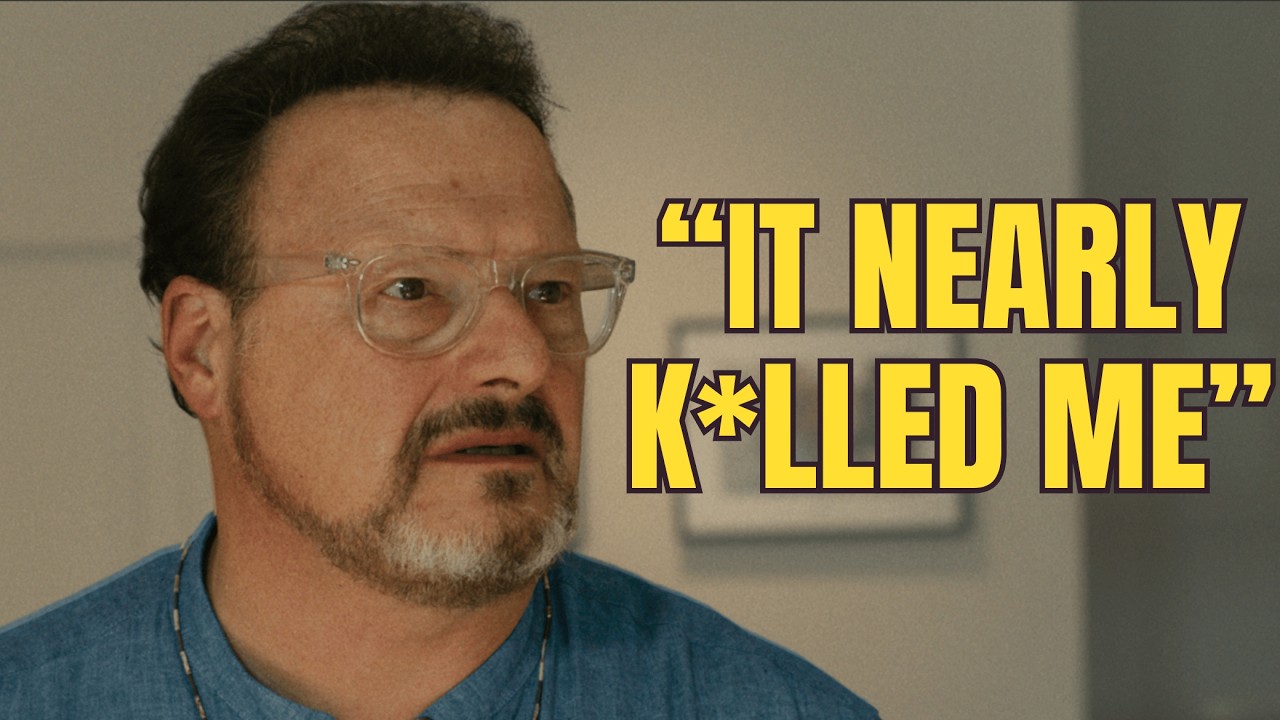
He was cast as Newman on Seinfeld, Jerry’s scheming, disgruntled postal-worker nemesis. The role made him one of the most recognizable faces of the 1990s, but that fame came wrapped in a devastating irony. The industry did not see a classically trained stage actor; they saw a heavy, sweaty punchline. Knight was making millions, but he was trapped in a body that was literally killing him, playing characters he secretly despised, and facing a medical crisis that would force him to choose between his career and his life.
Wayne Elliott Knight was born on August 7, 1955, in Cartersville, Georgia. As a heavy, shy kid in a town that prized athleticism, he used humor as armor. He found refuge in the drama department at the University of Georgia, but a professor looked at his unconventional physique and bluntly told him he would never make it as an actor. The comment was a violent catalyst.
Knight dropped out of college entirely and headed to the Barter Theatre in Virginia, taking a grueling internship that promised nothing but hard stage work. When he moved to New York City, the stages were not waiting. To pay the rent between sparse acting gigs, Knight became a licensed private investigator, tailing unfaithful spouses and observing people from the shadows. For nearly a decade, he lived in a bizarre Hollywood purgatory, appearing in the backgrounds of major films like Dirty Dancing, Born on the Fourth of July, and JFK.
He was on those sets, breathing the same air as the biggest stars, collecting steady paychecks, yet he remained completely invisible to the public. That changed in 1992 with Basic Instinct. Knight played one of the interrogators in the infamous scene where Sharon Stone uncrosses her legs. The scene relied entirely on the reaction of the men in the room, and Knight delivered a visceral, suffocating discomfort.
He allowed himself to look pathetic, sweating and shifting his eyes. In an industry built on vanity, a man willing to broadcast his physical awkwardness became a highly valuable commodity. Spielberg watched that performance and cast him as the first actor in Jurassic Park. When Jurassic Park shattered box office records in 1993, Knight was right at the center, meeting a gruesome end in the jaws of a Dilophosaurus.
The universe doubled down on his visibility. As Newman on Seinfeld, he became Jerry’s sworn nemesis, a creature of pure, comedic malice. Suddenly, the invisible man was gone. Everywhere he went, strangers would cross the street just to narrow their eyes and hiss, “Hello, Newman.
” He had proven his college professor entirely wrong. But the labels in Hollywood stuck, forming a gilded cage. Knight was not hired for his versatility; he was hired because audiences found his physical presence inherently repulsive. By the late 1990s, the joke was literally killing him.
He reached 327 pounds. He suffered chronic fatigue and began experiencing sharp chest pains right on the sound stages. He was breathing heavily just walking from his trailer to his mark. Still, the roles kept coming, all echoes of the same caricature.
He appeared in To Die For, Space Jam, For Richer or Poorer, and Rat Race. On television, he found a comfortable home on 3rd Rock from the Sun playing Officer Don Orville, yet another variation of the heavy, inept punchline. Seeking artistic refuge, Knight stepped into the sound booth. Voice-over work became his sanctuary because behind a microphone, his weight did not matter.
He lent his voice to Demetrius in Disney’s Hercules, Tantor in Tarzan, and Emperor Zurg in Buzz Lightyear of Star Command. His most iconic vocal contribution came in 1999 when he was cast as Al McWhiggin, the greedy toy store manager, in Pixar’s Toy Story 2. There was a cruel irony to the role: Wayne had gone to the booth to escape his physical body, yet the animators drew Al McWhiggin as a heavy, sweating obsessive man in short sleeves. Even in animation, Hollywood still saw him as Newman.
As the 2000s rolled in, the blockbuster roles dried up. He transitioned from a cultural centerpiece to a nostalgic artifact, taking supporting roles in Punisher: War Zone, She Wants Me, and guest spots on Bones, Hot in Cleveland, and CSI. He replayed Newman in 2009 for Curb Your Enthusiasm and again for a Super Bowl commercial with Jerry Seinfeld. By 2017, he was playing Colonel Sanders in a KFC ad.
He was still working, but the disorientation was profound. He was approaching 50, exhausted, and acutely aware that if he didn’t change his script, the chest pains would write his final scene for him. Knight’s personal life was defined by the same quiet crisis. In 1996, at the chaotic center of the Seinfeld hurricane, he married Paula Sutor, a talented makeup artist.
The marriage looked like a classic industry success story, but behind closed doors, it buckled under the gravity of his internal crisis. The anxiety was a third partner in the marriage, and as his health deteriorated, the foundation eroded. By 2003, the marriage quietly dissolved. That same year, Knight hit his absolute reckoning.
He underwent gastric bypass surgery, not for vanity, but because he wanted to survive. He shed a staggering 117 pounds. The brutal truth of such a profound physical transformation was that he changed his entire identity. Hollywood didn’t know what to do with a healthy Wayne Knight.
The phone stopped ringing. The industry had paid top dollar for the fat guy, and they felt almost cheated that he had dared to save his own life. It was a terrifying, isolating period. He had lost his wife, lost his famous silhouette, and was staring down 50 with a blank slate.
Then came the plot twist no sitcom writer could have penned. In 2006, Knight married Claire Dichen Nu. She met him after the weight loss, after the divorce, after the quiet realization that fame was a hollow pursuit. She did not fall in love with Newman or the guy who got spit on by a dinosaur.
She fell in love with Wayne, the quiet, fiercely intelligent, deeply insecure kid from Georgia who had finally learned how to breathe without apologizing. With Claire came fatherhood. They had a son, Liam. Becoming a father in his 50s altered the geometry of Knight’s soul.
He stopped caring about box office returns or studio executives. He only cared about whether he had enough energy to play in the backyard. Liam became his ultimate grounding force. For decades, Knight had used his size and humor as an impenetrable shield.
In his second marriage and in the quiet, unrecorded moments of fatherhood, he finally put the shield down. He realized the greatest role he would ever play wasn’t on a sound stage, but in his own living room. Today, as Knight pushes 71, he navigates his third act as a human being, not a caricature. He still works, but strictly on his own terms, returning to his first love of stage acting on Broadway and in regional theater.
He continues to lend his voice to animation, free from the physical judgment of a camera lens. He doesn’t need the grueling 14-hour days or the toxic validation of an industry that once paid him millions to slowly eat himself into an early grave. The ghosts of the 1990s still follow him. People still cross the street in New York City to hiss “Hello, Newman,” and Knight just smiles.
He doesn’t resent the legacy. He knows that being immortalized in the greatest sitcom of all time and getting eaten by a dinosaur in the biggest blockbuster of a generation are rare lightning strikes. But he also knows that Newman and Dennis Nedry were suits of armor he took off a long time ago. He left those guys back in the 1990s where they belong.
The ultimate lesson of Wayne Knight is that Hollywood is a transactional machine that will applaud while you destroy yourself so long as it gets a laugh. His triumph was realizing his life was worth more than a punchline. He chose to be a present father, a devoted husband, and a healthy man, even if it meant giving up his spot on the A-list.