The wail of a newborn is the most ancient alarm system on Earth, a sound that has signaled both triumph and immediate, mortal peril for hundreds of thousands of years. For modern parents, that cry is a prompt to check a diaper or offer a feeding, but for 99. 9% of human history, it was a beacon for predators, a siren call that could bring death from the dark in a matter of minutes.
To understand how our ancestors survived this crucible, we must dismantle the modern myth of the nuclear family and confront a biological reality that is as brutal as it is profound: human infants are the most helpless young of any species on the planet, and they have never been raised by one person alone. They were raised by a village, a clan, an entire band of ancient humans working in concert, and the evidence for this is not just in bones and artifacts, but in the hardwired biological programming of every infant alive today.
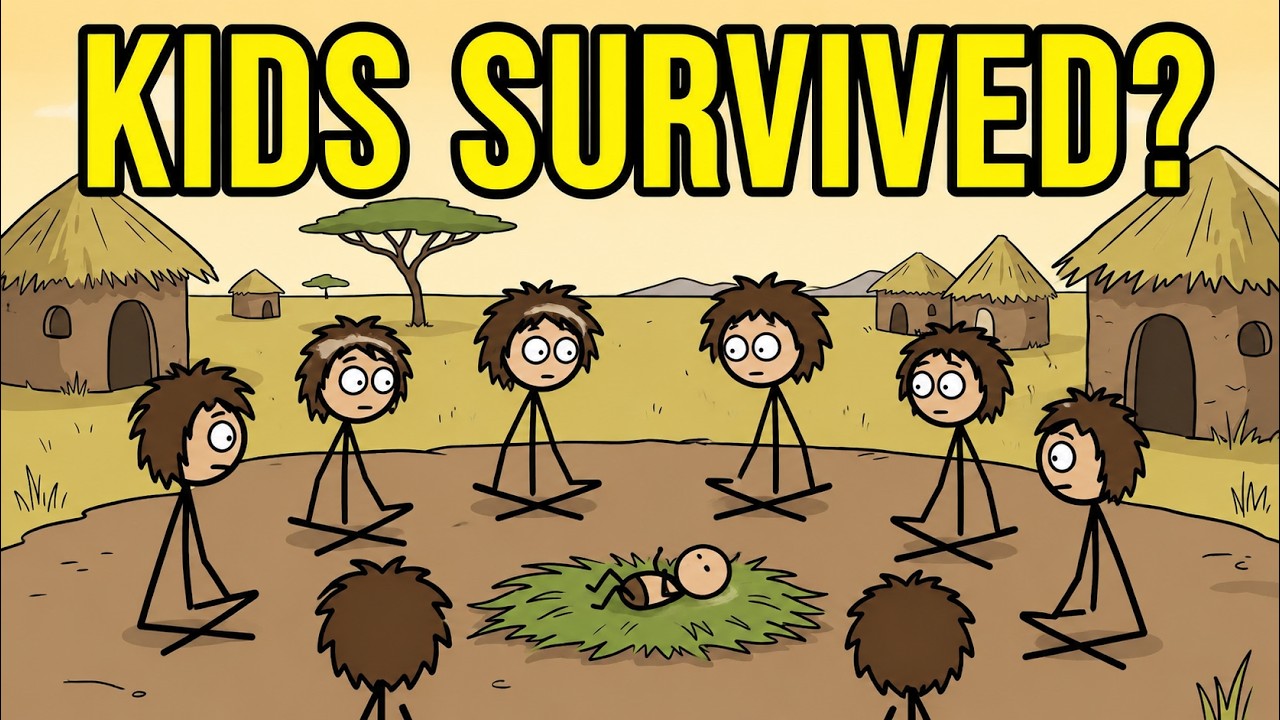 The staggering vulnerability of human infants is not a design flaw but the direct consequence of our most defining feature, the massive human brain. To accommodate the development of a brain that would eventually master fire, forge tools, and build civilizations, evolution had to make a critical compromise. Our ancestors traded a survivable, motor-skilled infant for a large-brained one, and the price was catastrophic at birth.
A newborn horse, within hours of exiting the womb, is standing and running, an escape strategy honed by millions of years of being prey. A chimpanzee infant, with its sharp grip, clings to its mother’s fur for contact and safety. A human baby, in stark contrast, can’t lift its head, can’t focus its eyes, and can’t travel a single inch on its own.
It is born at a helpless 25% of its adult brain size, compared to a chimpanzee’s forty percent, meaning 75% of all brain growth must happen externally, in the unforgiving world, after birth. The brain is still so large that it necessitated this evolutionary bargain, forcing a mother’s pelvis to expel a child long before its development is complete. For 300,000 years, that helplessness was a disaster waiting to happen, a prime target for leopards, hyenas, snakes, and every other carnivore that sees an infant as a meal.
The solution that ancient humans developed to confront this perils represents a revolution in social interaction, one that modern parents have largely abandoned. We didn’t survive because we were the strongest; we survived because we formed a web of care, a cooperative breeding strategy that is unique among the great apes. In direct contrast to chimpanzees, where a mother works solo and fiercely protects her young for up to five years, human mothers have relied on an extensive, hereditary network of childcare.
Anthropologist Sarah Blaffer Hrdy’s book, Mothers and Others, brought this chillingly bare: anthropologists call this “cooperative breeding,” and it was the foundational prerequisite for the survival of our species. The astronomical nutritional and protective cost of a baby with a huge brain, perpetually on the verge of becoming a leopard’s meal, would have driven us straight back into the void of extinction had it not been for the shared responsibility. The evidence gathered from living hunter-gatherer communities, which offer a living link to our Paleolithic past, shows this strategy was not merely a preference but a strict and bloody rule for survival.
Among the Efe foragers of the Congo’s Ituri forest, researchers documented that a single infant is held by an average of fourteen different individuals in a single 8-hour period, showing more than half the time the child is not in the care of the mother at all.
This “supermom” concept didn’t just extend to other women but involved fathers as well, and every level of the community as a survival mechanism. Among the Aka of Central Africa, Barry Hewlett’s research showed fathers are with an infant skin-to-skin, within arm’s reach, for over 47% of the day, holding, comforting, and feeding them. The baby was never separate from the group.
It was never left grounded. It was always, in some way, being held by a body with a beating heart. This isn’t just sentimentalism; it is a biological survival tactic, a strongly driven cultural evolution.
 The transition to a bipedal stance millions of years ago caused humans to lose the thick fur that ancient primates’ offspring needed to cling to, and in the absence of that fur to hold, mothers improvised. They engineered slings out of leather and plant fibers, which remain a universal constant in human history, from 10,000-year-old Italian burial sites showing a decorated female. The mat carrying doesn’t just transport a child, it triggers a reflex so ancient that it still functions perfectly in any modern baby’s nervous system called the transport response.
When an infant is picked up and held against a body, its heart rate drops, its breathing stabilizes, and it stops. This isn’t a learned behavior; it’s the baby clicking into a 300,000-year-old predator evasion program. A crying baby is a target; a silent baby is one that lives.
So when you pick up a screaming newborn who suddenly calms, you are seeing a system that believes it is being carried to safety, so it goes quiet to prevent you from becoming a meal.
Feeding the helpless child in this predator-rich world was possibly the hardest task humanity ever won. There was no ancient equivalent of formula, and a wide range of nutrition was impossible. The only viable source of survival exists in consuming a mother’s breast milk.
Now, mammalogy has data proving that the ancient solution was extended and orchestrated breastfeeding continued for a minimum of two to three years, and in some hunter-gatherer cultures even longer up to four or more. We know that monkey just because it provides complete nutrition, but because it is a clinical tool for survival. It is a sterile, infection-fighting source of antibodies, a kind of communal healthcare in a world with no vaccine.
Breastfeeding also did something biological and necessary for mom survival: it triggers the demonstration of ovulation. By nursing a child around the clock, the mother will stop having cycles, creating a natural spacing of births. If you had two infants requiring constant contact and constant carrying, the odds of both surviving in the Paleolithic world is indeed minuscule.
The sheer is a huge stone of survival.
 The moment the child started needing more than mother’s milk, the ancient human required a method to wean the child onto solid food. There was no baby food label, no pureed fruit in a jar. The result method, a daily practice that’s an anthropological truth but that sounds alien in the modern world, was chewing for the child.
A mother or a grandmother would chew meat or a tough root until it was soft, and partially digestion by her saliva, and then transfer it directly from her mouth into the infant’s mouth, lip to lip. This act, called premastication, is now washed in anthropologists as the very origin of human kissing. It was not a tender greeting, but the most necessary evolutionary invention.
The transfer of saliva, rich in digestive enzymes and maternal immune cells, gives the baby the exact capacity to fight off pathogens while quietly digesting solid food. In a world before clean water, this is how you gave whole food to an infant without poisoning them with dust or dirt. This method, kept the baby calorie-stable, and immune-protected.
The discovery of the “grandmother effect” is perhaps the most stunning twist in all of human evolutionary history, and it completely reframes what a grandparent is, and what menopause is. Unlike most other animals, humans live decades after they can no longer reproduce. An animal that cannot pass on its genes is an evolutionary dead end; every gene triggers a death upon sterility to avoid draining resources.
But human women defy this rule utterly. In 1997, anthropologist Kristen Hawkes studied the Hadza tribe in Tanzania, and her finding felt, for a time, insane. She discovered that the menopausal women in the group were the hardest working, and generally the most productive foragers in the whole camp.
These women spent hours in the sun, digging better roots, and providing foods that the youngest children technically can’t get for them. Because this food goes straight and directly to their grandchildren, this allows a mother to have an earlier next baby. The grandmother fueling the survival of the previous one is the enormous difference.
This truth, extracted from his data, became the Grandmother Hypothesis. We live prolonged lifespans after menopause because 300,000 years ago, the woman who went out to dig roots in the sun was guaranteeing her lineage would continue. Menopause is not a problem to be fixed; it is an evolutionary advantage plan, a mechanism that has won the survival race.
 So we’re so now forced to confront a hard and almost painful truth today’s all in this complete. For the entirety of human history, it has never, ever been accepted for one person alone to raise a child. There has always been coordination, a synergy of hands emerges.
It wasn’t a hypothetical network. It was a practical, hunter-gatherer system, and it’s the very foundation on which the human brain and the whole modern civilizations stand. An average mother in an ancient band could rely on between 5 and 15 people every single day to actively intervene to just keep the child from a terrible, terrifying death.
Fast-forward to the modern household in a Western, industrialized country, and the number of people helping each mother is solidly two, sometimes only one, often with the staying at home in a house to hold a lively child. This modern-day standard — an isolated parent on a 3:00 AM with a screaming, colicky infant and nobody is near, absolutely exhausted, overwhelmed, desolate — directly contradicts every biological mechanism by which we were designed to populate the Earth. The desperation, the panic, the crushing loneliness, the sensory overload, and the devastating depression that affects hundreds of thousands of new parents are not personal character flaws.
These feelings are a biological panic response, a visceral, level that is screaming while we try to single-handedly do a task that evolution built for a whole group of people to share. It can be done in the same way an illiterate toddler can try to read an advanced quantum mechanics paper, yet our bodies push us forward, the desperation builds.
Human history hasn’t passed on a genetic memory of how to be a solitary universal soldier parent. Instead, to make it to the point we are at today, to get over the paleolithic African savanna, it absolutely required you to rely on other people, and they to you. It was a web of social contracts that composed 300,000 years of evolution.
A 2024 study or look across hunter-gatherer populations shows we don’t do a reflectively think, “What would the opposite do?” At the core level of what your ancestry once was, the answer was always, “I will help you and you will help me, or we all die.” The species that survives is pure that gives.
The only reason any of us are here today, reading this, is because a grandmother gathered for you, an unrelated woman fed you, a father held the object, and a neighbor did a net patch to the transit. The very DNA that runs through we take into our heart is made from a legacy of care that was a communal care. Parent on Earth is a million dead mothers, desperate to survive, and never alone.
Modernity has given us a method of safety, but it has also separated our own from our laws. And if you look, and the fact the appearance, rather than a “natural” approach, the current raise of childbirth, it is the result of how deeply we need a village. The question of our species has always been, will we know enough to use one again?