Around 14,000 years ago, on the shores of a lake that has long since vanished in what is now northern Israel, a woman was buried with her hand resting on the skeleton of a puppy. She had been placed carefully on her side with her knees drawn up, and the person who laid her to rest positioned the dog so that its head touched her wrist. Her name, language, and beliefs are unknown, but the burial is evidence that something between humans and animals had fundamentally changed. That change was the beginning of a slow, unplanned process that eventually produced cities, writing, agriculture, and civilization itself.
There was no single inventor of farming, no sudden moment of discovery. Instead, a feedback loop between human behavior and the natural world ran for thousands of years before anyone could have recognized what was happening. For roughly 290,000 of the approximately 300,000 years humans have existed as a species, we did not farm. Small bands of hunter-gatherers moved with the seasons, tracking herds and harvesting wild plants at their peak.
They possessed detailed knowledge of their environments, coordinating drives that sent entire herds of horses and mammoths over cliffs. Domestication did not emerge from desperation or ignorance, but from people who understood the natural world with remarkable precision. The change likely began around human camps. People processing food created enormous amounts of organic waste, enriching the soil and attracting animals that were drawn to the scraps.
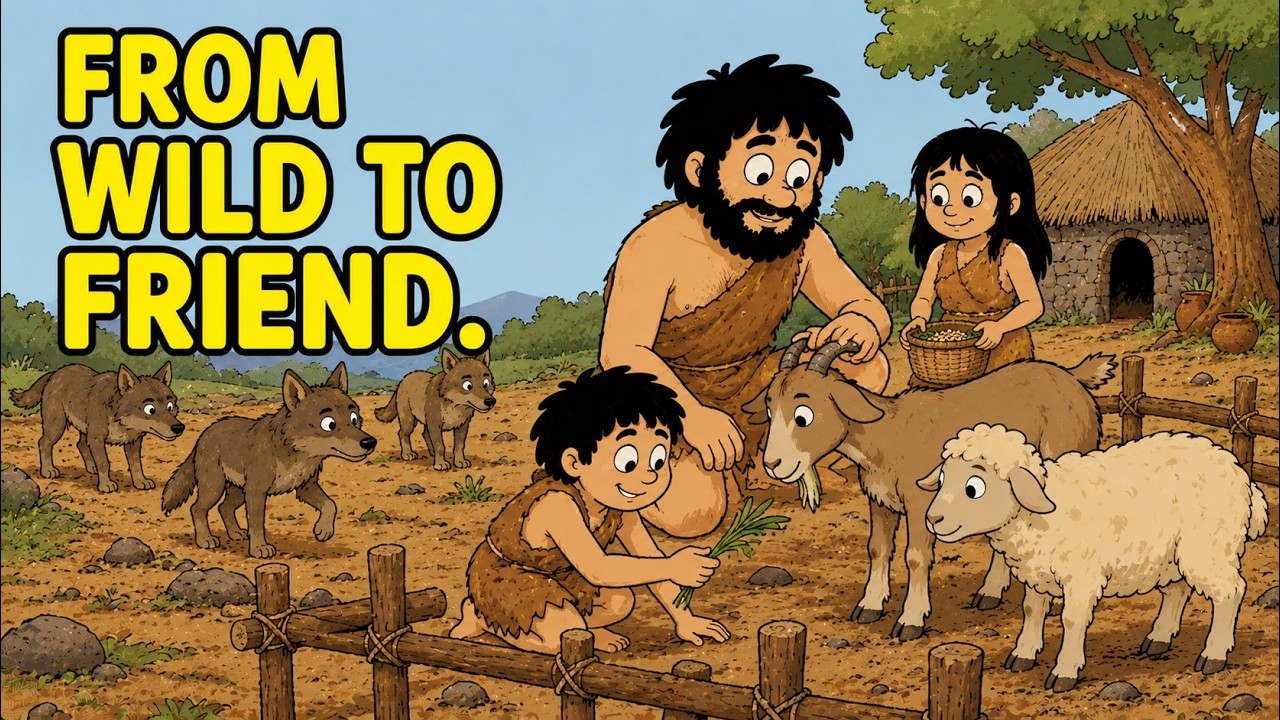
Among these animals were wolves. Within wolf populations there was natural variation in temperament. The less reactive individuals, those that did not panic at the sight of humans, could access the scraps that more fearful wolves could not. Over generations, this environment favored calmer, less aggressive wolves, whose pups inherited those traits.
This process is called the commensal pathway of domestication. The animal was not captured or intentionally bred; it simply sat down at the edge of the human table and, over thousands of years, changed because of it. A landmark experiment by Russian geneticist Dmitri Belyaev, beginning in 1959, demonstrated how quickly this can work. By breeding silver foxes solely for tolerance of humans, he produced a population that sought human contact and wagged its tails within 40 generations.
Alongside these behavioral changes came physical ones that had not been selected for directly: floppy ears, curled tails, spotted coats, and shorter snouts. These physical changes are tied to neural crest cells, which help build the adrenal glands, skull, ears, and pigment-producing cells. Selecting for reduced fear and aggression affects these cells across multiple body systems at once. Domestication, it turns out, does not just change behavior; it changes the body.
The wolves that became dogs diverged from wolf ancestors somewhere between 15,000 and 40,000 years ago, according to current genetic evidence. Dogs were the first domesticated animal, appearing in the archaeological record before agriculture, pottery, or permanent settlements. The same camps that attracted wolves were also changing the vegetation around them. People inadvertently planted seeds in fertilized ground.
Plants that grew fast in disturbed soil and produced large seeds thrived in this new niche. At Ohalo II, a site on the shore of the Sea of Galilee in Israel, archaeologists have found evidence of this relationship dating to roughly 23,000 years ago. The people there gathered wild barley, emmer wheat, and oats, and their stone blades show the wear patterns of sickle harvesting. Around the camp, they found the remains of plants that today we call weeds, species that thrive in disturbed soil and grow wherever humans are managing the ground.
The critical shift from gathering to farming lies in a change in the plants themselves. Wild cereal grasses are designed to scatter their seeds from a fragile seed head. When ripe, the slightest touch sends the seeds flying. This is effective for the plant but terrible for a human harvester, as most of the grain explodes off the head before it can be collected.
However, within any wild population there were rare mutant plants whose seed heads stayed intact. In the wild, this mutation was a disadvantage because the seeds did not scatter. For a human harvester, these intact heads were gold. When harvesters collected these intact heads and brought them back to camp, the next generation of plants near the camp had a higher proportion of non-shattering individuals.
Human harvesting behavior itself became a selective pressure favoring this mutation, generation after generation. The genetic signatures of this process are visible in domesticated crops today. In barley, the trait involves two genes; in rice, a single gene accounts for it; in wheat, a gene called Q shaped the entire domesticated form. Alongside the non-shattering seed head, other traits accumulated: larger seeds, uniform germination times, and thinner seed coats.
Domestic crops became plants optimized for human needs that could no longer compete in the wild without human help. The relationship had become one of mutual dependence. This story played out independently in multiple locations. In China, people domesticated rice in the Yangtze River Valley and millet in the Yellow River Valley around 10,000 years ago.
In Mesoamerica, a wild grass called teosinte was transformed into maize. In the Andes, potatoes and quinoa were cultivated. In New Guinea, farmers grew taro and yam. These centers of domestication had no knowledge of each other.
Agriculture was not an idea that spread from one inventor; it was a convergent solution arrived at independently across the globe. The fact that agriculture appeared in so many places around the same time, roughly 10,000 to 12,000 years ago, is not a coincidence. The climate was changing. The last ice age ended around 11,700 years ago, bringing warmer temperatures and more stable rainfall.
Wild cereal grasses spread, while the megafauna that had provided the biggest hunting returns were going extinct. This opened a window for certain populations, though it was not a simple cause and effect. Many earlier climate shifts had not produced agriculture. The regions that became the earliest centers of agriculture had access to a disproportionate share of the world’s most domesticable plants and animals.
The Fertile Crescent, an arc of land running from present-day Israel and Lebanon through Syria and southern Turkey into Iraq and Iran, had wild emmer wheat, einkorn wheat, barley, lentils, and peas. It also had wild sheep, goats, cattle, and pigs. Not every large mammal can be domesticated. Africa has more large mammal species than any other continent, including zebras, Cape buffalo, and elephants, none of which became livestock.
Zebras have a bite reflex that makes them nearly unbreakable. Cape buffalo kill more hunters in Africa than any other animal. African elephants were never domesticated. The Fertile Crescent had the lucky accident of being home to animals with social structures built around dominance hierarchies that humans could insert themselves into.
The domestication of these animals followed the prey pathway. Unlike the commensal pathway of the wolf, this began with humans hunting a species and gradually shifting to herding. Hunters may have driven herds into box canyons, selecting which animals to kill and letting others survive. Over time, animals most tolerant of human presence reproduced more, and the population’s genetics shifted toward tameness.
The primary product of early livestock was meat, a living food supply that could be stored on the hoof. Milk came later. Lactose intolerance is the ancestral human condition, but once dairy animals were available, a genetic mutation allowing adults to digest milk became valuable in populations that lived alongside dairy herds. Today, populations descended from early pastoralists in Western Eurasia and parts of East Africa have high rates of lactase persistence.
Domestication changed the animals, then it changed the people. This is one of the clearest demonstrations of gene-culture coevolution. Once a season’s labor was invested in a field of grain, the investment created an anchor. Human mobility, the core survival strategy for 290,000 years, became a liability.
The earliest Neolithic settlements show this transition happening with remarkable speed. At Jericho in the Jordan Valley, permanent occupation dates to around 11,000 years ago. At Çatalhöyük in what is now Turkey, occupied from around 9,300 to 7,500 years ago, thousands of people lived in densely packed mud-brick houses with no streets. The architecture itself is evidence of commitment.
Permanent settlements created new problems. Garbage and waste accumulated. Water sources became contaminated. Dense human populations living in close proximity to domestic animals created ideal conditions for the transmission of infectious disease.
Tuberculosis came from cattle. Measles is related to rinderpest, a cattle disease. Smallpox shares a family with cowpox. Influenza jumps between humans, pigs, and birds.
The skeletal evidence is stark. Upper Paleolithic hunter-gatherers were on average taller than the first farmers and showed fewer markers of nutritional stress. Their dental health was better. Early farmers worked harder physically, showed more wear on their vertebrae and joints, and ate more monotonously.
Trading wild protein and variety for domesticated carbohydrate was not, from the perspective of individual health, an upgrade. And yet agriculture spread. Populations that practiced it grew faster because the nature of settlement changed the spacing between births. Hunter-gatherer women typically had gaps of three to four years between children.
Settled women on cereal-heavy diets weaned their children earlier, ending lactational suppression of ovulation faster. The interval between births shrank to one to two years. More children per woman meant more people per generation, and the farming population quickly exceeded what the land could support through hunting and gathering alone. Going back was not an option because there were too many people.
Farming had produced more people than could survive without farming. This dynamic, the agricultural demographic trap, helps explain why farming won despite its health costs. A population that doubles every 40 years will eventually displace one that doubles every 100 years. Agricultural communities grew faster, and when they came into contact with foragers, the dynamics almost always went one way.
Farming communities can support 10 to 100 times more people per square kilometer, and numbers like that tend to resolve territorial conflicts in favor of the more numerous party. Surplus changed everything. For the first time in human history, some communities had more food than they needed. Surplus food could feed people who were not producing food.
A community with stored grain could support a full-time potter, a metalworker, priests, soldiers, and administrators. Writing almost certainly emerged from the need to track agricultural surplus. The earliest writing systems we know of, Sumerian cuneiform tablets from Mesopotamia dating to around 5,300 years ago, are accounting records. The first written documents in human history are receipts.
With surplus came inequality in a form that hunter-gatherers had rarely experienced. Mobile groups tend toward egalitarianism because you cannot accumulate more possessions than you can carry. A settled community could accumulate unequally. The archaeological record shows the emergence of burial patterns that did not exist in the Mesolithic.
Some graves are rich with goods and others are not. The first cities were organized around storage, and in many early civilizations the temple and the granary were the same building because the priest managed the redistribution of agricultural surplus. Horses were domesticated later than the other major livestock animals. Current evidence places the initial domestication on the Pontic-Caspian Steppe, north of the Black Sea and Caspian Sea, around 5,500 years ago.
Horses were not domesticated primarily for food. They were domesticated for speed. A person on horseback can cover ground at a rate impossible on foot. The spread of horse-riding pastoralist cultures from the Eurasian Steppe is one of the most significant demographic events in prehistory.
The Yamnaya culture, early Steppe pastoralists with horses and wheeled wagons, spread westward into Europe and eastward into Central Asia starting around 5,000 years ago. Their genetic signature now accounts for a substantial proportion of the ancestry of most Europeans, South Asians, and Central Asians. The domestication of a single animal reshaped the genetic map of multiple continents. The relationship between humans and other species was not a series of isolated decisions.
It was a system with emergent properties that none of the participants could have anticipated. The woman buried with her puppy was not trying to invent civilization. The people at Ohalo II were not trying to invent agriculture. They were living in the world they knew, and out of those ordinary behaviors pursued across thousands of generations came the entire architecture of human civilization.
The relationship was never one-directional. While humans were selecting wolves for tameness, the relationship was selecting humans for the ability to digest milk into adulthood. The calendar we live by is built around the life cycles of domesticated plants and animals. We did not invent that calendar and impose it on nature; nature imposed it on us because wheat ripens when wheat ripens.
There is a detail in the genetics of domestic dogs that captures this perfectly. Dogs have far more copies of the gene responsible for producing pancreatic amylase, the enzyme that breaks down starch, than wolves do. Dogs evolved to handle the agricultural diet of the people they lived with. The people changed the dog, then the people changed their diet, and the dog changed its metabolism to match.
Domesticated species have thrived beyond anything their wild ancestors could have achieved. Wheat now covers more land than any other crop. Cattle, sheep, and pigs collectively represent the majority of large mammal biomass on Earth. Domestic chickens outnumber all wild bird species combined.
But they thrived by becoming entirely dependent on humans, and humans became entirely dependent on them. The deeper question is whether domestication is even the right frame. The word implies a one-way process. But what actually happened was a mutual entanglement.
The wheat needs us to plant it. We need the wheat to feed us. Who domesticated whom? The honest answer is that the question assumes a kind of agency and intentionality that was not there at the beginning.
Domestication was a long, slow, unplanned negotiation between species in which every participant was changed by the relationship and none of them chose it with full understanding of where it was going.


